

When you send Bitcoin, you’re not just moving money from one place to another. You’re breaking apart and reassembling digital chunks of value-like splitting a $20 bill into two $10 bills and a $5 bill, then handing one to a friend and keeping the rest as change. That’s the UTXO model in action. On the other hand, when you send ETH, it’s more like updating a bank balance: your account had $100, now it has $95, and theirs has $5 more. That’s the account model. These two systems aren’t just different ways to track money-they shape how blockchains scale, how secure they are, and even what kind of apps can run on them.
How UTXO Works: Digital Cash, Not Bank Balances
The UTXO (Unspent Transaction Output) model treats cryptocurrency like physical cash. Every Bitcoin you own exists as a discrete, unspent output from a previous transaction. When you spend it, you must use the whole thing. If you have a 5 BTC UTXO and want to send 3 BTC, you can’t just take 3. You spend the full 5 BTC, create a new output of 3 BTC for the recipient, and another 2 BTC as change back to yourself. That leftover 2 BTC becomes a new UTXO in your wallet.
This design has real advantages. Because each UTXO is independent, multiple transactions can be processed at the same time without stepping on each other’s toes. That’s why Bitcoin’s Lightning Network can handle tens of thousands of transactions per second in testing-it’s not one big ledger being updated, it’s thousands of small, isolated payments happening in parallel.
Privacy also improves. In UTXO systems, there’s no global record saying “Alice sent Bob $100.” Instead, you see a chain of inputs and outputs. If Alice receives 10 different UTXOs from 10 different people, it’s hard to trace which ones she spent together. That’s why Bitcoin users often generate new addresses for each transaction-it keeps the trail fuzzy.
But there’s a cost. UTXO makes smart contracts harder. Imagine trying to build a decentralized exchange where users continuously deposit and withdraw liquidity. With UTXO, you’d need to track every single output change across hundreds of transactions, manually linking them like a puzzle. Ethereum’s account model handles this with a simple balance update: “User X’s balance = $12,345.” No chaining needed.
How Account Model Works: Like a Traditional Bank Ledger
The account model is familiar. It works like your checking account. Each address has a balance, a nonce (a counter tracking how many transactions you’ve sent), and optionally, code if it’s a smart contract. When you send ETH, the system checks your balance, subtracts the amount, adds it to the recipient’s balance, and increases your nonce by one. Simple.
This simplicity is why Ethereum exploded. Developers didn’t need to relearn how money works-they just wrote code that read and wrote balances like any other app. DeFi protocols like Uniswap, Aave, and Compound rely on this. They need to track thousands of user balances, interest rates, and liquidity pools in real time. The account model makes that possible.
But it has trade-offs. Because every transaction updates a global state, the system can’t process multiple transactions from the same account at once. If two people try to send ETH from your wallet simultaneously, one must wait. That’s why Ethereum gets congested during NFT drops-everyone’s trying to update the same state at the same time. It creates “gas wars,” where users bid up fees to get their transaction processed first.
Storage is another issue. Ethereum’s state data has grown to over 1.2 terabytes as of early 2024. Full nodes must keep every account’s balance, code, and nonce. That’s expensive and slows down adoption. Bitcoin’s UTXO set is smaller-around 5.2 GB-but it’s growing faster in number of items (over 100 million UTXOs), making validation more complex.
Performance and Scalability: Parallel vs. Sequential
Scalability looks different in each model. UTXO thrives on parallelism. Since transactions don’t interfere with each other, nodes can validate hundreds at once. Bitcoin processes 4-7 transactions per second on-chain, but that’s by design-it’s meant to be settled slowly and securely. The Lightning Network, built on top of UTXO, bypasses this limit entirely by handling payments off-chain.
Ethereum, using the account model, handles 15-30 transactions per second on-chain. That’s more than Bitcoin, but it’s still nowhere near Visa’s 24,000 TPS. Ethereum’s solution isn’t changing the model-it’s optimizing it. With Proof-of-Stake and Verkle trees coming in 2024, Ethereum aims to reduce the data each node needs to store, making the system faster without giving up the account structure.
But here’s the real kicker: UTXO can scale better under load. In 2018, Bitcoin Cash processed 1.2 million microtransactions of $0.01 each in under two hours. On an account-based system, that would mean millions of tiny balance updates-all competing for the same global state. The fees would skyrocket, and the network would grind to a halt.

Smart Contracts: Why Account Model Dominates
Smart contracts are the killer app of blockchain. They’re self-executing programs that run on the network. But they need to store and update state-like how much liquidity is in a pool, who owns an NFT, or what the interest rate is on a loan.
The account model is built for this. A contract address is just another account with code and balance. It can read its own state, write new values, and call other contracts-all in a single transaction. Uniswap V3, for example, tracks liquidity positions across thousands of price ranges. That’s impossible to do cleanly in a standard UTXO system without massive workarounds.
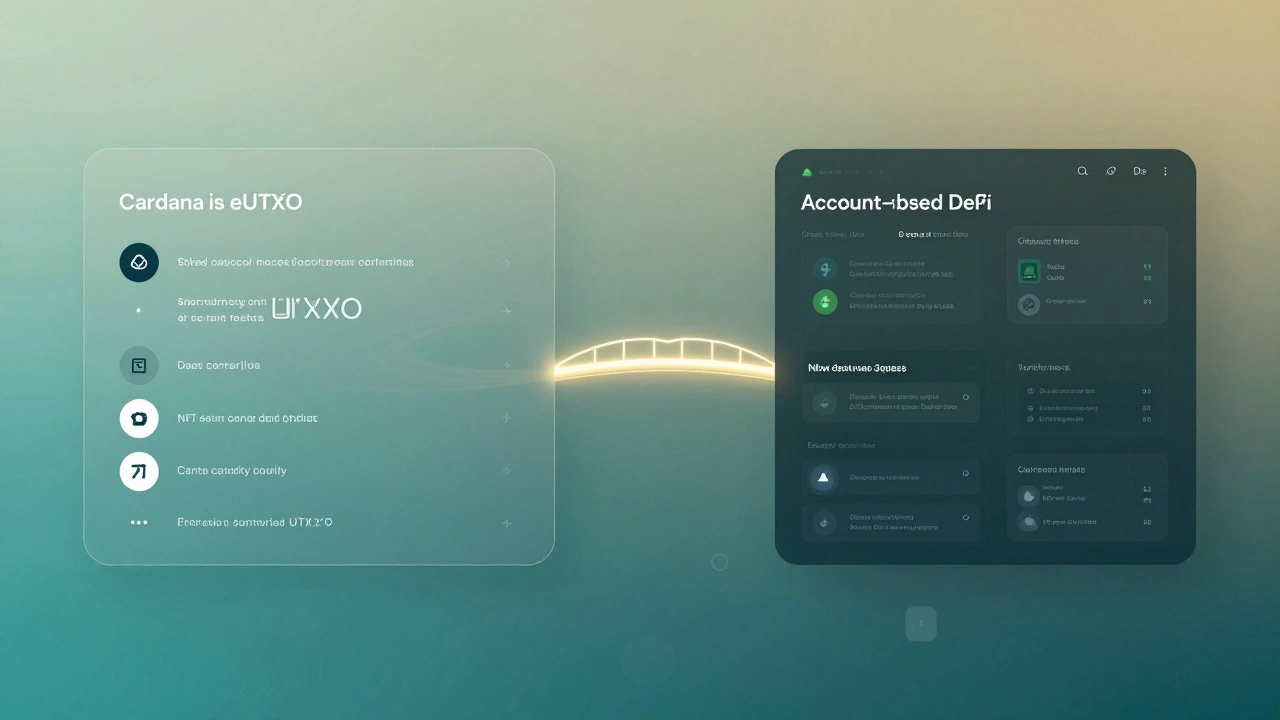
Cardano’s extended UTXO (eUTXO) is trying to fix this. It adds stateful contracts to the UTXO model, letting each UTXO carry data, not just value. That means a UTXO can represent a liquidity position, a voting token, or a game item-with rules attached. SundaeSwap, Cardano’s biggest DEX, runs on eUTXO and processes over a million transactions monthly with fees under $0.02. That’s 100x cheaper than Uniswap on Ethereum.
But adoption is still low. Only 9% of smart contract developers use Plutus (Cardano’s language), while 87% use Solidity (Ethereum’s). Why? Tooling. Debugging tools, libraries, tutorials, and community support for UTXO-based smart contracts are still in their infancy.
Privacy, Regulation, and Real-World Use
Privacy is where UTXO shines. Because transactions are fragmented and outputs are reused, tracing funds is harder. That’s great for users who don’t want their spending habits exposed. But regulators hate it. The EU’s MiCA rules and FATF’s Travel Rule require exchanges to track the origin and destination of funds. That’s easy with account models-every transfer is tied to a known address. With UTXO, you need extra tools like chain analysis to piece things together.
That’s why financial institutions prefer account models. A 2023 Ripple survey found 78% of banks using blockchain for cross-border payments chose account-based systems. They’re used to ledgers, not UTXO chains. But gaming and micropayment startups? They lean toward UTXO. A 63% preference in a 2023 survey shows they value low-cost, high-volume transactions.
What’s Next? Hybrid Models Are Rising
Neither model is perfect. UTXO is powerful but hard to code for. Account is easy but bottlenecked. The future isn’t one winning model-it’s hybrids.
Cardano’s eUTXO is leading the charge. It keeps the parallelization and privacy of UTXO but adds smart contract state. Solana’s account model has parallel execution built in, letting multiple contracts run at once. Even Bitcoin is evolving-Taproot upgraded its scripting capabilities, letting more complex logic run on UTXO without sacrificing privacy.
By 2026, analysts expect hybrid models to capture 15% of the blockchain market. That’s not huge, but it’s enough to shift the conversation. The goal isn’t to pick one side-it’s to use the right tool for the job.
Which One Should You Care About?
If you’re sending Bitcoin or Litecoin? UTXO is doing the heavy lifting. It’s secure, private, and handles microtransactions well.
If you’re using DeFi, NFTs, or Web3 apps? You’re on an account-based chain. Ethereum, Polygon, BSC-they all rely on the same model.
If you’re a developer? Start with Ethereum. The tools are there. But if you’re building a payment system, a gaming economy, or something that needs low fees and high throughput, keep an eye on Cardano’s eUTXO. It’s the quiet revolution nobody’s talking about-but it’s already working.
There’s no universal winner. The best blockchain architecture isn’t the one with the most users or the biggest hype. It’s the one that matches what you’re trying to build.
What’s the main difference between UTXO and account model?
The UTXO model treats cryptocurrency like physical cash-each transaction consumes previous outputs and creates new ones. The account model works like a bank account, where balances are updated directly. UTXO is stateless and parallelizable; account is stateful and sequential.
Which model is better for smart contracts?
The account model is better for smart contracts because it allows direct state updates. Contracts can read and write balances, store data, and interact with each other in a single transaction. UTXO requires complex workarounds, though extended UTXO (eUTXO) models like Cardano’s are closing this gap.
Why does Bitcoin use UTXO and Ethereum use account model?
Bitcoin was designed as digital cash, so UTXO’s privacy and parallel processing fit naturally. Ethereum was built for programmable contracts, so the account model’s simplicity and state management made it the obvious choice. Each followed its purpose.
Can UTXO handle high transaction volumes?
On-chain, Bitcoin handles only 4-7 transactions per second. But UTXO’s real strength is off-chain scaling. The Lightning Network uses UTXO to enable millions of microtransactions per second without burdening the main chain. In 2018, Bitcoin Cash processed 1.2 million $0.01 transactions in under two hours-a feat nearly impossible on account models.
Is one model more secure than the other?
Both are secure, but in different ways. UTXO has stronger cryptographic guarantees because each output is independently verifiable. Account models rely on global state consistency, which can be a single point of failure if the state trie becomes corrupted. However, Ethereum’s extensive audits and upgrades have made it extremely robust in practice.
Which model will dominate in the future?
Neither. Payment-focused chains will stick with UTXO or eUTXO for scalability and privacy. Smart contract platforms will keep using account models for developer ease. Hybrid models like Cardano’s eUTXO are emerging as a middle ground, but specialization-not convergence-is the trend. The best system depends on the use case.
15 Responses
so uhh bitcoin is like breaking a 20 into change and ethereum is just like updating your bank app lol
Let me just say this-UTXO isn’t ‘hard to code for,’ it’s deliberately anti-developer. Ethereum’s account model isn’t ‘simple,’ it’s lazy. You want state? You get state. You want chaos? You get gas wars. And yet, somehow, we’re supposed to believe this is the future? No. The future is parallelizable, trust-minimized, and doesn’t require a PhD in blockchain economics just to send $5. UTXO wins. Period. End of discussion.
Account model = centralized thinking wrapped in decentralization. UTXO = anarchic purity. But nobody wants purity. They want apps. They want NFTs. They want to buy monkey JPEGs with ETH. So we got the model that lets devs build glitter bombs instead of functional money. Sad. But predictable.
Both models have their place. Bitcoin for value transfer, Ethereum for applications. The real win is having options. Keep building.
It’s funny how we treat blockchain architectures like they’re moral choices. UTXO vs account isn’t about efficiency-it’s about what kind of society we want to encode. Do we want a world of isolated, private, fragmented transactions? Or one where everything is interconnected, traceable, and accountable? The answer isn’t technical. It’s philosophical.
Why are we even talking about this? Bitcoin’s slow. Ethereum’s expensive. Cardano’s a dream. Just use PayPal if you want to move money.
There’s no ‘winner’ here-only context. If you’re building a payment rail for farmers in Kenya, UTXO’s Lightning Network might be the only thing that works. If you’re building a DAO to fund climate research, Ethereum’s stateful contracts give you the tools to make it real. Neither is better. One just fits your purpose better. And that’s okay.
Great breakdown. I’ve been using Bitcoin for years and never thought about how UTXO enables privacy so naturally. And now seeing how Cardano’s eUTXO is trying to bridge the gap with smart contracts? That’s actually exciting. Not because it’s ‘better,’ but because it’s expanding what’s possible. Keep sharing these insights.
The structural implications of state management in distributed systems cannot be overstated. UTXO’s statelessness enables cryptographic verifiability at scale whereas the account model introduces global consensus bottlenecks that inherently limit throughput. Empirical data from Bitcoin Cash’s 1.2 million microtransaction event underscores the scalability advantage of UTXO under high-frequency load conditions. The future lies in hybrid architectures that preserve verifiability while enabling composability.
In India, we use UPI for everything. Fast, free, simple. Blockchain? Still too slow for daily use. But the ideas here? Interesting.
Wow someone actually wrote a novel about this? Congrats. UTXO is dead. Ethereum won. Get over it. Also your grammar is trash. It’s ‘its’ not ‘it’s’ when you mean possession. Seriously. Learn to write.
Cardano’s eUTXO is the real story here. People ignore it because it’s not Ethereum. But the fees are 100x lower and it handles complex logic. If you’re building anything serious, you’re already testing it. The industry will catch up.
How quaint. You’re all still debating 2015-era blockchain architecture as if it’s 2024 and we haven’t moved on to ZK-rollups, account abstraction, and modular consensus. UTXO vs account is like arguing over horse-drawn carriages vs Model T’s. The real revolution isn’t in the ledger-it’s in the execution environment. Stop fetishizing state models and look at what’s actually scaling: ZK-based L2s. They abstract the underlying model entirely. UTXO? Account? Who cares. The user just wants cheap, fast, private transactions. The rest is academic noise.
Let’s be real-Ethereum’s model works because devs are lazy. UTXO requires more brainpower. But that’s why it’s more secure. The fact that people call it ‘hard’ just proves they don’t want to learn. The future belongs to those who build systems that can’t be hacked, not ones that are easy to code on. eUTXO is the future. Cardano’s not the hype-it’s the blueprint.
America built the internet. China’s building the future. And here we are arguing over whether Bitcoin or Ethereum is better. Pathetic. We need a U.S.-led blockchain standard. Not some crypto bro’s fantasy. UTXO is American. Account is globalist tech bro nonsense. Pick a side.