
When astronauts step outside their spacecraft, they’re not just walking in space—they’re performing high-stakes work in the most hostile environment on Earth’s doorstep. This is called extravehicular activity, a planned operation outside a spacecraft where astronauts perform repairs, experiments, or maintenance while exposed to vacuum, extreme temperatures, and radiation. Also known as a spacewalk, it’s one of the most dangerous and technically demanding tasks in human spaceflight. There’s no room for error. A single mistake can mean life or death, which is why every astronaut spends months—sometimes years—training before their first spacewalk.
Training doesn’t happen in a classroom. It happens underwater. NASA uses the Neutral Buoyancy Laboratory, a massive pool at Johnson Space Center where full-scale mockups of the International Space Station are submerged to simulate microgravity. Astronauts wear modified spacesuits and spend up to seven hours at a time practicing tasks like replacing faulty components or installing new hardware. The water’s resistance mimics the slow, heavy movements needed in space, and the suits are weighted to float just right. But it’s not just about strength—it’s about precision. A bolt turned too far, a tool dropped, or a glove snagged can ruin hours of work. That’s why every movement is rehearsed hundreds of times.
They also train in virtual reality, a digital replica of the space station where astronauts practice navigation, tool use, and emergency procedures without leaving the ground. These simulations track eye movement, hand position, and reaction time to spot weaknesses before launch. And because spacewalks can last over six hours, astronauts train in the actual spacesuit, a pressurized, life-supporting garment that weighs over 280 pounds on Earth but feels weightless in orbit. They learn how to manage oxygen levels, communicate clearly through static-filled headsets, and deal with fogged visors—all while floating in zero gravity.
What you don’t see is how much of this training is about mental control. In space, you can’t just stop and rest. Every action has consequences. A misplaced hand can send you spinning into a solar panel. A loose screw becomes a deadly projectile. That’s why astronauts practice stress drills—like simulated suit leaks or communication blackouts—to build calm under pressure. They learn to breathe slowly, think clearly, and trust their training even when the Earth is 250 miles below.
Behind every successful spacewalk is a team of engineers, trainers, and medical staff who’ve spent years refining every detail. From the design of glove fingertips that let astronauts feel a bolt head to the way suit joints move to match human motion—everything is engineered for survival. And while private companies like SpaceX and Axiom are now sending civilians on spacewalks, the training hasn’t changed. The rules of space don’t care if you’re a professional astronaut or a tourist—you still need to know how to move, think, and survive outside the ship.
What follows is a collection of real-world stories, technical breakdowns, and behind-the-scenes insights into how spacewalks are planned, practiced, and executed. You’ll find how astronauts train for lunar EVA missions, how new suits are being designed for Mars, and why even the smallest detail—like the color of a tool handle—can make the difference between success and disaster.
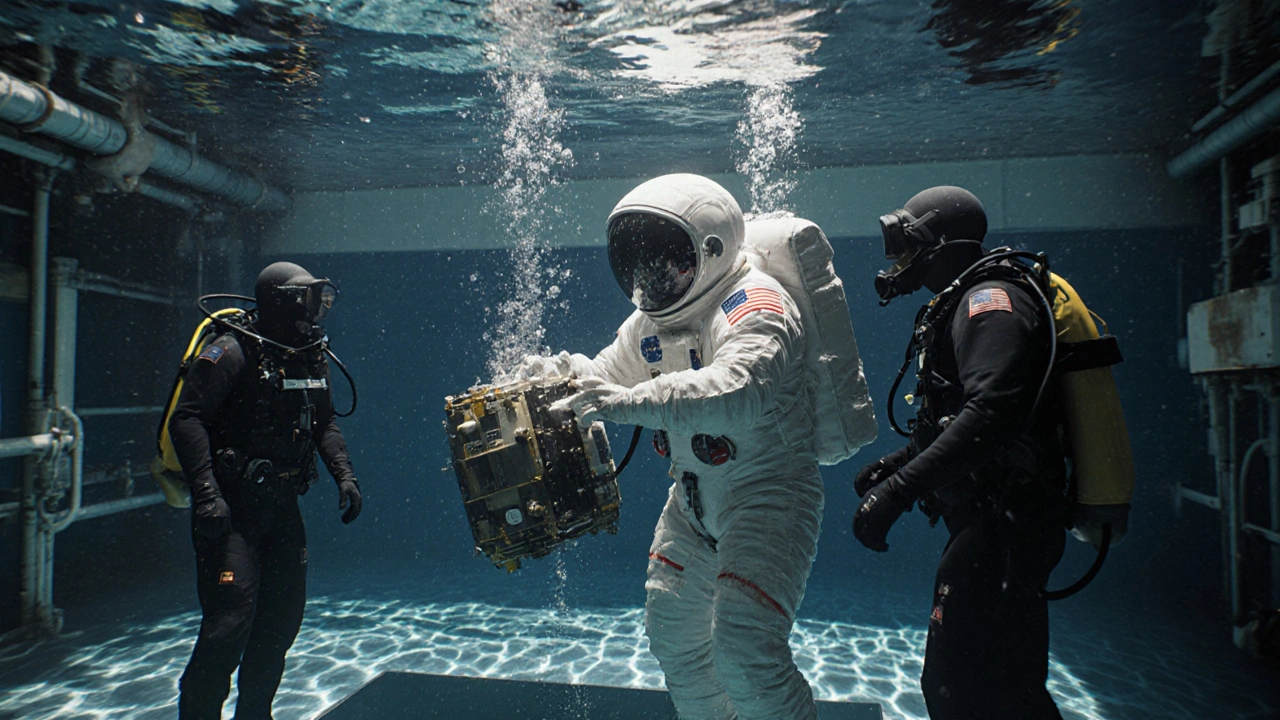
Astronauts train for hours underwater to prepare for spacewalks, using NASA's Neutral Buoyancy Laboratory to simulate microgravity. Learn how EVA training works, why it's so intense, and what happens when things go wrong.
Learn More