
When we talk about space sensors, devices that detect physical properties like light, magnetic fields, temperature, or motion in space environments. Also known as spaceborne instrumentation, they’re the eyes, ears, and nervous system of every satellite, rover, and crewed spacecraft. Without them, we wouldn’t know where we are, what’s out there, or if our missions are working. These aren’t just fancy cameras—they’re precision tools that measure radiation, track stars for navigation, sense atmospheric pressure on Mars, and even detect the faint heat signature of distant planets.
Satellite sensors, a core subset of space sensors used on orbiting platforms to collect data about Earth and space. Also known as remote sensing instruments, they’re what let us monitor wildfires, track ocean currents, and predict weather from 500 miles up. Think of the sensors on Landsat or Sentinel satellites—they don’t just take pictures. They capture data across dozens of wavelengths, from visible light to infrared, turning raw signals into maps of crop health, ice melt, or urban heat islands. Then there are navigation sensors, systems that help spacecraft know their position, orientation, and velocity without relying on Earth-based signals. Also known as attitude and heading reference systems, they include star trackers, gyroscopes, and sun sensors. The James Webb Space Telescope uses star trackers to lock onto distant stars so precisely that it can stare at one patch of sky for days without shaking. Meanwhile, Mars rovers use inertial measurement units to navigate dusty terrain where GPS doesn’t reach.
These sensors don’t work alone. They’re part of a chain: space sensors feed data to onboard computers, which trigger actions—like adjusting solar panels, firing thrusters, or shutting down instruments during radiation storms. Companies like SpaceX and NASA’s Jet Propulsion Lab design these systems to survive vacuum, extreme temperatures, and cosmic rays. Some sensors are built to last 15 years in orbit. Others, like the ones on lunar landers, must survive a hard touchdown and dust storms. You’ll find them in everything from CubeSats to the Europa Clipper mission, where they’ll scan for subsurface oceans under ice.
What you’ll find in this collection isn’t just theory. It’s how differential GPS boosts accuracy for satellites, how formation flying lets multiple spacecraft act as one giant sensor, and why NASA avoids calling microgravity "zero gravity"—because sensors prove it’s not. You’ll see how metamaterials shrink antennas without losing power, how lunar landing pads reduce dust that could blind sensors, and why private space companies now rely on the same navigation tech once reserved for the military. These posts show you the real machines behind the headlines—the quiet, rugged, brilliant tools that turn space from a void into a place we can measure, understand, and explore.
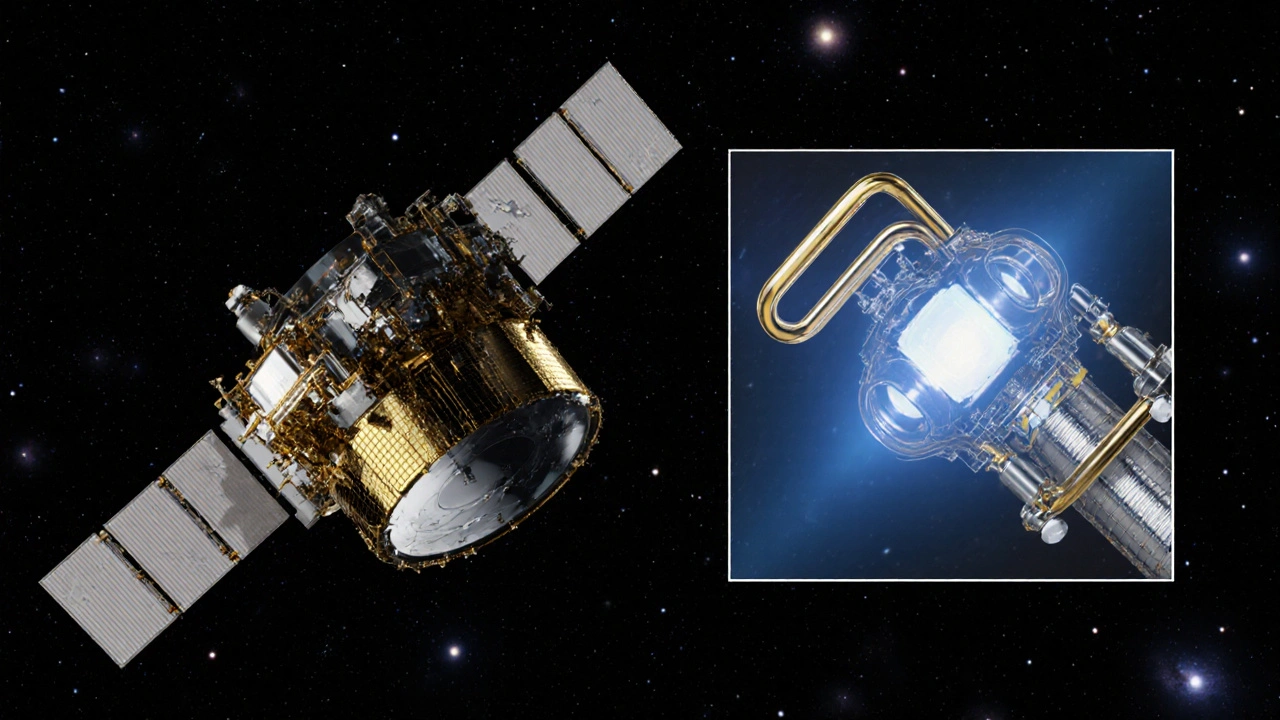
Cryostats and heat pipes enable space sensors to operate at near-absolute zero temperatures, making infrared astronomy possible. From JWST to future telescopes, this technology reveals the cold universe.
Learn More