
When a satellite reaches the end of its life, it doesn’t just vanish. satellite deorbit, the controlled process of lowering a satellite’s orbit so it burns up in Earth’s atmosphere. Also known as reentry disposal, it’s a critical step in keeping space clean and safe for future missions. Without it, dead satellites and broken pieces become dangerous space junk—floating hazards that can collide with working spacecraft, astronauts, or even other satellites. NASA, ESA, and private companies like SpaceX now treat deorbiting as a standard requirement, not an afterthought.
There are two main ways this happens. The first is orbital decay, a natural process where atmospheric drag slowly pulls a satellite down over months or years. This works for low-orbit satellites, like those in the ISS’s neighborhood, but it’s too slow for higher orbits. The second is active deorbit, using onboard thrusters to fire in a precise direction and drop the satellite’s altitude quickly. This is what companies use for constellations like Starlink—each satellite carries enough fuel to steer itself into a fiery end when it’s done. Some satellites even carry special deorbit sails or tethers that increase drag without needing fuel. These are cheap, simple, and becoming more common as regulations tighten.
It’s not just about cleaning up. satellite deorbit is tied to global space traffic management. The ITU satellite filings, the international system that tracks who owns what orbit and frequency, now require proof of a deorbit plan before launch. Countries and companies must show they won’t leave behind debris that could trigger a chain reaction of collisions—the Kessler Syndrome. That’s why even small CubeSats now have deorbit rules. The space debris, the growing cloud of human-made objects in orbit, already numbers in the tens of millions. Most are too small to track, but even a paint flake can wreck a solar panel at orbital speeds.
What you’ll find in this collection isn’t just theory. These are real missions, real engineering choices, and real policy shifts. You’ll read about how SpaceX plans to deorbit hundreds of Starlink satellites each year, how the orbital rights, the legal claims over specific paths in space are being redefined to force accountability, and how new tech like laser tracking and robotic tugs are being tested to clean up the worst offenders. This isn’t science fiction—it’s happening now, and the rules are changing fast.
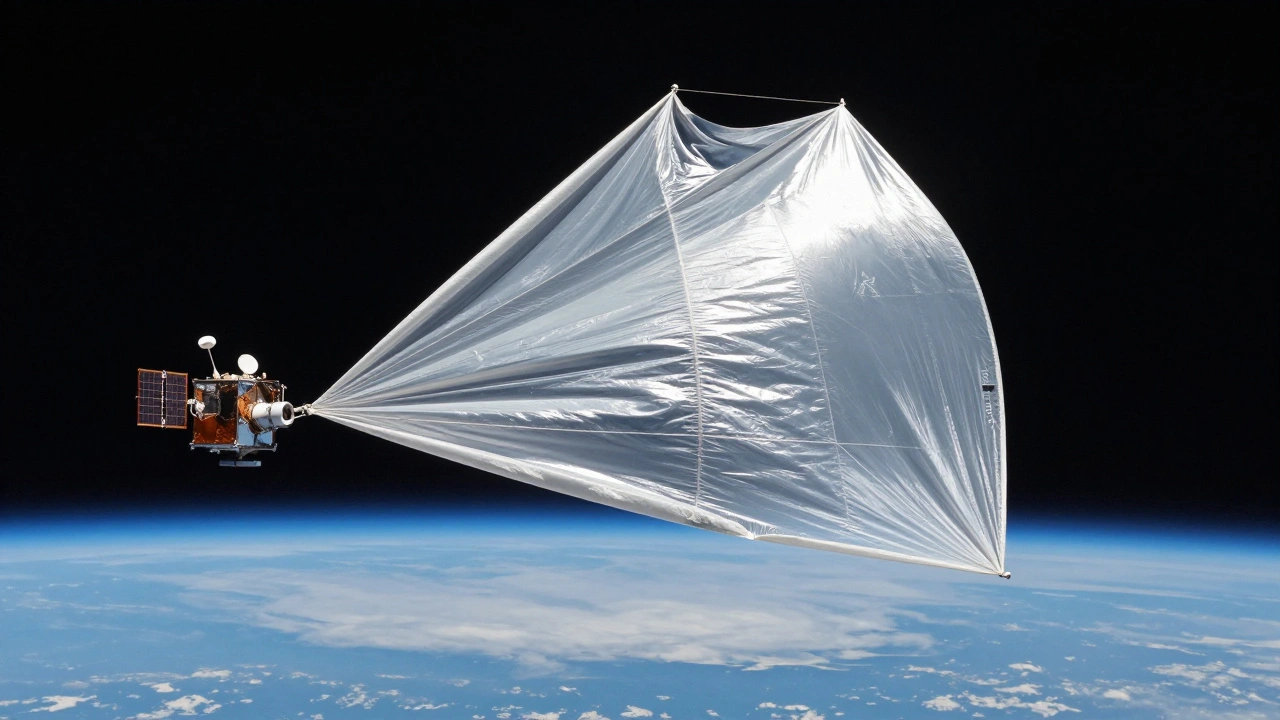
Drag sails are the simplest, most reliable way to deorbit small satellites and prevent space debris. Learn how they work, why they're mandatory, and which satellites use them today.
Learn More