
When a satellite finishes its job, it doesn’t just vanish. If left in orbit, it becomes space junk—dangerous, expensive, and growing fast. That’s where passive deorbit, a method of removing satellites from orbit using natural forces instead of engines. Also known as natural orbital decay, it’s becoming the standard for responsible space operations. Unlike active deorbiting, which requires fuel, thrusters, or onboard systems, passive deorbit relies on Earth’s thin upper atmosphere to slowly drag the satellite down over weeks or months. No rockets. No commands. Just physics.
This approach isn’t new, but it’s now mandatory for most new satellites launched by NASA, ESA, and major commercial operators. Why? Because active systems can fail. A dead satellite with a broken engine is a ticking bomb in orbit. Passive deorbit removes that risk. It’s built into the design—lightweight materials, larger surface area, and low-density structures that increase atmospheric drag. The space debris, human-made objects in space that no longer serve a function. Also known as orbital debris, it problem has over 100 million pieces larger than a millimeter, and even a paint chip can destroy a spacecraft. Passive deorbit is one of the few proven tools we have to stop the cascade of collisions known as Kessler Syndrome.
It’s not perfect. Lower orbits decay faster—satellites under 600 km might fall in under five years. Above 800 km, natural decay can take decades. That’s why regulators now require satellites to deorbit within 25 years, and many companies are pushing for under five. The orbital decay, the gradual lowering of a satellite’s altitude due to atmospheric drag. Also known as atmospheric drag decay, it rate depends on solar activity, which expands or shrinks the upper atmosphere. During solar storms, drag increases, speeding up deorbit. Smart operators track this and design satellites to fall even during quiet periods.
What you’ll find in these articles is real-world proof. You’ll see how companies are building satellites with deployable sails that unfold after mission end. You’ll learn why some satellites are made from materials that burn up completely on reentry, leaving no toxic residue. You’ll see how the space sustainability, the practice of operating in space without harming the environment or future missions. Also known as responsible space operations, it movement is turning passive deorbit from a nice idea into a legal requirement. This isn’t theory. It’s happening now, on satellites launched last year, and the ones coming next month.
There’s no magic here. Just smart engineering, strict rules, and the understanding that space isn’t infinite. The next time you hear about a satellite reentering the atmosphere safely—without a bang, without a pilot—it’s likely thanks to passive deorbit. And that’s how we keep the sky clear for the next generation of missions.
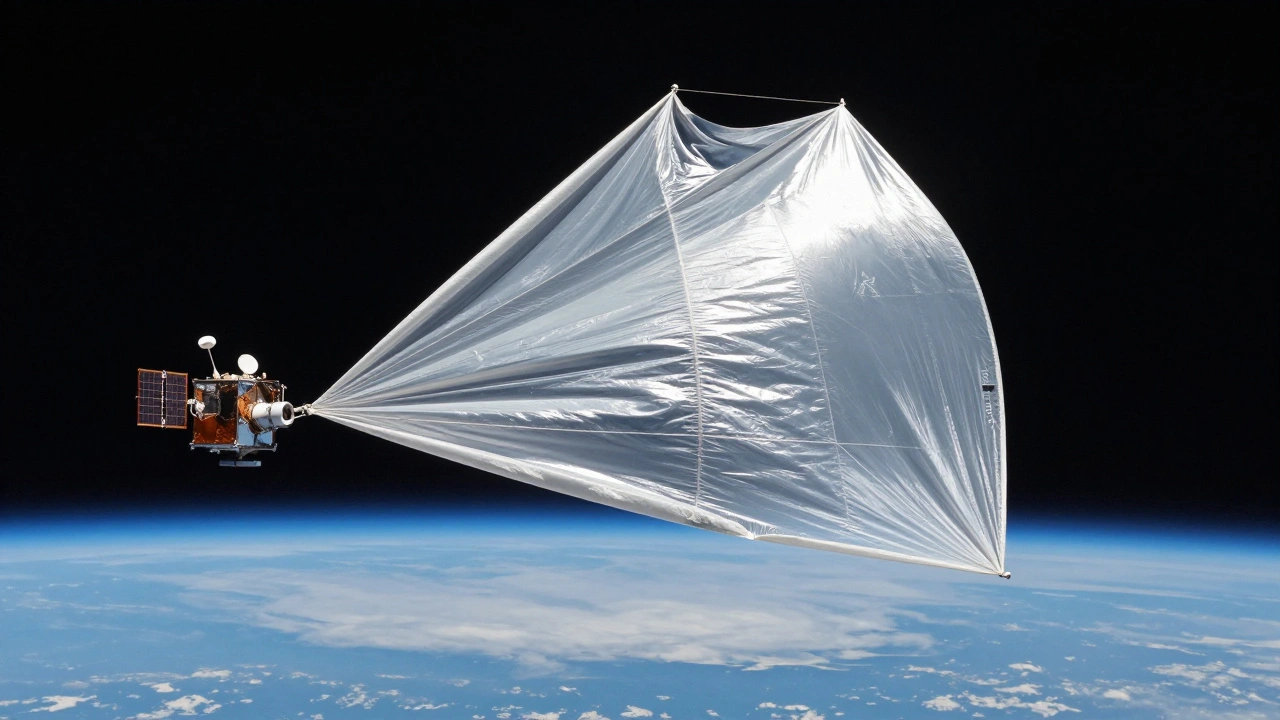
Drag sails are the simplest, most reliable way to deorbit small satellites and prevent space debris. Learn how they work, why they're mandatory, and which satellites use them today.
Learn More