
When you think of astronaut training, you might picture centrifuges or flight simulators—but the real magic happens in a Neutral Buoyancy Laboratory, a giant indoor pool at NASA’s Johnson Space Center where astronauts train for spacewalks by simulating weightlessness in water. Also known as NBL, it’s not just a pool—it’s the closest thing on Earth to floating in deep space. The water doesn’t make you weightless, but it cancels out most of your body’s weight, so you float the way you’d float in orbit. That’s why astronauts spend hundreds of hours here before every mission to the International Space Station.
The NBL holds over 6.2 million gallons of water, big enough to fit a full-scale mockup of the ISS. Astronauts suit up in actual spacewalk gear—weighing nearly 300 pounds on land—and spend up to six hours at a time underwater, practicing tasks like repairing antennas, replacing batteries, or fixing robotic arms. Every movement is choreographed, every tool is replicated, and every mistake is recorded. This isn’t just practice—it’s rehearsal for life-or-death situations. If a tool slips or a bolt won’t turn in space, they’ve already tried it here, dozens of times, with instructors watching every second. The microgravity simulation, a technique that mimics the sensation of zero gravity using buoyancy here isn’t perfect, but it’s the best we’ve got. You still feel drag from water, and your body doesn’t rotate the same way it would in vacuum—but for learning how to move, reach, and stabilize yourself, nothing else comes close.
The spacewalks, extravehicular activities performed by astronauts outside a spacecraft you see on TV? They didn’t happen by accident. Every handhold, every cable, every torque setting was tested first in the NBL. Engineers use the same pool to design new tools and test how equipment behaves in a simulated space environment. Even the suits you see astronauts wearing were refined here, with divers adjusting fit and mobility based on real-time feedback. The NASA, the U.S. government agency responsible for civilian space exploration and aeronautics research doesn’t just send people to space—they prepare them for every possible problem before they leave the ground.
What you won’t see on documentaries is how messy it gets. Water fills helmets during drills. Suits leak. Tools float away. Divers constantly adjust weights to keep astronauts balanced. It’s exhausting, frustrating, and utterly essential. This is where theory becomes muscle memory. And it’s why, when you watch an astronaut float outside the ISS, you’re not just seeing space—you’re seeing the result of hundreds of hours spent underwater, in a pool the size of a football field, learning how to work where there’s no up or down.
Below, you’ll find real stories and breakdowns from the people who train here, the tech they use, and how this underwater world keeps space missions alive.
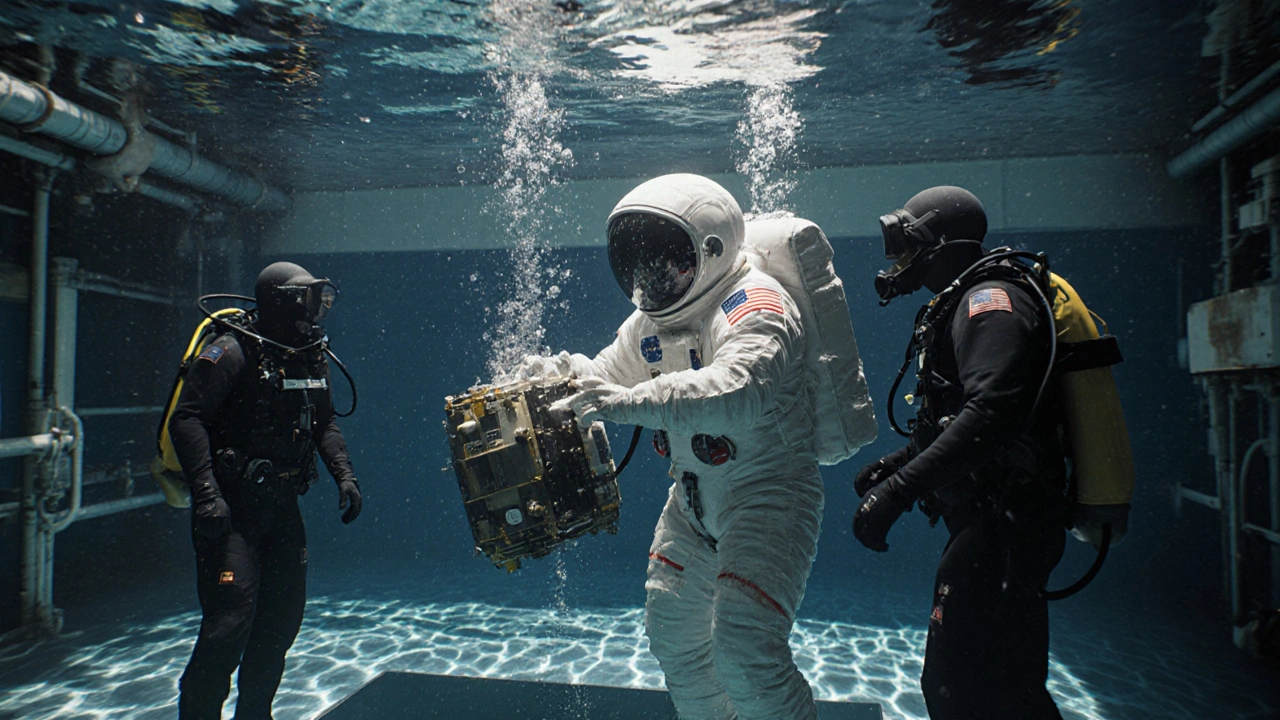
Astronauts train for hours underwater to prepare for spacewalks, using NASA's Neutral Buoyancy Laboratory to simulate microgravity. Learn how EVA training works, why it's so intense, and what happens when things go wrong.
Learn More