
When you hear NASA spacewalk, a planned extravehicular activity where astronauts leave the safety of a spacecraft to work in open space. Also known as extravehicular activity, it’s not just about floating around—it’s precision work under extreme conditions, often while orbiting Earth at 17,500 miles per hour. These missions don’t happen by accident. Every spacewalk is planned months in advance, tested in virtual reality, and rehearsed in giant pools on Earth. The International Space Station, a orbiting laboratory where astronauts live and work for months at a time relies on these outings to fix broken systems, upgrade hardware, and install new science tools. Without spacewalks, the ISS would have shut down years ago.
Behind every spacewalk is a team of engineers, doctors, and trainers making sure the space suit technology, a life-support system worn by astronauts during EVAs, designed to protect against vacuum, radiation, and extreme temperatures won’t fail. These suits aren’t just outfits—they’re mini spacecraft. They regulate temperature, remove CO2, supply oxygen, and even have built-in radios. If a seal leaks or a battery dies, the astronaut has minutes to get back inside. NASA has never lost an astronaut during a spacewalk, but near-misses have changed how they train. One glitch in 2013 forced a sudden return when water leaked into an astronaut’s helmet. Now, every suit gets extra drainage and better sensors.
Spacewalks aren’t just about fixing the ISS. They’re test runs for what’s coming next. The tools astronauts use today—like the Pistol Grip Tool, a high-torque electric wrench—are the same ones being tested for lunar missions. The way they move, secure themselves, and handle tools in microgravity tells engineers how to design gear for the Moon and Mars. You won’t see a spacewalk on TV every week, but when one happens, it’s usually because something critical broke, or a new experiment needed to be installed. The astronaut safety, the set of protocols, gear, and procedures ensuring astronauts survive and return from spacewalks system is flawless because the cost of failure is too high.
What you’ll find in the posts below aren’t just news clips. These are deep dives into how spacewalks really work—the physics of moving in zero-G, why astronauts train underwater, how new suits are being built for Artemis, and what happens when a tool floats away. No fluff. No hype. Just the real details behind the moments you see on screen.
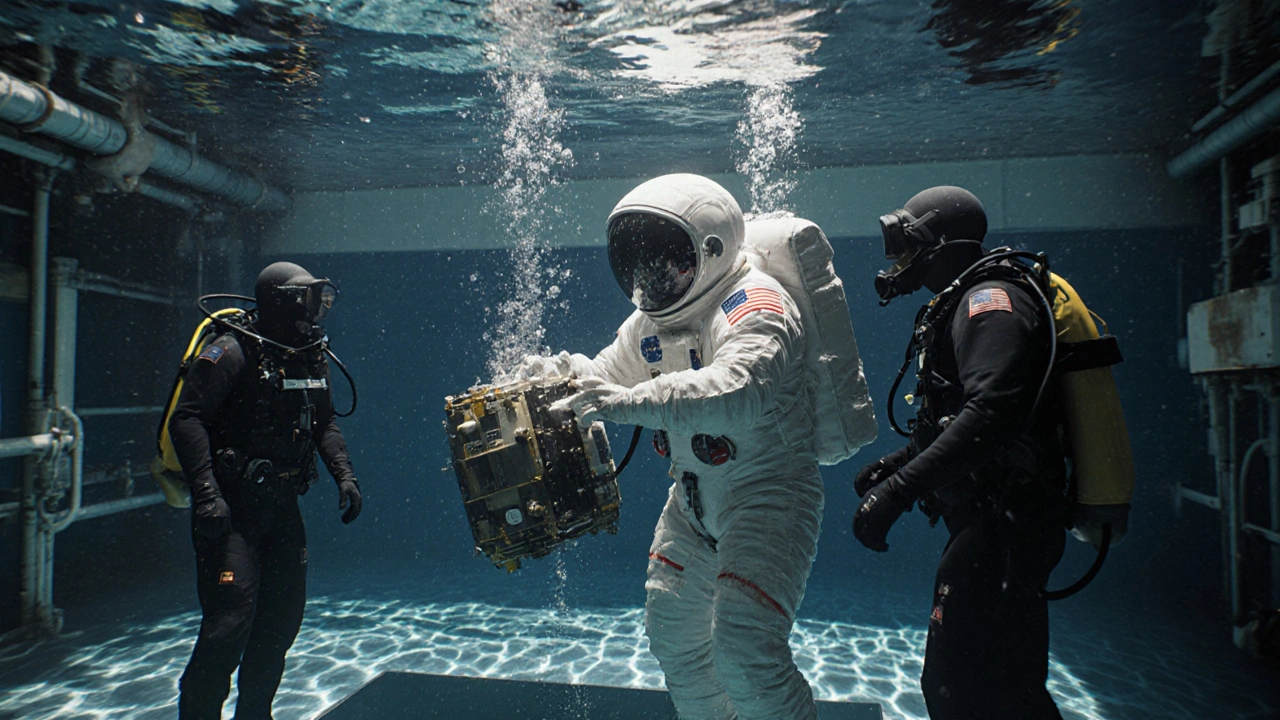
Astronauts train for hours underwater to prepare for spacewalks, using NASA's Neutral Buoyancy Laboratory to simulate microgravity. Learn how EVA training works, why it's so intense, and what happens when things go wrong.
Learn More