
When we talk about lunar infrastructure, the physical systems and structures needed to support human and robotic activity on the Moon. It’s not just about planting a flag—it’s about building roads, power grids, shelters, and supply chains that can last for years in one of the harshest environments in the solar system. Without it, any Moon mission is just a short visit. Real lunar exploration means staying, working, and eventually living there—and that needs more than a lander and a rover.
Lava tube habitats, natural underground tunnels formed by ancient lunar lava flows. These aren’t science fiction—they’re NASA’s top pick for shielding astronauts from radiation, micrometeorites, and extreme temperature swings. They’re already being studied for Artemis missions because they cut construction costs and boost safety. Then there’s NASA Artemis, the U.S. program aiming to return humans to the Moon and establish a permanent presence. It’s not just about landing—it’s about building the first real outpost on another world, powered by solar arrays, water-harvesting tech, and communication networks that link back to Earth. Private companies like SpaceX and Blue Origin are helping build the rockets, but the real challenge is what happens after touchdown: how do you keep people alive, fed, and productive for months or years?
Think about it: on the Moon, every bolt, wire, and solar panel has to survive 14 days of freezing darkness, then 14 days of scorching sun. No rain, no atmosphere, no easy fixes. That’s why lunar infrastructure isn’t just about big machines—it’s about smart materials, modular designs, and using what’s already there. Extracting water from ice in shadowed craters? That’s part of it. 3D printing shelters from Moon dust? That’s part of it too. Even something as simple as a reliable radio link between habitats counts as infrastructure.
What you’ll find below isn’t just a list of articles—it’s a roadmap. From how astronauts train for Moonwalks to how new materials are making lunar habitats lighter and stronger, these posts break down the real tech behind making the Moon a second home. You’ll see how the same systems that keep satellites in orbit are now being adapted for the lunar surface, and how private companies are pushing the limits of what’s possible. This isn’t a dream anymore. It’s a project. And it’s already underway.
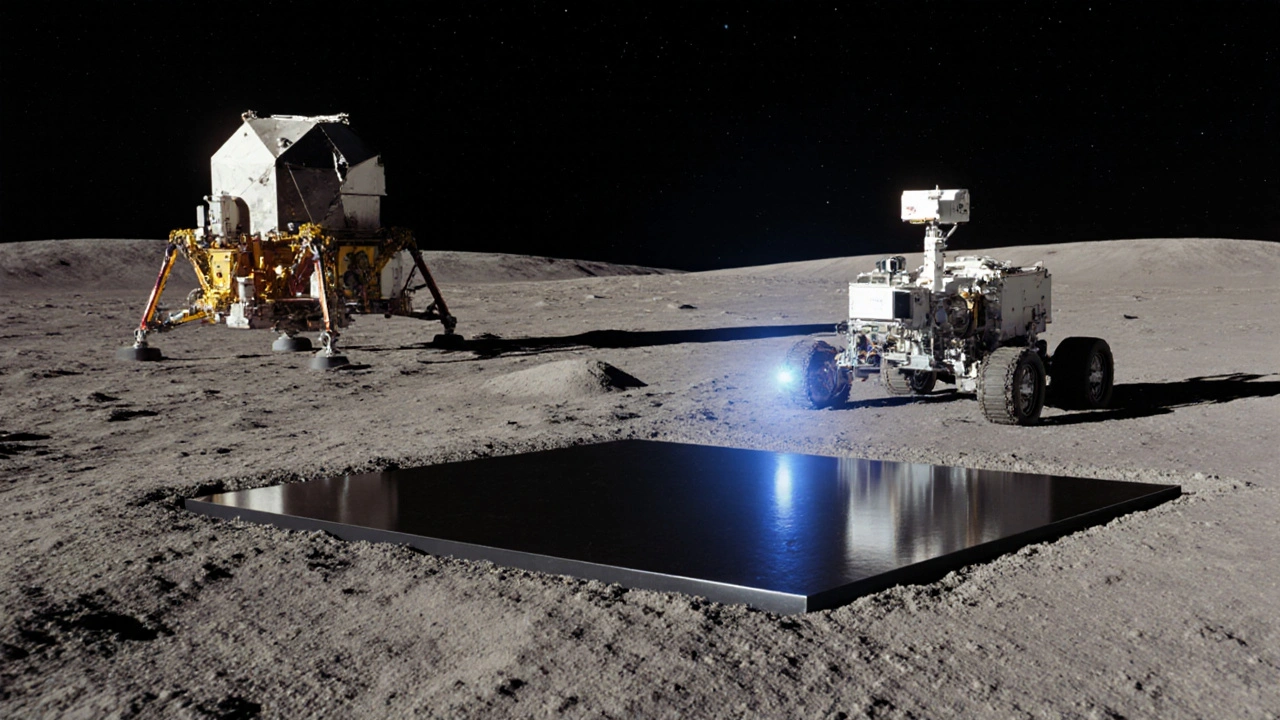
Lunar landing pads made by sintering Moon soil reduce dangerous dust ejecta from rocket landings. Using microwaves, lasers, or polymers, engineers are turning regolith into durable surfaces-cutting Earth-launched mass by 90% and enabling long-term lunar bases.
Learn More