
When you think of satellites, you might picture big, distant observatories floating far above Earth. But the real action today is in LEO satellites, low Earth orbit satellites that circle the planet between 160 and 2,000 kilometers up, enabling fast internet, real-time Earth imaging, and global connectivity. Also known as low-orbit satellites, they’re the backbone of today’s space-based services—from Starlink’s internet beams to weather monitors tracking storms before they hit. Unlike older satellites in higher orbits, LEO satellites are small, cheap to launch, and can be deployed in massive numbers. That’s why companies like SpaceX, Amazon, and OneWeb are racing to fill the sky with tens of thousands of them.
But putting up so many satellites isn’t just about speed and coverage—it’s a tug-of-war over space itself. Orbital rights, the legal claims countries and companies file to use specific paths around Earth. Also known as space traffic rights, they’re managed by the International Telecommunication Union, and the system is creaking under the weight of new launches. Every new satellite adds to the risk of collisions, and we’re already seeing space debris, dead satellites, rocket parts, and fragments from past explosions that now orbit Earth at dangerous speeds. Also known as orbital junk, it’s a growing threat to every spacecraft in LEO. The more satellites we launch, the more we need smart coordination. That’s why filings like those tracked by the ITU matter—they’re not just paperwork, they’re the rules of the road for space.
And it’s not just about internet. Satellite constellations, networks of dozens or hundreds of small satellites working together as one system. Also known as satellite swarms, they’re what make global coverage possible without relying on ground towers. These constellations can spot wildfires in real time, track shipping movements, monitor crop health, and even help with disaster response. But they also mean more radio signals, more light pollution for astronomers, and more pressure on the limited space near Earth.
What you’ll find in this collection isn’t just news about launches. It’s the real-world impact of LEO satellites—the legal battles, the tech behind them, the risks we’re ignoring, and the innovations that might save us from a space traffic jam. You’ll read about how satellite filings shape who gets to use space, how companies are designing satellites to deorbit safely, and why the next decade will decide whether LEO becomes a bustling highway or a graveyard of broken machines.
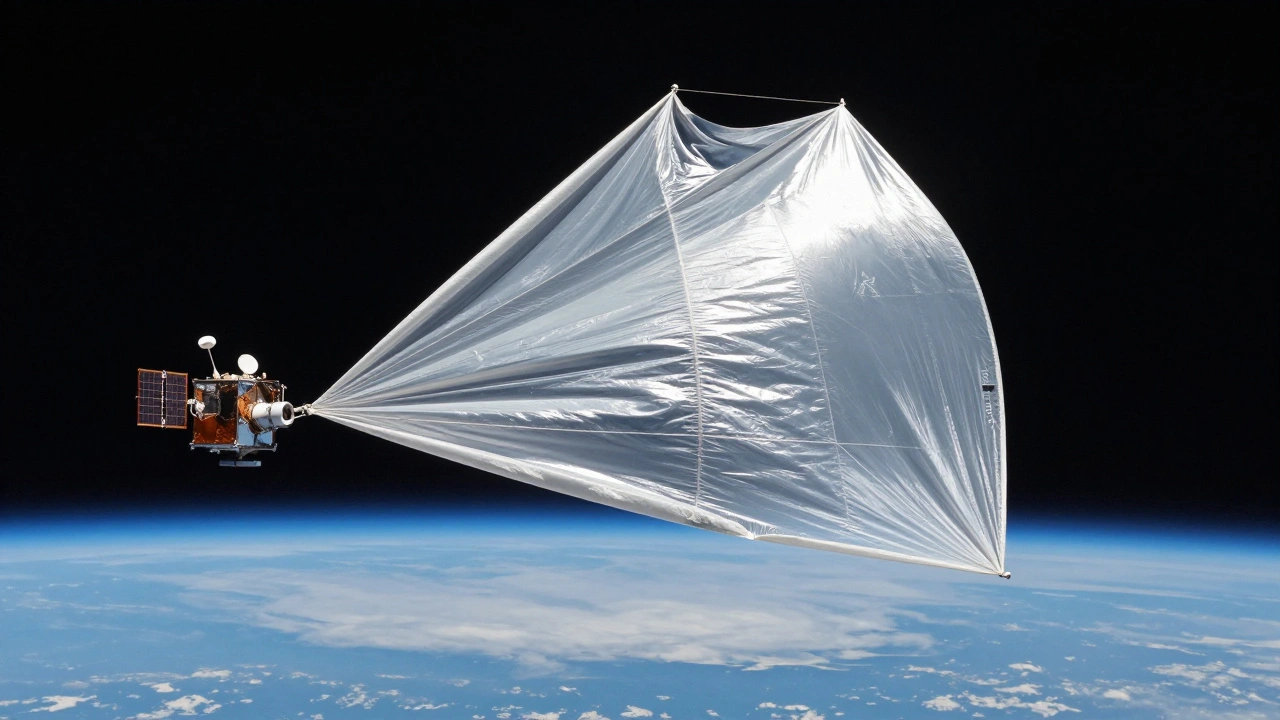
Drag sails are the simplest, most reliable way to deorbit small satellites and prevent space debris. Learn how they work, why they're mandatory, and which satellites use them today.
Learn More