
When you're walking through a dense city and your map app still knows exactly where you are, that’s GPS in cities, a system that uses satellites to pinpoint your location on Earth, even when surrounded by steel and concrete. Also known as satellite navigation, it’s not magic—it’s math, engineering, and a lot of signal processing working behind the scenes. You might think GPS is just about satellites talking to your phone, but in cities, that’s where things get messy. Tall buildings block direct signals, bounce them off glass and metal, and create what’s called multipath interference, a phenomenon where GPS signals reflect off surfaces before reaching your device, causing errors in location. This is why your map sometimes jumps from one side of the street to the other, or why your walking route looks like it’s cutting through buildings.
Modern phones don’t rely on GPS alone anymore. They use GNSS signals, a broader system that pulls data from multiple satellite networks like GPS (U.S.), GLONASS (Russia), Galileo (Europe), and BeiDou (China) to get more signals from more angles. That’s why newer phones are far more accurate in cities than older ones. They also use Wi-Fi positioning and cell tower triangulation to fill in gaps when satellite signals vanish. Even your phone’s barometer helps—by sensing changes in air pressure, it can guess which floor of a building you’re on. All of this combines to make urban navigation smoother, but it’s still not perfect. Ever stood in a canyon-like street and watched your dot wobble? That’s because the system is guessing, not knowing.
What makes GPS in cities work at all is a mix of hardware and software upgrades. Dual-frequency receivers, once only in military gear, are now common in smartphones. They can filter out signal noise caused by the atmosphere and buildings. Apps like Google Maps and Apple Maps use real-time traffic data and historical patterns to correct your position even when the raw signal is weak. And behind the scenes, companies are launching more satellites, improving ground stations, and even testing low-orbit constellations to boost coverage. The goal isn’t just to show you where you are—it’s to make sure you never lose your way, even when you’re stuck between skyscrapers.
There’s a reason this matters beyond getting to coffee on time. Emergency responders rely on accurate location data in cities. Delivery drivers need to find exact addresses in crowded neighborhoods. Ride-share drivers and autonomous vehicles can’t afford to be off by even a few meters. The same technology that helps you find the nearest gas station is the same one that could save a life during a crisis. And while GPS in cities still struggles in extreme environments—like underground parking garages or dense downtown cores—it’s getting better faster than most people realize.
Below, you’ll find a collection of posts that dig into the real-world tech behind this invisible system. From how civilian GPS now matches military precision, to how satellites are hardened against solar storms that can knock out signals, to how precision navigation is used in farming and space missions—these stories show you that GPS isn’t just a map tool. It’s a critical infrastructure, quietly holding our modern world together, even when you’re stuck in traffic on 5th Avenue.
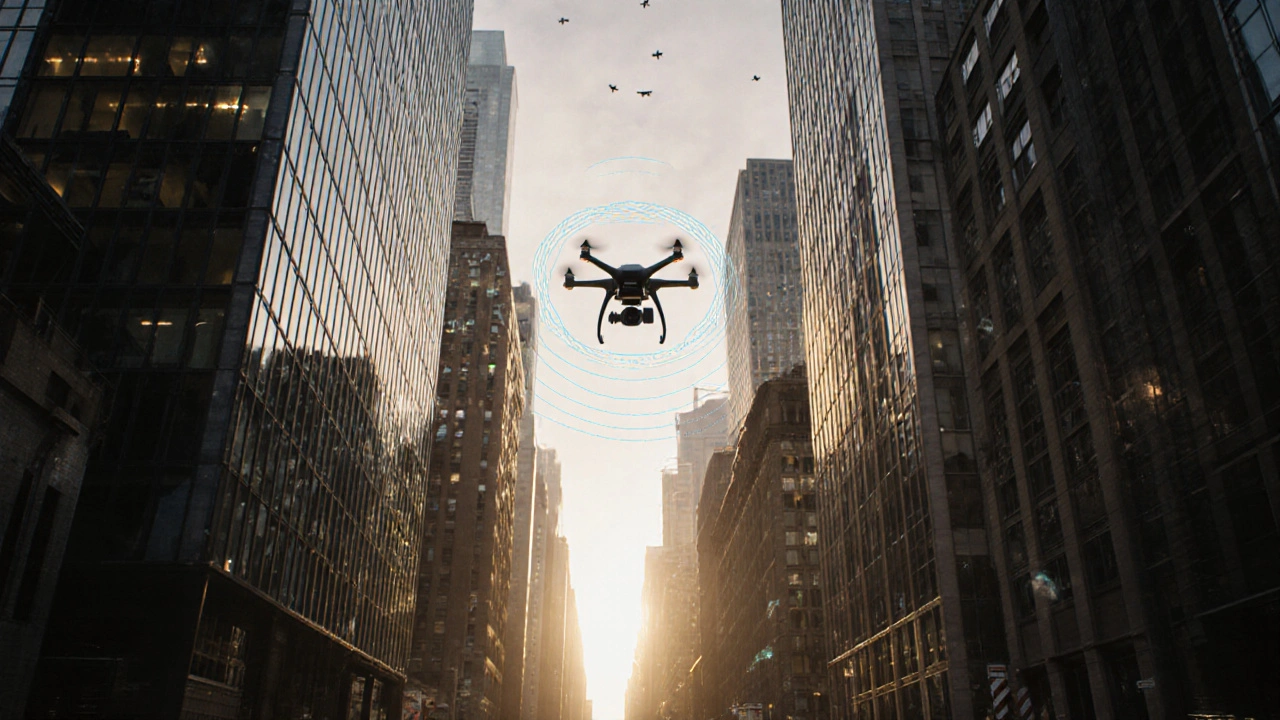
Urban canyons cripple GPS accuracy, but new software and sensor fusion techniques now deliver lane-level positioning in dense cities. Learn how HK model, SmartNav, and S-GNSS Auto are fixing satellite navigation for autonomous vehicles and smartphones.
Learn More