
When a satellite finishes its job, it doesn’t just vanish—it becomes space junk unless something stops it. That’s where drag sails, thin, deployable membranes that increase atmospheric drag to pull satellites out of orbit. Also known as aerodynamic deorbiting sails, they’re a simple, low-cost solution to one of space’s biggest problems: cluttered orbits. Unlike rockets that burn fuel to slow down, drag sails use Earth’s thin upper atmosphere to naturally slow satellites over weeks or months, guiding them into a fiery, safe reentry.
This isn’t science fiction. Missions like ESA’s RemoveDEBRIS, a European project that tested multiple space debris removal technologies successfully deployed a drag sail to bring a mock satellite down from low Earth orbit. NASA’s CubeSat Drag Sail Deorbit Experiment, a small satellite designed to prove drag sail effectiveness in orbit did the same. Even private companies like Planet Labs and Spire use them on their imaging satellites. The goal? Meet new rules from the FCC and ESA that require satellites to deorbit within five years of mission end. Without drag sails, that’s nearly impossible for small satellites that can’t carry big fuel tanks.
How do they work? Think of it like a parachute in reverse. A sail, often made of ultra-thin polymer like Mylar or Kapton, unfurls after the satellite’s job is done. It increases surface area by ten times or more, catching the faint air molecules at 400 to 600 kilometers up. Even though the atmosphere there is a near-vacuum, it’s enough—over time, drag builds up, lowers the orbit, and eventually pulls the satellite into thicker air where it burns up. No engines. No propellant. No risk of explosion. Just physics.
And it’s not just about cleaning up. Drag sails also help avoid collisions. With over 5,000 active satellites and more than 30,000 pieces of trackable debris, every uncontrolled object is a hazard. The Kessler Syndrome—where one collision creates a chain reaction of debris—is no longer theoretical. Drag sails are a practical way to prevent that. Countries and companies that use them aren’t just being responsible—they’re protecting their own future missions.
What you’ll find in these articles are real-world examples of drag sails in action, from tiny CubeSats to large commercial satellites. You’ll see how engineers design them to survive launch vibrations, how they deploy reliably in zero-g, and why some failed while others worked perfectly. You’ll also learn how they tie into bigger efforts like orbital debris regulations, satellite lifecycle planning, and the push for sustainable space operations. This isn’t just about one tech—it’s about how we’re learning to live in space without trashing it.
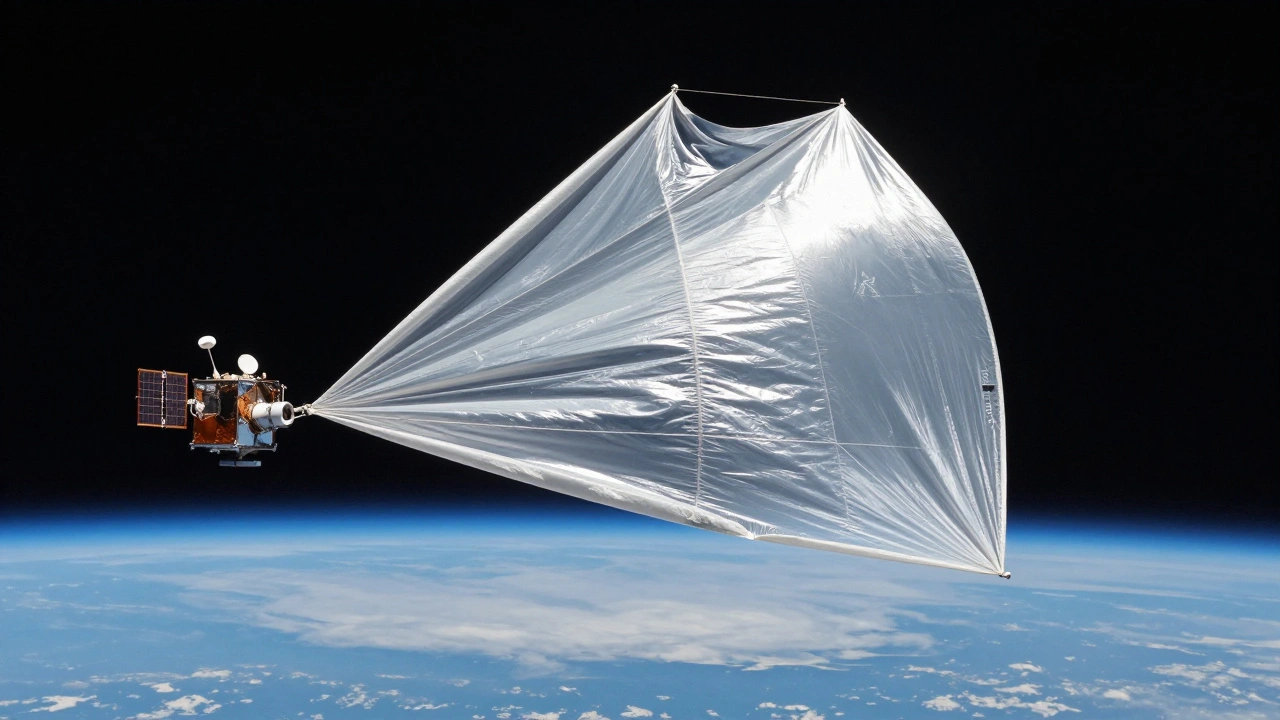
Drag sails are the simplest, most reliable way to deorbit small satellites and prevent space debris. Learn how they work, why they're mandatory, and which satellites use them today.
Learn More