
When space telescopes and scientific sensors look for faint signals from distant galaxies, they’re fighting one enemy: heat. Even the tiniest amount of warmth from the instrument itself can drown out the signals they’re trying to detect. That’s where detector cooling, the process of lowering sensor temperatures to near absolute zero to reduce thermal noise. It’s essential for infrared astronomy, exoplanet hunting, and deep-space imaging. Without it, missions like the James Webb Space Telescope would be blind to the cold, distant universe.
Detector cooling isn’t just about freezing a chip. It’s a system—combining cryogenic systems, engineered methods to reach and maintain temperatures below -200°C using liquid helium or mechanical coolers, thermal control, the design of heat shields, radiators, and insulation to block external heat from the Sun and spacecraft, and infrared detectors, specialized sensors that capture light too faint for human eyes, requiring extreme cold to function. These pieces work together. A detector might sit inside a multi-layered shield, connected to a mechanical cooler that vibrates just enough to move heat away, all while floating in the vacuum of space where heat doesn’t flow like it does on Earth.
Why does this matter? Because the universe is cold, and the things we want to see—dust clouds forming stars, the atmosphere of a planet 40 light-years away—are colder still. If your sensor is at -100°C, it can’t tell the difference between a signal from space and its own internal noise. But when you cool it to -270°C, suddenly, the faint glow of a forming galaxy becomes clear. NASA’s Webb telescope uses this principle to see the first galaxies. ESA’s Euclid mission relies on it to map dark matter. Even small satellites now carry miniaturized coolers to study Earth’s climate or track asteroids.
It’s not easy. Cooling systems add weight, use power, and can fail. That’s why engineers test them in vacuum chambers that mimic space, and why missions often include backups. But when it works, detector cooling turns invisible heat into visible science. Below, you’ll find real examples of how this tech powers missions—from the way lunar landers keep their sensors cold to how future Mars rovers will hunt for signs of life without being blinded by their own warmth.
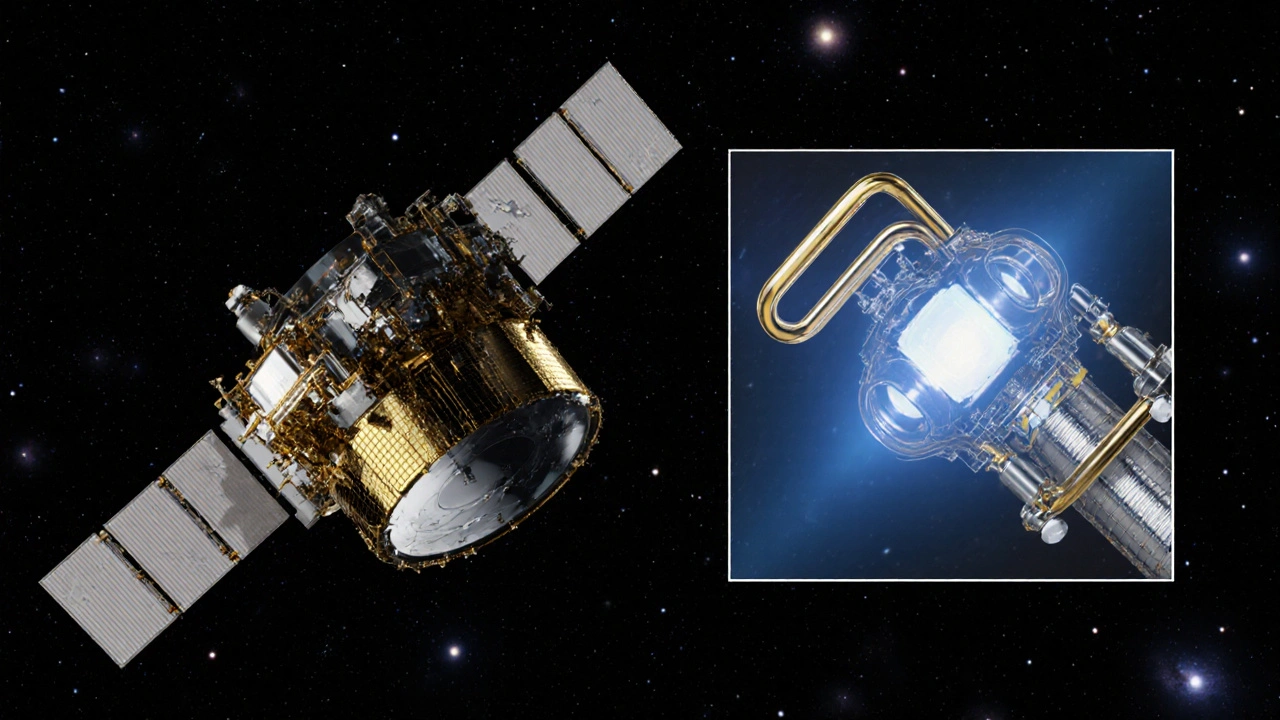
Cryostats and heat pipes enable space sensors to operate at near-absolute zero temperatures, making infrared astronomy possible. From JWST to future telescopes, this technology reveals the cold universe.
Learn More