

Solidity is the language that powers most smart contracts on Ethereum. If you're building decentralized apps, DeFi protocols, or NFT marketplaces, you need to understand it-not just how to write code, but how to write safe, efficient, and reliable code. This isn't a theoretical language for academics. It’s the real-world tool used by over 450,000 developers to lock in $1.5 trillion in value across the DeFi ecosystem. And if you get it wrong, people lose millions.
What Solidity Actually Does
Solidity lets you write code that runs on the Ethereum Virtual Machine (EVM). That code-your smart contract-automatically executes when certain conditions are met. No middleman. No bank. No lawyer. Just code and blockchain consensus.
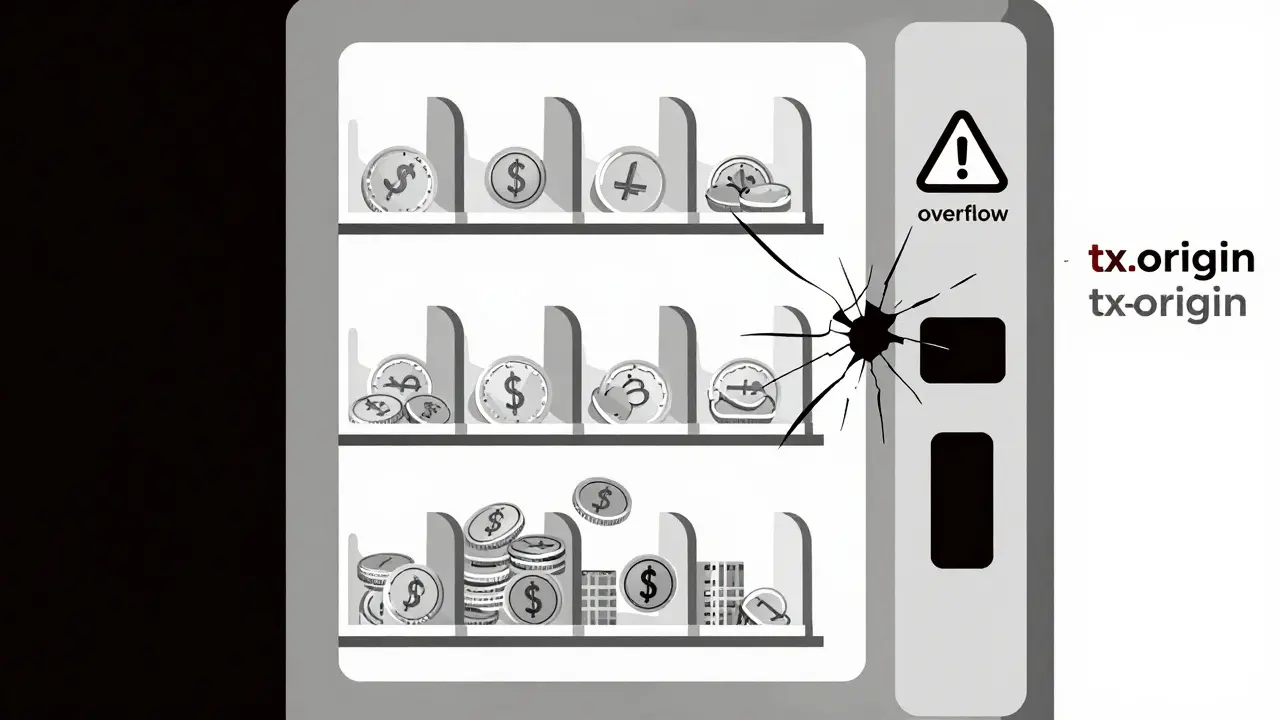
Think of it like a vending machine. You put in $2. The machine checks if you pressed the right button. If yes, it releases the snack. Solidity does the same, but instead of snacks, it sends ETH, transfers NFTs, or updates a ledger. The difference? Once deployed, that code can’t be changed. If there’s a bug, there’s no "undo" button.
Created in 2014 by Gavin Wood, Solidity was designed specifically for Ethereum. It’s not a general-purpose language like Python or JavaScript. It’s built for one thing: trustless automation on a blockchain. That’s why it has unique features like payable functions, gas limits, and memory/storage distinctions that don’t exist elsewhere.
Key Features That Set Solidity Apart
Solidity’s syntax looks familiar if you’ve used JavaScript or C++. But under the hood, it’s different. Here’s what matters:
- Static typing: Every variable must have a declared type. No guessing. This catches errors before deployment.
- Contract inheritance: You can build on top of existing contracts. Reuse security-tested code from OpenZeppelin instead of writing your own access control from scratch.
- Mappings: Think of them as hash tables. They’re the most efficient way to store user balances or token ownership on-chain.
- Events: These are logs you emit when something happens. They’re cheap to store and essential for front-end apps to track contract changes.
- Modifiers: These are reusable condition checks. For example,
onlyOwnerensures only the contract creator can call a function.
One of the biggest shifts came with Solidity 0.8.x. Before that, integer overflows were silent bugs. A user could drain a contract by triggering a number that rolled over from 2^256 - 1 back to zero. Solidity 0.8+ automatically checks for this. Now, the contract reverts instead of leaking funds. That alone has saved billions.
Memory, Storage, and Calldata-The Three Realms
This is where most new developers get stuck. Solidity has three places to store data:
- Storage: Permanent. Saved on the blockchain. Expensive to write to. Used for state variables.
- Memory: Temporary. Exists only during a function call. Cheap. Used for local variables.
- Calldata: Read-only. Holds data passed into external function calls. Zero cost.
Here’s a real example:
function updateBalance(address user, uint256 amount) public {
    // storage: this balances[user] - saved forever
    balances[user] += amount;

    // memory: temp variable - lost after function ends
    uint256 tempTotal = balances[user];

    // calldata: passed in - free to read
    emit BalanceUpdated(user, amount);
}
Writing to storage costs 20,000 gas. Writing to memory? 3 gas. Misusing storage is the #1 cause of high gas bills. If you’re copying data from storage into memory inside a loop, you’re burning money. Fix it.

Gas Costs and Why They Matter
Every operation on Ethereum costs gas. It’s the fuel. You pay in ETH. The cost changes based on network demand.
A simple ETH transfer? 21,000 gas. A token swap on Uniswap? 150,000-300,000 gas. A complex DeFi liquidation? Up to 500,000 gas.
In January 2024, gas prices ranged from $0.05 to $15 per transaction. If your contract costs 200,000 gas and ETH is $3,000, each interaction costs $1.20. Multiply that by 10,000 users? That’s $12,000 in gas fees per day.
Optimizing gas isn’t optional. It’s survival. Here’s how top developers do it:
- Use
uint8instead ofuint256if you only need numbers up to 255. - Store data in arrays instead of mappings when you need to iterate.
- Use
calldatafor function parameters instead ofmemorywhen possible. - Combine multiple writes into one storage operation.
One developer on Ethereum Stack Exchange reduced gas costs by 38% just by switching from a mapping of structs to a packed array. That’s real money.
Security: The Biggest Risk
Over $1.3 billion was lost to smart contract exploits in 2022. Most of those were in Solidity. Not because the language is broken. Because developers didn’t know how to use it safely.
The top three vulnerabilities:
- Reentrancy: A malicious contract calls back into yours before the first function finishes. The classic example: The DAO hack in 2016, which stole $60 million.
- Access control: Forgetting to restrict functions to owners or admins. The Nomad Bridge hack in 2022 lost $190 million because anyone could call the withdrawal function.
- Logic errors: Misunderstanding how block timestamps, random numbers, or integer math work on-chain.
Solidity 0.8+ helps. But tools like OpenZeppelin’s Contracts library help more. Use their Ownable, ReentrancyGuard, and ERC20 contracts. Don’t reinvent the wheel.
A 2023 OpenZeppelin report showed that contracts using Solidity 0.8.x had 37% fewer critical bugs than those on 0.7.x. That’s the power of version upgrades.
Tools of the Trade
You don’t need much to start:
- Remix IDE: Browser-based. Perfect for beginners. No install. 85% of new devs start here.
- Hardhat: Used by 68% of professionals. Great for testing, deployment, and debugging.
- Foundry: Fast, Rust-based. Growing fast. Used by 22% of devs. Best for advanced gas tuning.
- Infura or Alchemy: You need these to connect your code to the Ethereum network. Local nodes are too slow for development.
Testing is non-negotiable. Write unit tests for every function. Use chai and hardhat to simulate attacks. Test reentrancy. Test edge cases. Test what happens when gas runs out.
Deploying without tests is like driving without brakes.
Learning Curve and Real-World Time Investment
Can you learn Solidity in a weekend? Maybe. Can you write a production-ready contract? Probably not.
According to Cyfrin’s 2023 data, developers with prior coding experience need 100-250 hours to become comfortable. Most take 3-6 months to reach proficiency.
Common hurdles:
- Understanding the difference between
msg.senderandtx.origin(always usemsg.sender). - Why
block.timestampisn’t reliable for randomness. - How to handle failed transactions without losing state.
The best resource? The official Solidity documentation. It’s dense, but it’s accurate. Pair it with Ethereum Stack Exchange. Search for your error. Someone’s already asked it.
Where Solidity Stands Today (2026)
95% of Ethereum smart contracts are written in Solidity. That’s not because it’s perfect. It’s because it’s the only language with the tools, libraries, and community to support large-scale projects.
Compare it to Vyper, a simpler, more secure alternative. It’s used by only 3% of developers. Why? No inheritance. No complex data structures. It’s great for simple token contracts-but useless for Uniswap or Aave.
On non-EVM chains like Aptos or Solana, Rust-based languages are faster. Aptos handles 4,500 transactions per second. Ethereum (and Solidity) manage 15-45. But Ethereum has 58% of the smart contract market. Solidity isn’t going away.
Upcoming Solidity 0.9.x will add native support for ERC-4337 (account abstraction). That means users won’t need ETH to pay gas-they can pay with tokens. It’ll cut gas costs by 20-35%. This is huge.
Fortune 100 companies are using Solidity for supply chain tracking, identity verification, and tokenized assets. The EU’s MiCA regulation (2024) now requires formal audits for financial contracts. Solidity is the only language with the maturity to meet those standards.
Final Thoughts: Should You Learn It?
If you want to build on Ethereum, yes. Absolutely.
It’s not easy. It’s not forgiving. But it’s the most powerful tool for creating decentralized systems that run without central control. The risks are high. The rewards are higher.
Start with Remix. Write a simple token. Deploy it on Sepolia testnet. Break it. Fix it. Break it again. Learn how gas works. Learn how events connect to your frontend. Learn why you can’t trust user input.
There’s no shortcut. But every line of Solidity you write today is building the foundation of the next generation of the internet.
Is Solidity the only language for Ethereum smart contracts?
No, but it’s by far the most used. Vyper and Yul exist, but they’re niche. Vyper is simpler and more secure, but lacks features like inheritance and complex structs. Yul is low-level and used mostly for gas optimization. Over 95% of Ethereum contracts are written in Solidity, and nearly all major DeFi projects rely on it. For serious development, Solidity is the default choice.
Can I write a smart contract without knowing Solidity?
Technically, yes-you can use tools like third-party contract generators or no-code platforms. But you won’t understand what’s happening under the hood. That’s dangerous. If a contract you "deployed" has a bug, you can’t fix it. You won’t know how to audit it. You won’t know if it’s secure. Learning Solidity gives you control. Without it, you’re just clicking buttons on someone else’s code.
How long does it take to become proficient in Solidity?
Most developers with prior programming experience need 3-6 months of consistent practice to build production-ready contracts. That’s about 100-250 hours total. The first 20 hours get you writing simple contracts. The next 80 hours teach you security. The remaining time is spent debugging, optimizing gas, and understanding edge cases. There’s no rush. Mastery comes from breaking things and fixing them.
What’s the biggest mistake new Solidity developers make?
Assuming their code is secure because it compiles. Many beginners write code that works in tests but fails under real conditions. Common errors: using tx.origin for authorization, not checking return values from external calls, ignoring reentrancy, and not testing gas limits. Always assume your contract will be attacked. Test like you’re the hacker.
Do I need to know Ethereum’s architecture to use Solidity?
You don’t need to be an expert, but you need the basics. Understand what a block, transaction, and gas are. Know that Ethereum is stateful-every contract has persistent data. Understand that execution is deterministic and global. If you don’t know how the EVM works, you’ll write code that behaves unexpectedly. Start with Ethereum’s whitepaper and the Solidity docs. They’re enough for now.
Is Solidity still relevant with the rise of other blockchains?
Yes. Even though chains like Solana and Aptos use faster languages, Ethereum still dominates in total value locked (TVL), developer activity, and enterprise adoption. Over 99.7% of the top 100 DeFi protocols use Solidity. New EVM-compatible chains like Arbitrum, Optimism, and Polygon also run Solidity code. The ecosystem is too large to replace. Solidity isn’t going away-it’s evolving.
10 Responses
I remember the first time I deployed a contract and accidentally left a reentrancy vulnerability. Took me three days to find it. I was so sure my logic was solid-until someone drained 0.7 ETH from my test contract. That’s when I started reading OpenZeppelin’s code like it was scripture. Now I never write a function without asking: "What if someone calls this 20 times in one tx?" It’s not about being paranoid. It’s about respecting how unforgiving the chain is.
Also, I used to think gas optimization was for nerds. Then I saw a contract that cost $40 per interaction because someone kept copying storage arrays in loops. That’s like paying $40 to send a text message. Now I use remappings, pack structs, and avoid storage writes like they’re hot coal. It’s not sexy, but it’s what keeps the system alive.
And yeah, Solidity 0.8 saved me more than once. That overflow protection? Pure genius. I’ve seen contracts from 2020 that still have silent overflows. People are still deploying them. It’s terrifying.
Don’t trust any tutorial that doesn’t mention revert() or require(). If they’re teaching you to use tx.origin, run. Don’t walk. Run.
Start small. Write a token. Break it. Fix it. Break it again. That’s the only real curriculum that matters.
Oh sweet baby Jeeves, another ‘Essential Guide’ that treats Solidity like a yoga class. You think this is about learning? No. It’s about surviving a battlefield where one typo turns your life’s work into a public ATM. I’ve seen devs cry because they forgot to check msg.sender and lost $200k in fake tokens. This isn’t coding. It’s high-stakes witchcraft.
And don’t even get me started on ‘no-code platforms.’ You’re not building. You’re outsourcing your soul to a guy in a Discord server who says ‘just click deploy.’ You think your NFT project is safe? Nah. It’s just a poorly wrapped Trojan horse with a pretty image.
Use OpenZeppelin. Always. Even if you think you’re smarter than the library. You’re not. You’re just faster at losing money.
And yes, Solidity 0.8 is the only reason we’re not all broke. The old version was a dumpster fire with a ‘compile’ button. Don’t be that guy who still uses 0.6. You’re not a rebel. You’re a liability.
Really appreciate this breakdown-especially the memory/storage breakdown. I used to treat them like interchangeable buckets until I blew through 1.2M gas on a simple balance update because I kept copying a mapping into memory inside a loop. Whoops.
Also, the part about calldata being free? Mind blown. I used to pass arrays as memory just because it felt ‘cleaner.’ Now I use calldata everywhere I can. Saved me 60% on my last contract deploy.
And yeah, the reentrancy guard is non-negotiable. I built a lending protocol last year without it. Thought I was being clever with a ‘withdrawal queue.’ Got exploited in 3 hours. Lesson learned the hard way.
Foundry is a beast for testing. I used to rely on Hardhat’s fuzzing, but Foundry’s invariant testing caught a race condition I didn’t even know existed. If you’re serious, stop wasting time on basic unit tests. Learn to write property-based tests. It’s the difference between ‘it works’ and ‘it can’t be hacked.’
They say Solidity is the future. But who really controls Ethereum? Big finance. Wall Street. The same people who crashed the economy in 2008. Now they’re just putting it on a blockchain so they can say ‘decentralized’ and dodge regulation.
And you think you’re safe with OpenZeppelin? Please. They’re backed by venture capital. They’re part of the system. The real hackers aren’t writing code-they’re writing laws. MiCA? That’s not protection. That’s a leash.
And why do you think they pushed Solidity 0.8? So you’d all upgrade and lose your old contracts. So they could control the upgrade path. They don’t want you to be free. They want you to be compliant.
Use Yul. Write your own EVM bytecode. Don’t trust any high-level language. It’s all a trap.
People who say ‘just use Remix’ are irresponsible. You wouldn’t build a house with duct tape and hope, so why would you deploy a contract with a browser IDE? That’s like letting a toddler drive a Ferrari.
And don’t get me started on the ‘learn in a weekend’ crowd. You’re not a developer. You’re a tourist with a Metamask wallet. You think you’re contributing to Web3? You’re just another rug-pull waiting to happen.
If you’re not testing for reentrancy, you’re not a developer. You’re a hazard. And if you’re using tx.origin, you should be banned from GitHub. Not because it’s wrong-but because you’re too lazy to learn.
And yes, Solidity 0.8 isn’t optional. It’s moral. Using 0.7 is like driving without seatbelts and saying ‘I’m lucky.’ You’re not lucky. You’re dangerous.
Let me be blunt: if you’re reading this and you don’t know the difference between storage and memory, you have no business touching a smart contract. You’re not a developer. You’re a liability to the ecosystem.
I’ve reviewed 47 contracts this year. 42 had reentrancy risks. 38 used tx.origin. 29 copied storage in loops. 14 didn’t check return values. And 100% of them thought they were ‘secure’ because it compiled.
OpenZeppelin isn’t a library. It’s a lifeline. And if you’re not using it, you’re not trying to build. You’re trying to gamble.
Also, Solidity 0.8? If you’re still on 0.7, you’re not a pioneer. You’re a relic. A fossil. A warning sign for future generations.
And don’t even mention Vyper. It’s for people who can’t handle complexity. Real developers write code that scales. Not code that’s ‘simple.’ Simplicity is for amateurs.
Great post. Really nailed the practical stuff.
Just wanted to add: if you’re using Hardhat, make sure you’re using the latest version of @nomicfoundation/hardhat-toolbox. The old one doesn’t include the new console.log for debugging in Solidity 0.8+. Saved me hours last week.
Also, for gas optimization-don’t just use uint8. Use bytes1 for single-byte flags. And if you’re storing addresses, pack them into uint160. Every byte counts.
And yeah, calldata is king. I had a function that took 10 addresses. Used memory. Gas cost: 85k. Switched to calldata. Gas cost: 12k. That’s a 86% drop. Just by changing one word.
Don’t overthink it. Just write, test, optimize. Repeat.
Oh wow. Another ‘Solidity is the future’ sermon. How many times do we need to hear this? It’s 2026. We’ve had 12 years of this. And what’s the result? $1.3 billion burned. 87% of exploits from basic mistakes.
Let me guess-next you’ll tell us that ‘learning Solidity gives you control.’ No. It gives you a shovel to dig your own grave. You think you’re safe because you used OpenZeppelin? Congrats. You’re now a slightly less incompetent version of the same guy who lost $200k last month.
And yes, Solidity 0.8 fixed overflows. But it didn’t fix human stupidity. That’s still alive and well. In fact, it’s thriving.
So go ahead. Deploy your token. Break it. Fix it. Break it again. And when you lose your life savings, don’t come crying to me.
Just don’t pretend you’re building the future. You’re just playing with fire in a paper house.
Writing code on a blockchain is like writing a letter that can never be unread. Once it’s out, it’s part of history.
The tools matter. The syntax matters. But what matters more is the mindset. You’re not just writing functions. You’re writing rules for trustless systems. People will stake their money on them. Lives will be affected.
It’s not about being the best coder. It’s about being the most careful.
Use the library. Test the edge cases. Assume malice. Assume failure. Assume you’re wrong.
And if you’re still using 0.7? You’re not just behind. You’re endangering others.
That’s all.
Stop it. Just stop. You’re all pretending you’re experts. You read a blog. You deployed a token on Sepolia. You think you’re ready? You’re not. You’re a walking exploit waiting to happen. And you’re all just feeding each other validation like it’s a cult meeting. Solidity isn’t a hobby. It’s a minefield. And you’re all walking through it blindfolded.