
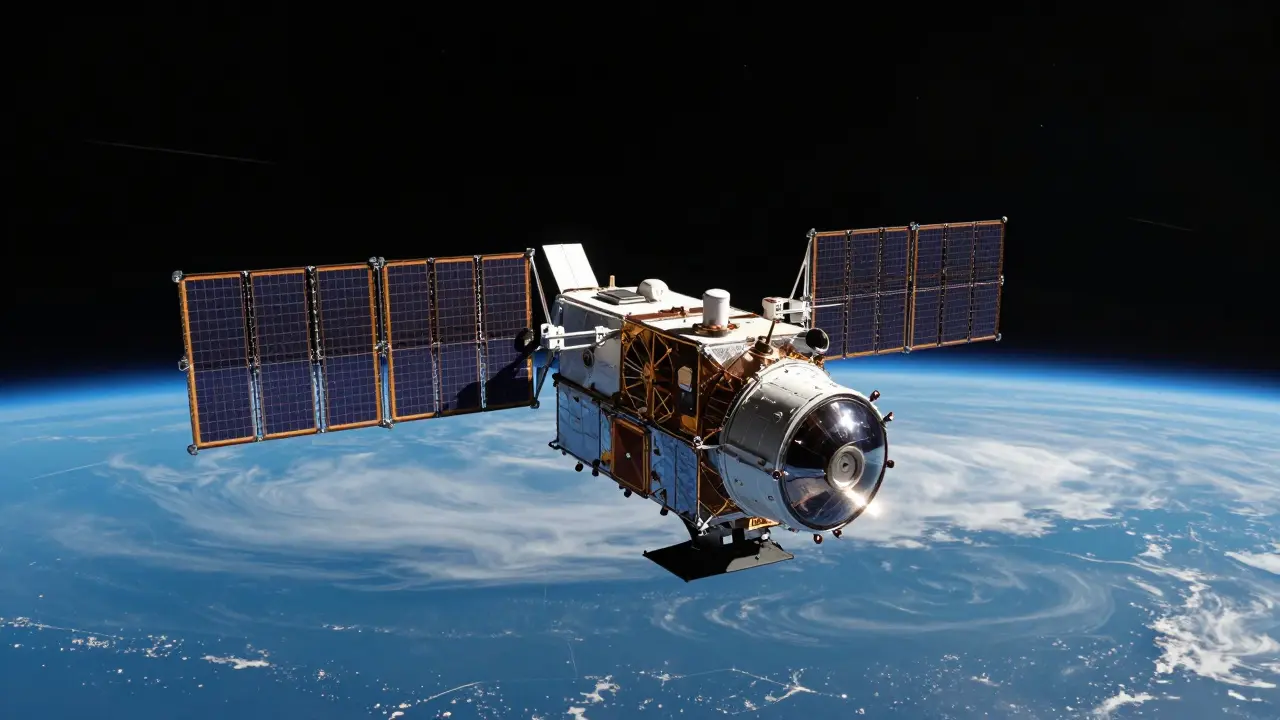
Imagine launching a multi-billion-dollar satellite into orbit, only to have its power system fail three years before the mission ends. That scenario is not science fiction; it happens when engineers rely on rough estimates instead of precise solar array degradation models. In space, there are no repair crews waiting in a van with a wrench. If the solar panels degrade faster than predicted, the spacecraft loses attitude control, scientific instruments shut down, and the mission becomes a dead weight in orbit. Predicting exactly when those panels will hit their end-of-life (EoL) threshold is the difference between a successful decade-long observation run and an expensive piece of space junk.
The stakes are incredibly high because solar arrays are the lifeblood of most uncrewed missions. From small CubeSats to massive observatories like the James Webb Space Telescope, every watt counts. As we move deeper into the 2020s, with global photovoltaic capacity hitting new records and space agencies pushing for longer mission lifespans, understanding how these arrays age is critical. This isn't just about tracking a percentage drop in output; it's about forecasting the exact moment when power generation falls below the minimum required to keep the spacecraft alive.
The Physics of Orbital Decay: Why Space Panels Degrade Faster
Solar panels on Earth face weather, dirt, and temperature swings. Panels in space face something far more hostile. The primary enemies of a space-based photovoltaic array are atomic oxygen, ultraviolet radiation, and charged particle bombardment from the sun and cosmic rays. These factors cause physical changes at the cellular level that terrestrial models often miss or underestimate.
In low Earth orbit (LEO), atomic oxygen erodes the protective coverglass of the solar cells. This erosion increases reflectivity, meaning less sunlight reaches the silicon underneath. Simultaneously, proton irradiation creates defects in the crystal lattice of the semiconductor material. These defects act as traps for electrons, reducing the cell's ability to generate current. Unlike terrestrial panels that might degrade by 0.4% annually due to heat and humidity, space panels can lose significant efficiency within months depending on their orbit altitude and inclination.
Dr. Sarah Kurtz, a leading expert in PV reliability at NREL, has emphasized that standard terrestrial models fail in space because they don't account for these specific failure modes. For instance, Potential-Induced Degradation (PID), which affects ground-based systems in humid climates, is irrelevant in the vacuum of space. Instead, engineers must model 'displacement damage' caused by high-energy particles. A model that ignores this distinction will overestimate the lifespan of the array, potentially leaving the satellite without enough power to perform essential maneuvers during its final years.
Key Variables in Space Solar Degradation Models
To build an accurate prediction model, you need more than just the initial power rating of the panel. You need a comprehensive set of environmental and operational data points. Here are the critical variables that define the trajectory of your array's health:
- Orbital Environment: The altitude and inclination determine exposure to Van Allen radiation belts and atomic oxygen density. Geostationary orbits (GEO) face intense proton flux, while LEO faces atomic oxygen erosion.
- Cell Technology: Multi-junction III-V cells (like GaInP/GaAs/Ge) used in space are more resistant to radiation than terrestrial silicon cells, but they still degrade. Their specific bandgap structure determines how quickly radiation-induced defects accumulate.
- Thermal Cycling: Every time the satellite passes through eclipse, the panels cool rapidly. Repeated thermal expansion and contraction can cause micro-cracks in the interconnects and solder joints, increasing series resistance.
- Coverglass Erosion Rate: Measured in angstroms per year, this metric tracks the thinning of the protective glass. Thinner glass means less protection against micrometeoroids but also higher reflectivity losses.
- Mission Profile: Does the satellite point directly at the sun constantly? Or does it rotate? Fixed-wing arrays experience different stress patterns compared to dual-axis tracking systems.
Each of these variables interacts with the others. For example, higher temperatures can accelerate the diffusion of impurities in the cell, worsening the effects of radiation damage. A robust model doesn't treat these factors in isolation; it uses a coupled physics-based approach to simulate the cumulative impact over time.
Modeling Approaches: From Linear Estimates to AI-Driven Precision
Historically, mission planners relied on simple linear degradation curves. They would take the manufacturer's warranty data-often based on limited testing-and apply a straight-line decline over the mission duration. While easy to calculate, this method is dangerously inaccurate. Real-world degradation is rarely linear. It often starts with a rapid initial drop (light-induced degradation equivalent in space terms) followed by a slower, non-linear decay as radiation damage accumulates.
Today, advanced models use statistical regression and machine learning to improve accuracy. The National Renewable Energy Laboratory (NREL) developed tools that incorporate uncertainty bounds, achieving over 92% accuracy in long-term forecasts when sufficient historical data is available. However, for new satellite designs with no flight heritage, these data-driven models struggle. This is where physics-based simulations shine. By simulating the interaction of protons with the crystal lattice, engineers can predict degradation even for brand-new cell technologies.
A comparative look at common modeling strategies reveals distinct trade-offs:
| Method | Accuracy | Data Requirement | Best Use Case |
|---|---|---|---|
| Linear Extrapolation | Low (±15%) | Minimal | Preliminary budget estimates |
| Physics-Based Simulation | High (±5-8%) | Material properties | New cell technologies, pre-launch design |
| Statistical Regression | Very High (±3-5%) | 5+ years of flight data | Existing constellations, fleet management |
| AI/Machine Learning | Highest (±2-4%) | Large datasets + real-time telemetry | Active mission optimization, anomaly detection |
Artificial Intelligence is emerging as a game-changer here. Platforms like Greyb X-Ray use machine learning to analyze IV curves and thermal imaging from operating satellites. These AI models can detect subtle anomalies-like a single degraded string in a large array-that traditional models miss. They reduce the need for extensive historical data by learning from similar systems across different missions. However, the 'black box' nature of AI makes it harder for regulatory bodies to certify, so many agencies still require a physics-based backup model.
Predicting End-of-Life: Defining the Threshold
What exactly constitutes 'end-of-life' for a space solar array? On Earth, a panel might be considered retired when it drops below 80% of its original capacity. In space, the definition is mission-specific. For a communications satellite, EoL might mean the power level where it can no longer transmit at full bandwidth. For a scientific probe, it could be the point where the spectrometer can no longer cool itself to operating temperature.
Accurate EoL prediction allows operators to make strategic decisions. If a model predicts the array will hit its limit in two years, the operator might decide to repurpose the satellite for a lower-power role rather than letting it fail catastrophically. Alternatively, they might schedule a deorbit burn earlier to avoid cluttering valuable orbital slots with dead hardware. The European Union's recent regulations now require asset owners to submit EoL forecasts with high confidence intervals, mirroring trends in terrestrial renewable energy management.
Consider the case of a next-generation GPS satellite. Its mission requires continuous power for signal transmission. If the degradation model shows a steep drop-off after year 10 due to unexpected radiation hardening failures, the operator knows to plan for replacement satellites sooner. Without this insight, the constellation's integrity could be compromised, affecting navigation services globally. This shift from reactive maintenance to predictive lifecycle management is saving billions in avoided mission failures.

Practical Implementation Challenges and Solutions
Even with sophisticated models, implementation hurdles remain. One major issue is data quality. Many older satellites lack high-frequency telemetry. If you only get power readings once a day, you miss the nuances of thermal cycling and eclipse transitions. Modern best practices, recommended by groups like the Solar Energy Industries Association (SEIA) for terrestrial and adapted for space, call for 15-minute interval data collection. This granularity allows models to distinguish between temporary shading events and permanent degradation.
Another challenge is the gap between lab testing and real-world performance. Accelerated life testing in radiation chambers provides initial data, but these tests often fail to replicate the complex synergistic effects of space environment. Dr. Dirk Weiss from Fraunhofer ISE notes that encapsulant failure-a rare event in space but catastrophic when it occurs-is nearly impossible to predict with standard models. To mitigate this, engineers are incorporating probabilistic risk assessments into their degradation models, acknowledging that some failures are stochastic rather than deterministic.
Data gaps from communication blackouts or sensor malfunctions also plague models. Sophisticated interpolation techniques, such as those found in NREL's open-source RdTools package, help fill these gaps. However, improper interpolation can introduce errors of up to 0.15% in degradation rates, which compounds over decades. Redundant data logging systems are becoming standard on new missions to ensure continuous monitoring.
The Future: Circular Economy and Recycling in Orbit
As the amount of space debris grows, predicting EoL is not just about power; it's about sustainability. The concept of a circular economy is slowly penetrating the space industry. New platforms like PV Cycle 2.0 are beginning to integrate degradation forecasting with material recovery value predictions. While recycling satellites in orbit is still futuristic, knowing the residual value of materials helps in planning end-of-mission disposal strategies.
NREL's recent 'Degradation-to-Recycling' model incorporates real-time silver and indium recovery rates into economic calculations. Even if we can't recycle in space yet, understanding the degradation path helps in designing panels that are easier to dismantle or deorbit safely. California's upcoming Solar Asset Management Act, which mandates annual degradation forecasts for large installations, sets a precedent that may eventually influence international space law regarding satellite decommissioning.
Looking ahead, the integration of AI with digital twins of satellites will allow for real-time adjustment of degradation models. As each satellite collects data, it feeds back into the central model, improving predictions for future missions. This continuous learning loop promises to push prediction accuracy beyond the current 95% ceiling, bringing us closer to truly autonomous, long-duration space operations.
How does solar degradation in space differ from Earth?
On Earth, degradation is primarily driven by heat, humidity, UV exposure, and mechanical stress from wind or snow. In space, the main drivers are atomic oxygen erosion (in LEO), proton and electron radiation damage, and extreme thermal cycling between sunlight and eclipse. These factors cause physical changes in the semiconductor lattice and coverglass that terrestrial models do not account for, leading to faster and more complex degradation patterns.
What is the typical annual degradation rate for space solar panels?
There is no single fixed rate, as it depends heavily on orbit and technology. Generally, modern multi-junction space cells degrade between 0.5% to 2.0% annually in low Earth orbit, and potentially higher in geostationary orbits due to intense radiation. Terrestrial panels typically degrade around 0.4% annually. The first year often sees a steeper drop due to initial radiation hardening effects.
Why is predicting End-of-Life (EoL) power important for satellites?
Accurate EoL prediction prevents mission failure by ensuring the satellite has enough power for critical functions until retirement. It also aids in financial planning, allowing operators to schedule replacements or repurposing. Furthermore, it helps manage space debris by enabling timely deorbiting of dead satellites, keeping valuable orbital slots clear.
Can AI improve solar degradation models for space missions?
Yes, AI and machine learning can significantly improve accuracy by detecting subtle patterns in telemetry data that traditional physics-based models might miss. AI models can adapt to real-time conditions and learn from fleets of similar satellites. However, they require large amounts of high-quality data and are often used alongside physics-based models to provide explainable results for certification purposes.
What data is needed to build an accurate degradation model?
You need high-frequency power telemetry (ideally every 15 minutes), temperature data, orbital parameters, and initial cell specifications. Historical data from similar missions is also valuable. For new technologies, detailed material property data and accelerated life test results are essential to seed the physics-based portion of the model.