
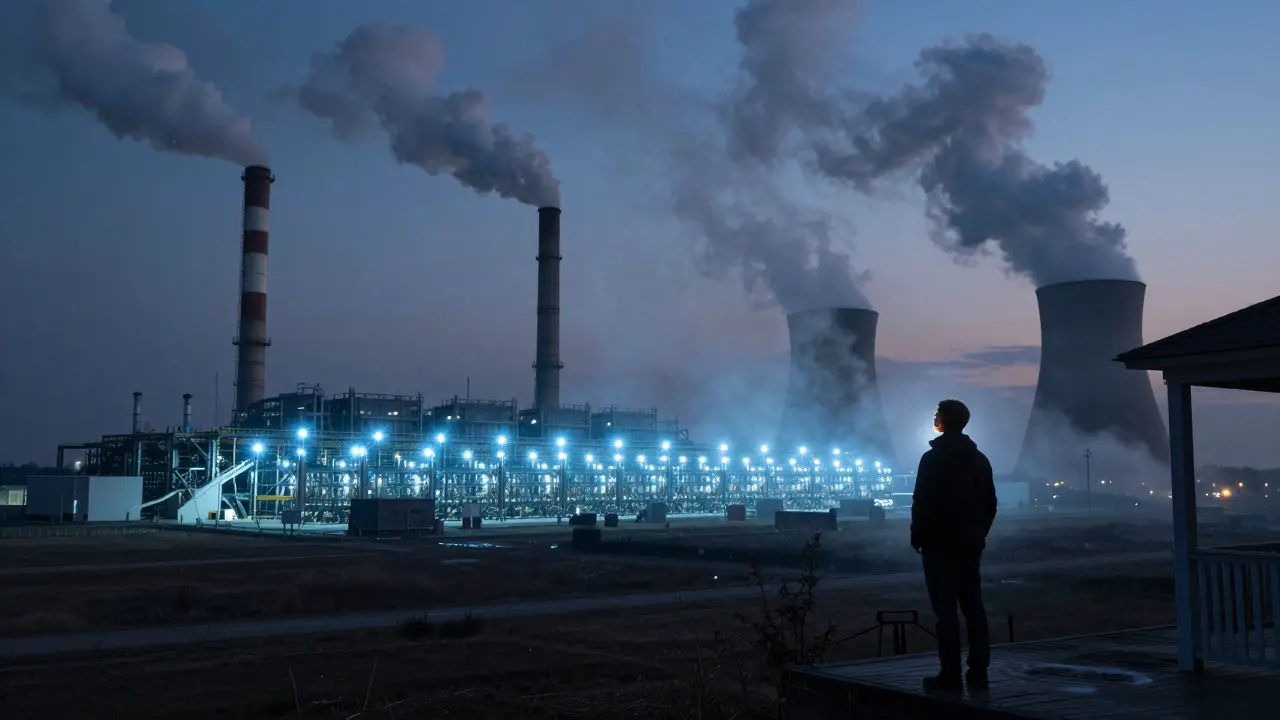
When people hear about Bitcoin mining, they often picture a room full of glowing computers. But what they don’t see is the power plant behind those machines-sometimes burning coal, sometimes flaring gas, always feeding electricity into a system that doesn’t care where the power comes from, only that it’s cheap and abundant.
The public isn’t confused about the issue. They see the numbers: crypto mining in the U.S. alone released 27.4 million tons of CO₂ between 2021 and 2022. That’s more than three times what the country’s biggest coal plant emitted in a single year. By 2027, the International Monetary Fund warns, crypto could be responsible for nearly 0.7% of global carbon emissions. And it’s not just about climate-it’s about air. In 2023, Harvard researchers found that 1.9 million Americans were breathing air polluted by fine particles linked to Bitcoin mines. In Metropolis, Illinois, people were inhaling pollution from a coal plant in Kentucky that powered a mine in North Carolina. No one in Kentucky was told their air quality was being sacrificed for digital currency.
Why the Industry’s Messaging Falls Flat
Crypto miners aren’t silent. They’ve got PR teams, sustainability reports, and even a global pledge called the Crypto Climate Accord-modeled after the Paris Agreement-that promises net-zero emissions by 2040. But here’s the problem: the math doesn’t match the message.
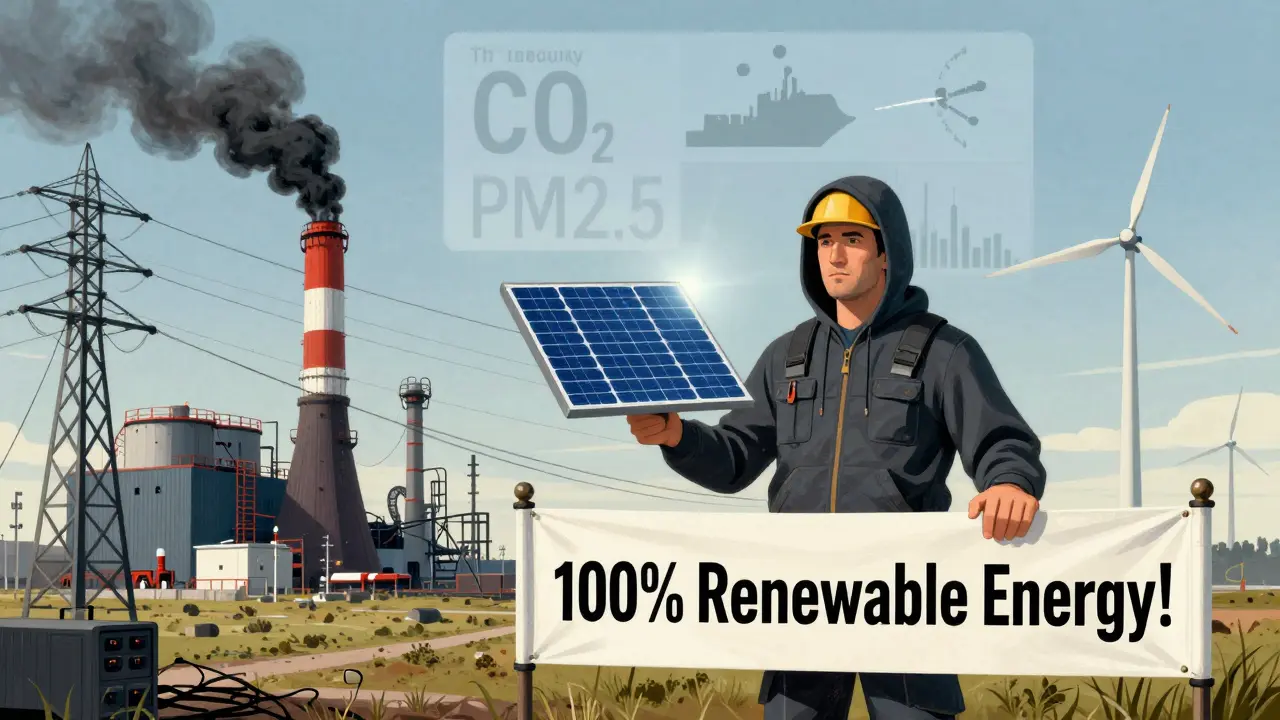
Miners talk about using renewable energy. They point to solar farms in Texas or hydro plants in Quebec. But the reality is messier. Most mining operations don’t own their power. They sign deals with utilities or buy electricity from the grid. That means a mine in Texas might claim it’s "100% renewable" because it buys credits from a wind farm in Iowa-but the actual electricity flowing into its servers could be coming from a natural gas plant just down the road. The grid is a mix. And miners aren’t changing the mix-they’re just using the cheapest slice.
Earthjustice calls this "greenwashing." And they’re not alone. The industry’s claims often sound like hopeful theories, not hard facts. When a miner says they’re using "excess methane" from oil wells to power their rigs, it sounds noble. But in practice, these projects are tiny. In 2025, only a small fraction of Bitcoin’s energy came from methane capture. Meanwhile, the largest mines are still chasing cheap power wherever they can find it-from abandoned coal plants in Indiana to rural grids in Georgia where regulations are loose and electricity is cheap.
The Structural Problem: Mining Is Designed to Use More Energy
Here’s the uncomfortable truth no one talks about: Bitcoin mining isn’t just a business. It’s a race. Every time the price goes up, more miners join. Every time a new machine is built, it demands more power. The system is designed to consume energy, not save it. Unlike factories or data centers that optimize for efficiency, Bitcoin miners are incentivized to use as much electricity as possible-because more power means more coins.
This isn’t a flaw-it’s the rule. The proof-of-work algorithm rewards those who solve puzzles fastest, and speed means power. That’s why miners move to places like Kazakhstan, where coal is abundant, or Texas, where deregulated grids let them snap up surplus power at midnight. They’re not trying to be green. They’re trying to win.
And when they talk about sustainability, it sounds like a PR move, not a business shift. Because if the price of Bitcoin drops, the mine shuts down. The solar panels stay. The wind turbines keep spinning. But the miners? They pack up and go where the next cheap kilowatt is waiting.
Health Costs You Can’t See
The environmental damage isn’t just global. It’s local. And it’s personal.
When a Bitcoin mine uses electricity from a coal plant, it doesn’t just add CO₂ to the atmosphere. It also releases PM2.5-the tiny particles that get into your lungs and bloodstream. Harvard’s research showed these particles don’t stop at state lines. Pollution from a power plant in Kentucky drifted into Illinois. Air quality in Houston and Austin took a hit because of mines in North Carolina. These are real people breathing worse air because of a digital system that doesn’t pay for the damage it causes.
And yet, miners rarely mention health impacts in their reports. They talk about carbon. They mention renewable percentages. But they don’t say: "Our operations contributed to 1.9 million Americans being exposed to dangerous air pollution." That’s because acknowledging that would mean admitting their business has a human cost. And that’s harder to spin.
Regulators Are Starting to Act
Public perception isn’t just changing-it’s turning into policy.
The IMF has calculated that a simple tax of $0.047 per kilowatt-hour could cut crypto emissions dramatically. Add in the cost of air pollution, and that rate jumps to $0.089. At that level, the industry would pay $5.2 billion a year globally-and cut emissions by 100 million tons. That’s equivalent to taking Belgium off the emissions map.
Some U.S. states are already moving. New York is considering a moratorium on fossil-fueled mining. Illinois is looking at emissions reporting rules. Texas regulators are starting to ask how much pollution each mine produces. These aren’t just local rules-they’re signals. The world is moving toward holding crypto accountable for its environmental footprint.
Miners who ignore this are betting against reality. The same way coal companies couldn’t outrun climate science, crypto miners can’t outrun public pressure. The question isn’t whether regulation is coming. It’s whether the industry will adapt-or get left behind.

What Miners Should Do Instead
Greenwashing won’t work anymore. The public is watching. The science is clear. The data is public.
Here’s what miners need to do:
- Stop claiming renewables they don’t directly use. If your mine is plugged into a grid powered by coal, say so. Honesty builds trust.
- Report real-time emissions. Publish where your power comes from, down to the power plant. Let people see the connection.
- Invest in real solutions-not tokens. Fund methane capture projects that are measurable. Partner with local utilities to build new solar or wind capacity, not just buy offsets.
- Pay for the damage. Support fees that fund public health programs in areas affected by mining pollution. It’s not charity-it’s responsibility.
The industry has a choice: keep pretending it’s clean, or start acting like it’s serious. The public isn’t asking for perfection. They’re asking for honesty.
The Bottom Line
Crypto mining’s environmental cost isn’t a rumor. It’s measured in tons of CO₂, in micrograms of PM2.5, in hospital visits, in state-by-state pollution data. The miners who succeed won’t be the ones with the flashiest sustainability reports. They’ll be the ones who stop lying to themselves-and start facing the truth.
Because when the public sees through the spin, they don’t just stop believing. They stop buying.
Is Bitcoin mining really that bad for the environment?
Yes. Between 2021 and 2022, U.S.-based Bitcoin mining alone emitted 27.4 million tons of CO₂-more than three times the emissions of the largest coal plant in the country. By 2027, global crypto mining could produce nearly 0.7% of all human-caused carbon emissions, according to the International Monetary Fund. The energy used by the top 34 U.S. Bitcoin mines in 2022-2023 exceeded the entire electricity consumption of Los Angeles.
Do crypto miners really use renewable energy?
Some do-but not as much as they claim. The 2025 Cambridge report says about 52% of Bitcoin’s power comes from renewable or low-carbon sources. But that includes indirect credits and grid mixes. In reality, most mining operations rely on fossil fuels because they’re cheaper. A mine in Texas might say it’s "100% green" because it bought renewable energy credits, but the electricity powering its machines could be coming from a nearby natural gas plant.
Why do miners keep moving to coal-heavy regions?
Because coal and natural gas electricity are cheaper and more reliable in those areas. Miners aren’t driven by sustainability-they’re driven by profit. The proof-of-work system rewards those who use the most electricity, so miners go where power is cheapest, even if it means partnering with a soon-to-be-retired coal plant in Indiana or a rural grid in Kazakhstan. This isn’t accidental-it’s built into the system.
How does crypto mining affect public health?
Bitcoin mining contributes to air pollution, especially fine particulate matter (PM2.5), which causes respiratory and cardiovascular problems. Harvard researchers found 1.9 million Americans were exposed to higher levels of PM2.5 due to mining operations. Pollution from power plants supplying mines crossed state lines-people in Illinois were breathing air contaminated by a coal plant in Kentucky that powered a mine in North Carolina.
Can regulation fix crypto’s environmental problem?
Yes, and it’s already starting. The IMF estimates a tax of $0.047-$0.089 per kilowatt-hour could cut global crypto emissions by 100 million tons annually-equivalent to Belgium’s total emissions. States like New York and Illinois are already considering bans or strict reporting rules. Miners who ignore these trends risk being shut down or taxed out of existence.
15 Responses
Oh my god, this is such a mess. I mean, seriously? We're talking about a system that's literally *designed* to guzzle energy like it's going out of style? And then they slap a 'green' sticker on it? Pfft. I'm not even mad, I'm just... disappointed. Like, you can't just buy renewable credits and call it a day. That's not sustainability, that's a magic trick. And the air pollution? 1.9 million Americans? That's not a statistic, that's your neighbor, your cousin, your kid breathing in coal dust because some dude in Texas is mining Bitcoin while watching Netflix. The hypocrisy is so thick you could spread it on toast.
The math is clear. Mining uses too much power. The industry needs to be transparent.
It's fascinating how the narrative around crypto mining has shifted so dramatically. What was once hailed as a decentralized revolution now looks more like a high-stakes energy gamble. The irony? The very technology meant to disrupt traditional systems is now dependent on their most polluting infrastructure. And yet, the response from miners? PR campaigns, not policy changes. It's like a car company claiming to be eco-friendly while still using leaded fuel and calling it 'optional'. The disconnect is staggering.
The environmental impact of cryptocurrency mining is not merely a concern-it is a quantifiable crisis. According to empirical data, the carbon emissions from U.S.-based Bitcoin mining alone exceed the annual output of the nation's largest coal plant. Furthermore, the indirect health consequences, particularly from PM2.5 exposure, constitute a public health emergency. Regulatory intervention, such as a kilowatt-hour tax calibrated to externalized costs, is not only economically rational but ethically imperative. The industry's refusal to adopt real-time emissions reporting and direct renewable integration is a failure of corporate responsibility.
Let’s be real-this isn’t about energy. It’s about control. The entire narrative around crypto is a neoliberal Trojan horse. They’re not mining Bitcoin; they’re mining the entropy of regulatory oversight. The 'renewable credits'? A financialized smoke screen. The methane capture? A PR stunt for venture capitalists with ESG portfolios. And let’s not forget: the entire proof-of-work mechanism is a Ponzi scheme disguised as decentralization. The grid isn’t being used-it’s being weaponized. And the fact that they’re not even paying for the externalities? That’s not capitalism. That’s theft with a whitepaper.
The article correctly identifies the core issue: greenwashing. However the term is misused. Greenwashing refers to deceptive marketing. What we are witnessing is not deception but outright fraud. Miners are not misrepresenting-they are fabricating. The use of renewable energy credits without direct consumption violates the very definition of sustainability. Furthermore the phrase '100 percent renewable' is legally ambiguous yet commercially exploited. This is not a semantic error. It is a systemic failure of accountability.
You know what’s wild? We live in a world where a machine can solve math problems faster than a human can blink, and we let it burn entire coal plants just to create digital money. It’s like building a cathedral out of smoke. We’ve traded our future for a ticker on a screen. The miners don’t care about the environment. They don’t care about the people in Illinois breathing Kentucky’s exhaust. They care about the next block. And the next. And the next. It’s not greed-it’s obsession. The blockchain doesn’t care if the world burns. It just keeps mining. And we’re the ones holding the match.
I get it-mining is energy hungry. But here’s the thing: we can fix this. Not with bans, not with outrage. With innovation. Imagine miners partnering with rural utilities to build new solar farms. Or using stranded wind power in the Midwest that would otherwise go to waste. It’s not about shutting it down-it’s about redirecting it. The tech is here. The infrastructure is waiting. What’s missing is the will. Let’s stop treating miners like villains and start treating them like partners who just need the right incentives. We can turn this into a climate win.
Okay but let’s be honest-no one cares about the coal plant in Kentucky. People in Texas are getting cheap electricity and miners are making bank. Meanwhile, the rest of us are just supposed to feel guilty? That’s not fair. If the grid is deregulated and the power is cheap, then yeah, miners are using it. But the real villain here is the system that lets this happen. Why isn’t the government taxing fossil fuel use? Why aren’t they building more renewables? Stop blaming the miners and start blaming the people who let this happen.
The system is designed to consume energy that’s the point
This whole thing feels like a psyop. Who exactly benefits from this narrative? The media? The regulators? The IMF? Or is it just another distraction so we don’t ask why our electricity bills keep rising? I mean, if crypto is so bad for the environment, why is it still growing? Why are governments still letting it happen? Someone’s getting paid. Someone’s pulling strings. And we’re just over here arguing about coal plants like it’s a moral issue. It’s not. It’s a power play.
There’s something deeply human about this whole mess. We created a system that rewards the most energy use, not the most intelligence, not the most innovation-just raw power. And yet, we call it progress. Isn’t that ironic? We built a digital utopia that runs on the same fossil fuels that are destroying our physical one. Maybe the real question isn’t how to make mining greener, but why we ever thought a machine should be rewarded for consuming more than it creates. We’re not just mining Bitcoin. We’re mining our own future.
i mean like... i get that its bad but like... dont you think maybe its just kinda... inevitable? like we cant stop tech right? like the world is going to use energy no matter what so why not let it go to something cool? also i heard like some mines are using like abandoned nuclear plants? idk maybe its a lie but like... maybe its not all bad? i just dont wanna be mad at something i dont fully understand
This is all just Western propaganda. Why are we letting foreign governments dictate how India should think about crypto? We have our own energy problems, but we also have our own solutions. Why is the IMF suddenly so concerned about Bitcoin? Maybe they’re scared of losing control. Crypto is freedom. And freedom always comes with a cost. Don’t let them scare you into giving up your digital rights.
i think the whole thing is overblown. sure mining uses power but like... think about all the data centers running for netflix and tiktok and amazon. no one talks about that. and also the bitcoin network is way more secure than banks. like who cares if it uses a little extra juice if its keeping our money safe? plus the grid is already overbuilt so its just using waste power. theyre just making a fuss because they dont understand it. its not that bad. really.