
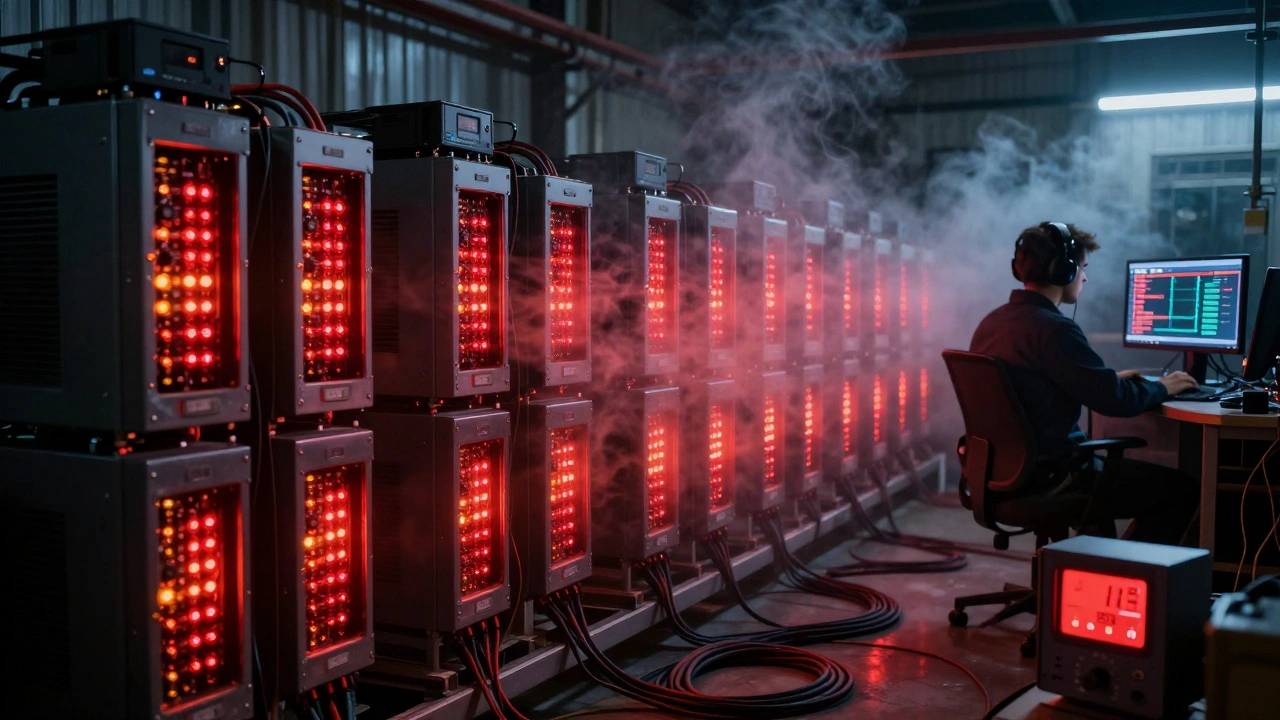
Back in 2021, if you wanted to mine Bitcoin, you needed a room full of machines that hummed like air conditioners, sucked electricity like a small town, and cost thousands just to buy. Today, that same Bitcoin network still runs on the same system - but Ethereum, the second-largest blockchain in the world, switched off its power-hungry setup for good. On September 15, 2022, Ethereum completed The Merge, swapping out Proof-of-Work for Proof-of-Stake. The result? A 99.95% drop in energy use. That’s not a marketing claim - it’s measured in terawatt-hours. One network went from using as much power as Argentina to using less than a single data center.
So what’s the real difference between Proof-of-Work and Proof-of-Stake? And why does it matter now more than ever?
How Proof-of-Work Actually Works
Proof-of-Work (PoW) is the original blockchain consensus method. It was designed by Satoshi Nakamoto for Bitcoin and has kept the network running since 2009. The idea is simple: computers compete to solve a math puzzle. The first one to solve it gets to add the next block of transactions and earns a reward in Bitcoin.
But here’s the catch - these puzzles aren’t just hard. They’re intentionally designed to be computationally expensive. That means miners need powerful hardware, like ASIC chips, that cost thousands of dollars and draw between 1,500 and 3,500 watts each. The entire Bitcoin network uses an estimated 121.5 terawatt-hours per year. That’s more than the entire country of Argentina.
This isn’t just about electricity bills. It’s about security. The cost of running this system is the barrier to attack. To take over Bitcoin, you’d need to control more than half of all the mining power - which, as of late 2023, would cost around $13.5 billion in hardware and electricity. That’s why Bitcoin has never been hacked. It’s not because it’s unbreakable. It’s because breaking it would cost more than the value you’d steal.
But there’s a downside. The more Bitcoin’s price rises, the more mining power gets added. More machines. More power. More carbon. And the people who benefit most? Those with access to cheap electricity - like large mining farms in Kazakhstan, Texas, or parts of China. Individual miners? Most have been priced out. The average Antminer S19 XP, which costs $2,499, only makes about $0.42 a day in profit at current prices and electricity rates. That’s not a business. That’s a hobby with a very high electricity bill.
How Proof-of-Stake Replaces Mining
Proof-of-Stake (PoS) throws out the competition. Instead of miners solving puzzles, validators are chosen based on how much cryptocurrency they’re willing to lock up - or “stake” - as collateral. The more you stake, the higher your chance of being selected to validate the next block. If you behave honestly, you earn rewards. If you try to cheat, you lose part - or all - of your stake. That’s called slashing.
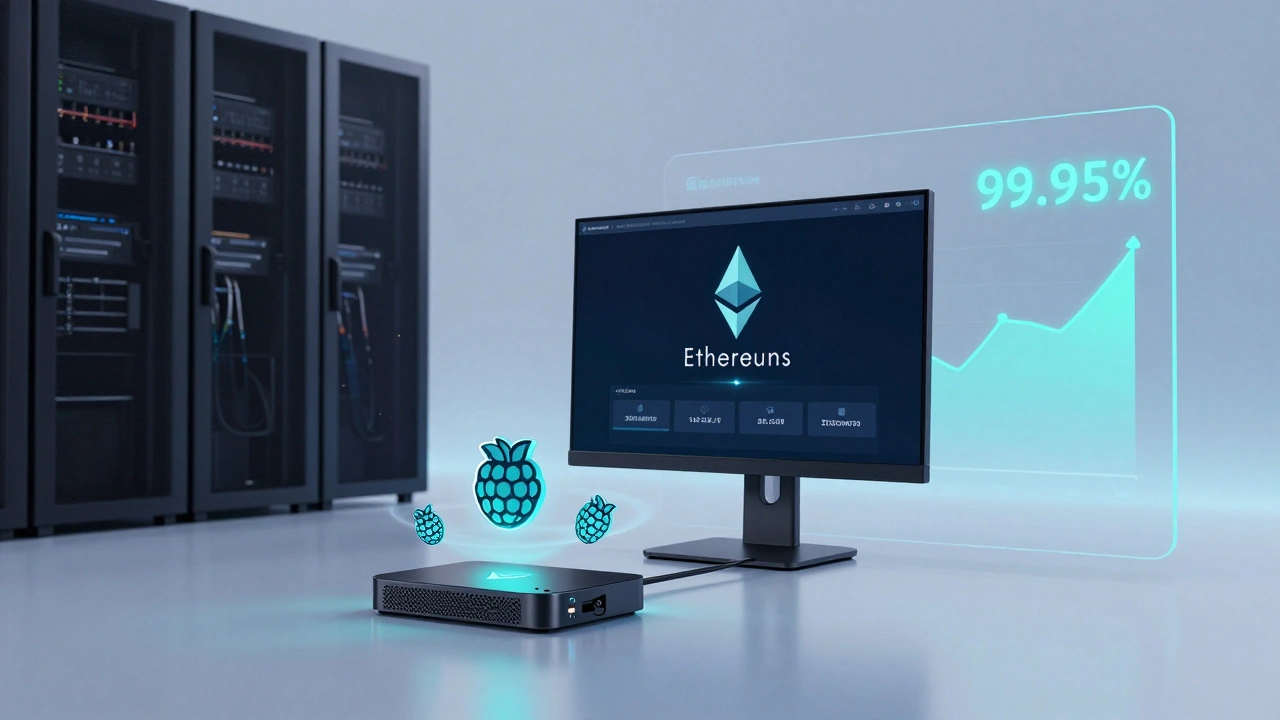
Ethereum’s shift to PoS didn’t just save energy. It changed the economics. You don’t need a warehouse of mining rigs. You just need a computer - even a $150 Raspberry Pi - and 32 ETH (about $59,840 as of November 2023). That’s a big barrier for most people. But you don’t have to stake alone. Services like Lido, Coinbase, and Kraken let you stake smaller amounts - even $10 - and split the rewards. They take a cut (5-7%), but you avoid the technical headache.
And the energy savings? Massive. Ethereum’s annual power use dropped from 77.84 TWh to just 0.0026 TWh after The Merge. That’s 2,000 times more efficient. The entire Ethereum network now uses less electricity than a single Google data center.
Other PoS chains are even more extreme. Cardano lets you stake with just 2 ADA - around $0.30. Solana, with its hybrid system, hits 65,000 transactions per second. That’s 9,000 times faster than Bitcoin.
Security: Is PoS Really as Safe as PoW?
This is the biggest question. If you don’t need expensive hardware to secure the network, how do you stop bad actors?
With PoW, an attacker needs to outspend everyone else on mining equipment. With PoS, they’d need to buy 51% of all the ETH in circulation. As of late 2023, that meant controlling $107 billion worth of Ethereum. That’s not just expensive - it’s nearly impossible. You’d have to buy up nearly half the entire market, which would drive the price up so much that your own stake would become worthless.
And PoS has built-in penalties. If a validator tries to validate two conflicting blocks - a double-spend attempt - they get slashed. Their stake is burned. That’s a real financial risk. In PoW, you could theoretically mine on two chains at once without losing anything. That’s called the “nothing at stake” problem. But PoS fixes it by making dishonest behavior costly.
Academic research from UC Berkeley in April 2023 confirmed that properly designed PoS systems can match PoW’s security - without the environmental cost. The Ethereum Foundation’s own post-Merge audits showed no increase in attack attempts. In fact, the network handled more transactions with less energy.
But here’s the nuance: PoW’s security is physical. You can see the machines. You can measure the power. PoS’s security is economic. It’s trust in math, incentives, and penalties. That’s harder for some people to grasp - and that’s why Bitcoin still holds onto PoW. It’s not just about technology. It’s about belief.
Centralization: The Hidden Risk in PoS
Proof-of-Stake isn’t perfect. One of its biggest weaknesses is stake centralization.
On Ethereum, the top 10 staking providers controlled 67.8% of all staked ETH as of September 2023. That means if one of them got hacked, went offline, or decided to act maliciously, the network could be disrupted. That’s not theoretical. In 2023, a major staking provider went down for 12 hours. The network kept running - but it caused panic.
Compare that to Bitcoin. There are over 10,000 active mining nodes spread across dozens of countries. No single entity controls more than 15% of the hash rate. The system is decentralized by design - because it’s too expensive for one player to dominate.
But PoS has tools to fight this. Cardano allows anyone to run a stake pool with just $0.30. Ethereum has a “decentralized staking” initiative that rewards smaller operators with extra rewards. And newer PoS chains like Algorand and Solana use different selection methods to reduce the risk of centralization.
Still, the fact remains: PoS makes it easier for big players to control the network. If you’re worried about who really runs the blockchain, PoW still wins on decentralization.
Real-World Adoption: Who’s Moving and Why
The market is speaking. And it’s choosing PoS.
As of November 2023, 58 of the top 100 cryptocurrencies by market cap use PoS or a variant. Only 21 still use PoW. That’s up from just 12% PoS adoption in 2020 to 47% today. The shift isn’t just happening - it’s accelerating.
Why? Three reasons: regulation, cost, and demand.
The European Union’s MiCA regulations, which took effect in January 2024, require crypto projects to disclose their carbon footprint. PoW networks now face legal pressure. Some exchanges in Europe have already delisted PoW coins.
Enterprise adoption is also shifting. Gartner found that 78 of the top 500 global companies are using PoS-based blockchains for supply chain tracking, identity verification, and digital contracts. Only 12 are using PoW. Why? Because PoS is cheaper, faster, and aligns with ESG goals. Investors don’t want to fund energy-guzzling tech.
Even Bitcoin miners are adapting. After The Merge, 89% of former Ethereum miners switched to other PoW chains like Ravencoin or Conflux. But even those chains are feeling the heat. Some are exploring hybrid models - using PoS for finality while keeping PoW for block creation.

What’s Next? The Future Beyond PoW and PoS
Neither PoW nor PoS is the final answer. Both are evolving.
Ethereum’s next upgrades - Verkle Trees and Danksharding - aim to make the network even faster and cheaper. Bitcoin’s Taproot upgrade in 2021 improved smart contract capabilities, but it’s still stuck in a slow, energy-heavy model.
Meanwhile, new systems are emerging. Solana’s Proof-of-History adds a time layer to speed up consensus. Filecoin uses Proof-of-Space-Time, where miners prove they’re storing data instead of solving math problems. IOTA uses a directed acyclic graph (DAG) - no blocks, no miners, no stakers.
By 2025, Gartner predicts 75% of new blockchain projects will use PoS or something similar. But PoW isn’t going away. It’s becoming the digital gold standard - the secure, slow, energy-intensive backbone for value storage. PoS is the engine for everything else: DeFi, NFTs, smart contracts, enterprise apps.
It’s not about which is better. It’s about which is right for the job.
Which Should You Use?
If you’re a miner? PoW is dying. The profits are gone. The hardware is obsolete. Unless you have access to near-free electricity, it’s not worth it anymore.
If you’re a regular crypto user? PoS is the future. You can stake with $10. You can earn 3-5% annual returns. You’re not powering a data center. You’re helping secure a network that’s clean, fast, and growing.
If you’re building a business? Use PoS. It’s cheaper, faster, and meets global regulations. No CFO wants to explain why their blockchain uses more power than a small country.
If you’re an investor? Bet on PoS. The market cap shift is real. The funding is flowing. The innovation is happening there.
And if you still believe in Bitcoin’s PoW model? You’re not wrong. It’s the most secure blockchain in existence. But security isn’t the only thing that matters anymore. Speed, cost, and sustainability are now part of the equation.
Is Proof-of-Stake more secure than Proof-of-Work?
Proof-of-Stake can be just as secure as Proof-of-Work - but it works differently. PoW relies on physical cost (hardware and electricity) to deter attacks. PoS uses economic penalties (slashing staked coins) to punish bad behavior. Ethereum’s PoS system has handled over $200 billion in value since The Merge without a major breach. Academic research confirms that well-designed PoS networks match PoW’s security guarantees. The difference isn’t in safety - it’s in how that safety is enforced.
Can I still mine Ethereum after The Merge?
No. Ethereum stopped using Proof-of-Work entirely after The Merge in September 2022. Any mining software claiming to mine Ethereum is either outdated or a scam. Former Ethereum miners moved to other PoW chains like Ravencoin, Ergo, or Bitcoin Cash. You can still mine Bitcoin or other PoW coins - but Ethereum is no longer an option.
How much money do I need to start staking Ethereum?
To run a solo validator on Ethereum, you need 32 ETH, which was about $59,840 as of November 2023. But you don’t need to stake that much yourself. Services like Lido, Coinbase, and Kraken let you stake any amount - even $10 - and earn a proportional share of rewards. They charge a fee (typically 5-7%), but they handle the technical setup for you.
Does Proof-of-Stake make crypto more centralized?
It can - and that’s a real concern. On Ethereum, the top 10 staking providers controlled nearly 68% of all staked ETH in late 2023. If one fails or acts maliciously, it could impact the network. However, PoS networks are actively working to fix this. Cardano allows staking with just $0.30. Ethereum offers bonus rewards to small operators. Newer chains use different validator selection methods to reduce centralization. It’s not perfect - but it’s being improved.
Why did Ethereum switch from Proof-of-Work to Proof-of-Stake?
Ethereum switched because Proof-of-Work was too slow and too energy-intensive. The network was processing only 30-50 transactions per second, while global demand kept growing. Meanwhile, Bitcoin’s energy use was drawing criticism from regulators, investors, and environmental groups. The Merge allowed Ethereum to scale better, reduce energy use by 99.95%, and prepare for future upgrades like sharding. It was a strategic move to stay relevant, not just a technical one.
Is Proof-of-Work dead?
No - but it’s becoming niche. Bitcoin still runs on PoW, and it’s the most valuable cryptocurrency by market cap. PoW is the gold standard for security and decentralization. But for new projects, it’s increasingly seen as outdated. Regulatory pressure, environmental concerns, and the rise of faster, cheaper alternatives mean PoW will likely remain limited to store-of-value applications like Bitcoin - not everyday transactions or smart contracts.
8 Responses
So PoW is basically the crypto equivalent of a gas-guzzling SUV - iconic, nostalgic, and completely out of touch with the future. Meanwhile, PoS is the Tesla that just got a 99.95% efficiency upgrade and now runs on solar-powered hamsters. 🤖⚡️ I mean, if you’re still mining Bitcoin in 2025 like it’s 2017, you’re not a HODLer - you’re a fossil fuel enthusiast with a GPU collection.
But what if the ‘security’ of PoS is just an illusion built on trust in centralized staking pools? What if the real attack vector isn’t 51% of ETH - but 51% of Lido’s governance votes? The math looks clean… until you realize the validators are just corporate subsidiaries with VC backing. We’re not decentralizing. We’re rebranding.
Bro, PoW is dead. Get over it. I used to mine ETH on a 3080 - now I’m staking $50 on Coinbase and getting 4.2% APY while my laptop idles. The miners? They’re all mining Ravencoin now, pretending it’s a comeback. Newsflash: it’s not. The market’s moved on. Stop crying about your ASICs and start staking.
Uhh… PoS is a central bank model disguised as decentralization. The 32 ETH barrier? That’s a gatekeeping mechanism. And those staking pools? They’re just oligarchs with better PR. The Ethereum Foundation is basically the Fed now. And if you think ‘slashing’ prevents attacks - lol. They just need to bribe the validators. It’s all a simulation. 🌐👁️🗨️
I just wanted to say thank you for explaining this so clearly. I used to think crypto was just a bunch of tech bros with expensive GPUs. Now I get why PoS makes sense - and why I can actually participate without going broke. 💛
Wait so if I stake $10 on Lido, I’m literally helping secure the network? Like… I’m part of the guard now? That’s wild. I thought you needed to be some kind of hacker or billionaire. I’m just a librarian who bought ETH during the last dip. 😅
Interesting analysis. But let’s not ignore the environmental impact of ASIC manufacturing and e-waste from obsolete miners. PoS doesn’t just save energy - it reduces electronic pollution. Also, 32 ETH is high, but pooled staking democratizes access. The real issue is education - not accessibility. 🙏
Okay, but what if the entire PoS system is a psyop by the IMF and the World Bank to control digital money under the guise of ‘sustainability’? Think about it - they shut down PoW because it was decentralized and untraceable, and now PoS lets them monitor every validator, track every transaction, and freeze accounts with a single command. The Merge wasn’t about energy - it was about control. They’re building a blockchain surveillance state, and you’re all clapping because you got a 4% yield. 🤖📉 The machines are learning. The machines are watching. The machines… are staking.