
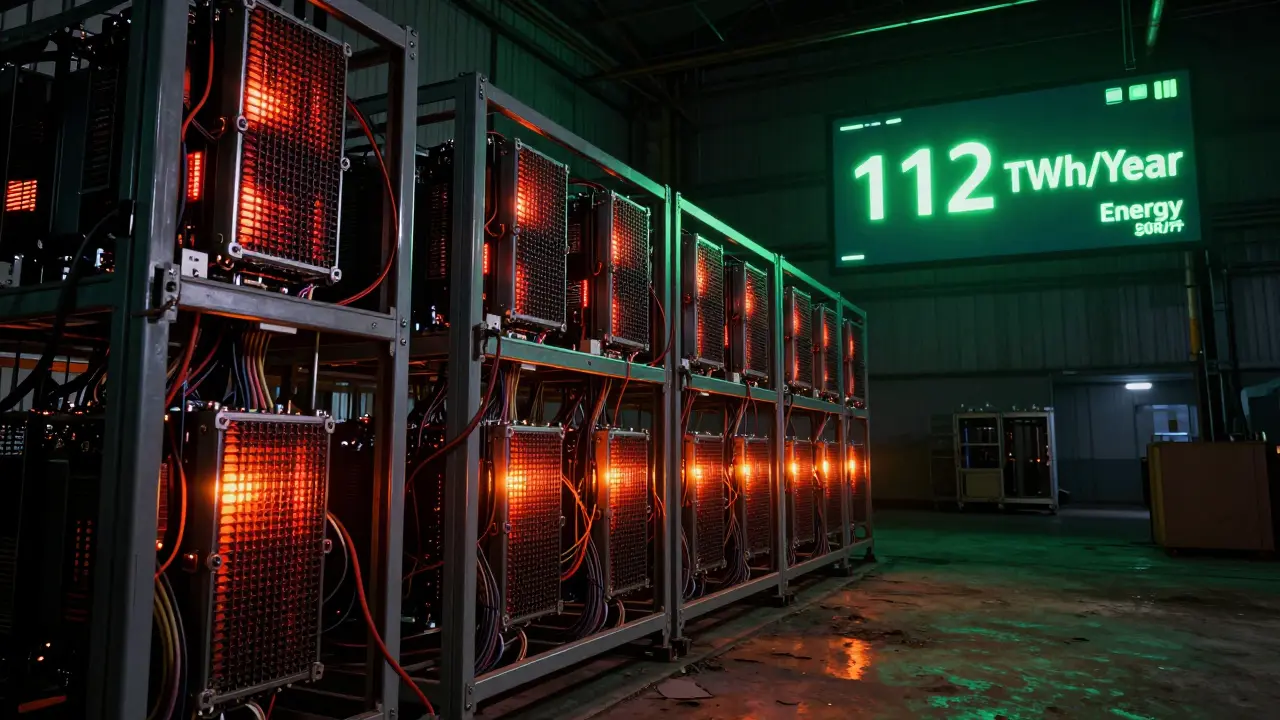
When you hear about Bitcoin mining, you might picture a warehouse full of loud, humming machines. That’s not just a movie scene-it’s real. These machines are burning through electricity at a scale that rivals entire countries. Meanwhile, another kind of blockchain runs quietly on a regular laptop, using less power than a light bulb. The difference? Proof of Work versus Proof of Stake. One is energy-hungry. The other is lean. But which one is better? And what are you really trading when you choose between them?
How Proof of Work Burns Energy
Proof of Work (PoW) is how Bitcoin and many early blockchains keep their ledgers secure. Miners compete to solve cryptographic puzzles. The first to solve it gets rewarded with new coins. Sounds fair? It is. But here’s the catch: every single miner is doing the same work, over and over. Only one wins. The rest? Their electricity bills are still due.
Bitcoin alone uses about 112 terawatt-hours of electricity per year. That’s more than the entire country of the Czech Republic. Each Bitcoin transaction emits roughly the same carbon as driving a gas car for 500 miles. And it’s not just power-it’s heat, hardware, and waste. Every year, Bitcoin mining throws away 39 kilotons of electronic gear. Think of it like replacing every smartphone in Australia every few months, just to keep one blockchain running.
Why does this happen? Because PoW is a race. You need the fastest, most powerful rigs. That means ASICs-specialized mining chips that cost thousands of dollars. They’re loud, hot, and short-lived. Most end up in landfills. Even if miners try to use renewable energy, the system itself demands constant, massive power. It’s like building a highway that only one car uses-but you still pave it for 10,000 cars.
Proof of Stake: The Quiet Alternative
Proof of Stake (PoS) doesn’t need a race. It doesn’t need powerful machines. Instead, it picks validators based on how much cryptocurrency they already own and are willing to lock up as collateral. Think of it like a lottery-your odds of being chosen depend on how many tickets you hold. No brute force. No overheating rigs.
Ethereum’s switch from PoW to PoS in 2022 cut its energy use by 99.95%. That’s not a marketing claim-it’s a hard number. Before the switch, Ethereum used as much power as a small country. After? It uses less than a single data center. The entire PoS ecosystem-Ethereum, Solana, Polkadot, Cardano-combined uses less energy than 200 U.S. households.
Carbon emissions? PoS networks like Polkadot produce under 33 tons of CO2 per year. Bitcoin? Over 62,000 tons. That’s a difference of more than 1,800 times. PoS doesn’t need giant mining farms. It doesn’t need cooling systems. It runs on standard servers, or even a laptop. The physical footprint? Tiny. The environmental cost? Almost negligible.

Security: Who’s Really Safer?
One of the biggest arguments for PoW is security. The idea is simple: attacking Bitcoin would cost billions in hardware and electricity. It’s expensive. So expensive, it’s not worth it. That’s why Bitcoin has never been hacked at the protocol level.
PoS doesn’t rely on cost. It relies on economics. If you try to cheat on a PoS chain, you risk losing your staked coins. That’s a strong deterrent. But here’s the twist: PoS has a different kind of vulnerability. In PoW, if someone tries to create a fake chain, they have to out-mine everyone else. In PoS, they can try to validate multiple chains at once-called "nothing-at-stake" attacks. There’s no cost to trying. That’s why PoS networks use slashing penalties: if you act dishonestly, you lose part of your stake. It works, but it’s not as intuitive as "it costs too much to attack."
Real-world proof? Bitcoin’s PoW has held for over 14 years. Ethereum’s PoS has held for over two. Both are secure. But they’re secure in different ways. PoW is like a fortress with thick walls. PoS is like a bank vault with motion sensors and automatic locks. One is brute force. The other is smart design.
Decentralization: Power to the People?
PoW sounds like the ultimate decentralizer. Anyone can buy a miner and join. Right? Not quite. The reality is brutal. Most Bitcoin mining is controlled by a handful of large mining pools, mostly in the U.S., Kazakhstan, and Russia. Why? Because you need cheap electricity and big warehouses. Small miners can’t compete. The barrier to entry isn’t just technical-it’s financial.
PoS, on the other hand, lets anyone with a few hundred dollars in crypto become a validator. You don’t need a warehouse. You don’t need a power plan. You just need to hold the coins and run a node. That sounds more democratic. But here’s the catch: the rich get richer. If you have 10,000 ETH, you earn more than someone with 10 ETH. Over time, wealth concentration can grow. That’s not a flaw in the code-it’s a feature of economics.
So which is more decentralized? PoW started that way. But now? It’s centralized by cost. PoS started as open. But now? It’s centralized by wealth. Neither is perfect. But PoS at least lets more people try. And it doesn’t require a power plant to join.

The Bigger Picture: What’s Really Changing?
The shift from PoW to PoS isn’t just about saving electricity. It’s about rethinking what blockchain is for. PoW was built for trustless, permissionless systems. But it came with a hidden tax: the planet. PoS says: we can keep trust without the waste.
Regulators are noticing. New York banned new PoW mining operations. The EU’s MiCA law requires crypto projects to prove their environmental impact. Even Wall Street firms like Fidelity now openly prefer PoS. Why? Because the math doesn’t lie. PoW’s energy use is unsustainable. PoS’s is not.
Some still argue: "But Bitcoin is digital gold. It needs to be secure at all costs." Maybe. But what if that cost is no longer acceptable? Climate change isn’t waiting for us to optimize mining efficiency. We’re past the point where "it’s getting greener" is enough. We need systems that were designed to be green from the start.
What’s Next?
Bitcoin isn’t going away. But the future of blockchain is clearly PoS. New projects? Almost all use PoS. Upgrades? PoW networks are being phased out. Even Ripple, which never used PoW, is now pushing for PoS adoption across the industry.
The real question isn’t whether PoS is better for the environment. It’s whether we’re willing to accept that security and decentralization don’t have to come at the cost of the planet. The answer, for most developers and users, is already yes.
Is Proof of Work really that bad for the environment?
Yes, especially at Bitcoin’s scale. Bitcoin mining uses more electricity annually than most countries, emits over 62,000 metric tons of CO2, and generates nearly 40,000 tons of e-waste each year. Even if miners use renewables, the system’s design demands constant, massive energy input-making it inherently wasteful compared to alternatives.
Can Proof of Stake be hacked?
PoS isn’t immune to attacks, but it makes them expensive in a different way. Instead of needing expensive hardware, attackers must hold a large amount of the network’s native coin. If they try to cheat, they risk losing their entire stake through slashing penalties. This economic disincentive has proven effective so far, with no major PoS chain successfully compromised.
Why did Ethereum switch from PoW to PoS?
Ethereum switched to reduce its energy use by over 99%. Before the switch, it used as much power as a small country. After, it uses less than a single data center. The move was also about scalability, cost, and sustainability. It proved that major blockchains can evolve without sacrificing security.
Does Proof of Stake make crypto less decentralized?
It can, if wealth concentrates. PoS lets anyone with enough coins become a validator, but those with more coins earn more rewards. Over time, this can lead to centralization around large holders. However, unlike PoW-which is dominated by corporate mining farms-PoS still allows small participants to join with modest stakes. The trade-off is wealth vs. hardware, not access vs. exclusion.
Are there any PoW blockchains still worth using?
If you value proven security above all else, Bitcoin remains the most battle-tested PoW chain. But for most applications-DeFi, NFTs, smart contracts-PoS networks like Ethereum, Solana, or Polygon offer faster, cheaper, and far greener alternatives. Unless you’re specifically seeking Bitcoin’s scarcity model, there’s little reason to choose PoW today.
13 Responses
Bitcoin's energy use is a legitimate concern. But let's not pretend PoS is some magic bullet. Validators still need hardware. Servers still draw power. The math looks better, sure-but it's still electricity. And someone's still paying the bill.
PoS is just centralized control with a fancy name the elites want you to believe in
It's honestly disturbing how many people treat blockchain like it's immune to real-world consequences. We're talking about planetary-scale resource consumption here. And yet, some still defend PoW like it's a moral imperative. What are we protecting? A speculative asset? Or our collective future?
I get both sides. PoW feels like the OG way, but PoS just makes more sense now. Less noise, less waste, same security. Why cling to the loud, expensive version when the quiet one works better?
PoS is a scam the big players invented to lock out normal people. They own the coins so they own the chain. Bitcoin at least let anyone with a GPU try
Every time I see another PoW miner bragging about their 'energy efficiency,' I want to scream. Efficiency? You're burning 112 TWh a year. That's not efficiency. That's a planetary emergency wearing a Bitcoin hoodie. We're not optimizing mining-we're delaying the inevitable.
Actually, the claim that Bitcoin generates 39 kilotons of e-waste annually is misleading. The source? A 2021 study that didn't account for hardware reuse or repurposing. You're oversimplifying a complex supply chain. And don't even get me started on PoS's server lifecycle emissions.
Security isn't just about cost-it's about incentives. PoW makes attack expensive. PoS makes betrayal costly. One uses physical force. The other uses economic gravity. Both work. But PoS doesn't require you to destroy the planet to defend a ledger. That's not a trade-off. That's evolution.
why do people care so much about mining? just use ethereum
Can we just acknowledge that PoW is the digital equivalent of burning forests to power a toaster? I mean, we have solar panels. We have wind. We have *brains*. And yet we're still running a 2010s energy hog like it's sacred? It's not devotion-it's denial.
I don't like how aggressive the conversation has become. Both systems have value. Maybe we don't need to choose one. Maybe we just need to stop pretending the other is evil.
Canada's grid is 80% hydro. US miners are just using our clean power. Stop whining about energy use-you're mad because we're doing it better
Been running a node on an old Raspberry Pi for a year. Zero drama. Zero noise. Zero electricity bill spikes. PoS isn't perfect. But it's quiet. And that's kinda beautiful.