
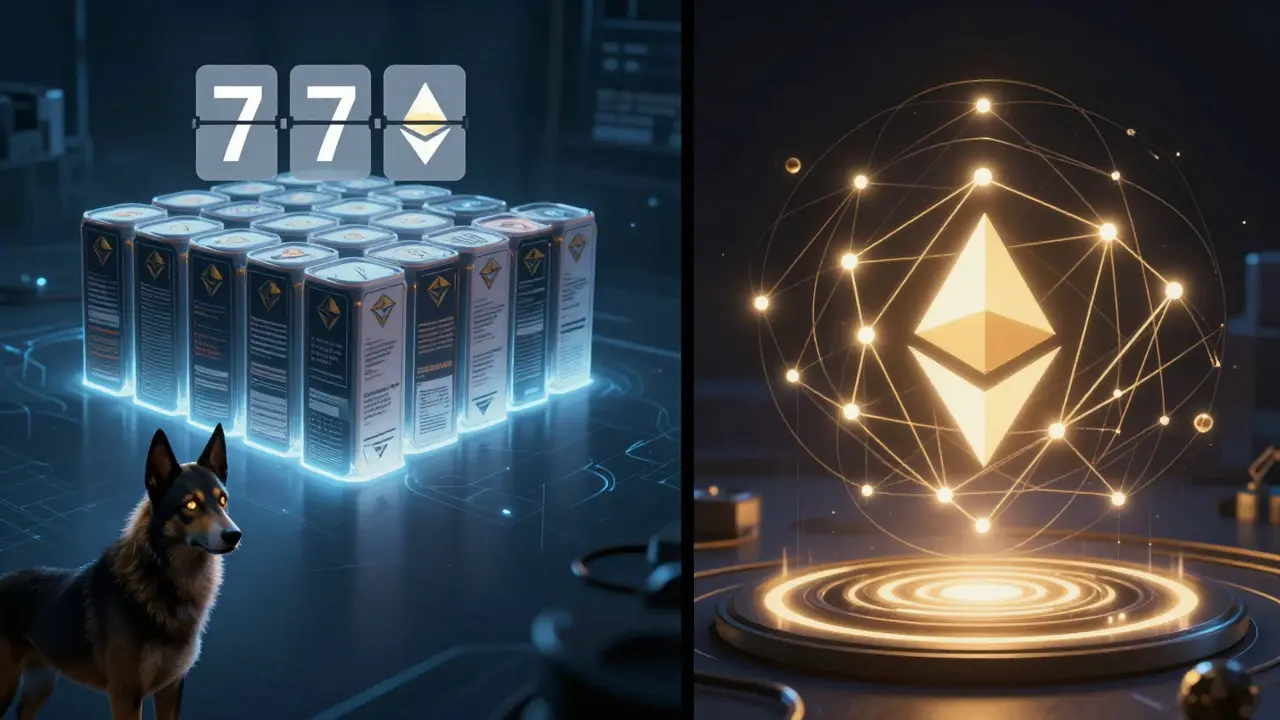
When Ethereum started getting crowded, transaction fees shot up and speeds slowed down. That’s when Layer 2 solutions like rollups came in to save the day. But not all rollups are the same. Two main types dominate the scene: optimistic rollups and zero-knowledge rollups. They both aim to make Ethereum faster and cheaper, but they do it in completely different ways. If you’re using DeFi, trading NFTs, or just sending ETH, knowing which one you’re on matters - because it affects how fast your money moves, how secure it is, and how much it costs.
How Optimistic Rollups Work
Optimistic rollups operate on a simple idea: assume everything is fine until someone proves it’s not. When you send a transaction on an optimistic rollup, it gets bundled with dozens or hundreds of others off-chain. These batches are then posted to Ethereum as calldata - basically, a public record of what happened. But here’s the twist: no one checks if those transactions are valid right away.
Instead, the system waits. For seven days. That’s the challenge period. During that time, anyone can submit a fraud proof if they spot a bad transaction. If someone does, the rollup rolls back the fraudulent batch and penalizes the bad actor. It’s like having a watchdog that only barks when something’s wrong. Most of the time, the watchdog stays quiet. That’s why it’s cheap: no heavy math, no complex proofs. Just simple data storage and occasional checks.
This design makes optimistic rollups incredibly efficient for high-volume use cases. Gas costs for batching transactions are around 40,000 gwei, compared to 500,000 gwei for zero-knowledge rollups. That’s a 12.5x difference. For users doing frequent trades or small payments, that adds up fast. Projects like Arbitrum and Optimism run on this model - and they handle billions in daily activity.
How Zero-Knowledge Rollups Work
Zero-knowledge rollups take a totally different approach. Instead of waiting for fraud, they prove everything is correct before even posting to Ethereum. They use something called zero-knowledge proofs - a cryptographic magic trick that lets you prove a statement is true without revealing the details.
Think of it like proving you know a secret password without saying the password out loud. A zk-rollup takes a batch of transactions, runs a complex mathematical proof on them, and submits just that proof to Ethereum. The Ethereum smart contract checks the proof. If it’s valid, the whole batch is accepted. No waiting. No challenge period. Instant finality.
This means users can withdraw their funds in minutes, not days. It also means less data is stored on Ethereum - only the proof, not the full transaction history. That’s a big win for scalability. But there’s a cost: generating these proofs is computationally intense. It needs powerful hardware, specialized software, and serious processing power. That’s why zk-rollups are harder to build and more expensive to run.
StarkNet and zkSync are leading examples. They’re gaining traction fast, especially for applications where speed and privacy matter - like high-frequency trading or private payments.
Speed and Finality: The Waiting Game
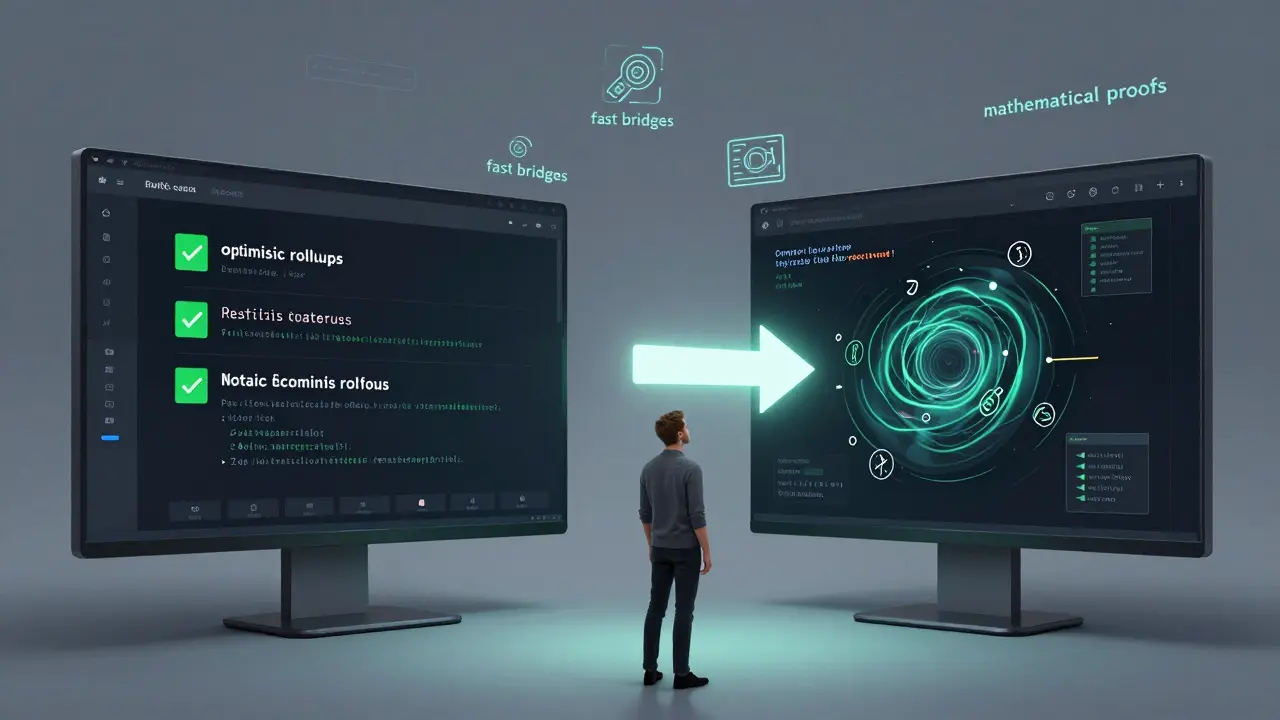
This is where the two really split apart. With optimistic rollups, you’re stuck waiting seven days to withdraw funds. Why? Because the system needs time to make sure no one files a fraud claim. If you’re moving money out of a rollup to pay bills or buy something on Ethereum, that delay can be frustrating. Some services offer “fast bridges” that let you withdraw early - but they charge fees and require trust in third parties.
Zero-knowledge rollups don’t have this problem. Since validity is proven mathematically before submission, withdrawals are near-instant. You submit your withdrawal request, the proof is verified, and your ETH is on Ethereum within minutes. For users who value predictability and speed, this is a huge advantage.

Cost: Cheaper Now, More Expensive Later?
Optimistic rollups win on cost - hands down. Because they don’t need to generate complex proofs, their operational overhead is low. Transaction fees on Arbitrum are often 10x cheaper than on Ethereum mainnet. Even with the seven-day wait, users get massive savings.
Zero-knowledge rollups, on the other hand, require expensive computation. Generating a zk-proof can cost hundreds of dollars in server time. That cost gets passed down - either as higher fees or slower throughput. Right now, zk-rollups are more expensive to operate. But here’s the catch: as the tech improves, that gap is closing. New proof systems like zk-SNARKs and zk-STARKs are getting faster and cheaper. Some experts believe that within a few years, zk-rollups could become more cost-efficient than optimistic ones - not because they’re cheaper to run today, but because they use far less Ethereum data space.
Security: Trust vs Math
Optimistic rollups rely on vigilance. They assume there’s at least one honest actor watching the chain. If no one checks, a bad actor could slip through. While this hasn’t happened yet (thanks to economic incentives for validators), it’s a theoretical risk. If the network gets too small or too centralized, the fraud-proof system weakens.
Zero-knowledge rollups don’t have that problem. Their security is mathematical. If the proof checks out, the transaction is valid - no exceptions. There’s no need to trust anyone. The math does the work. That makes zk-rollups more secure in theory. But they’re not bulletproof. If the proving system has a bug, or if the cryptographic assumptions break down, the whole thing could fail. Still, for most users, that’s a lower risk than relying on human watchdogs.
Adoption and Maturity
Right now, optimistic rollups dominate. Why? Simplicity. They were the first to launch at scale. Arbitrum and Optimism have been live for years. Developers know how to build on them. Tools are mature. EVM compatibility is near-perfect - meaning most Ethereum apps work out of the box.
Zero-knowledge rollups are catching up fast. But they’re harder to build on. Writing smart contracts for zk-rollups often requires learning new languages like Cairo or Rust. Tooling is improving, but it’s not as polished. Still, projects like zkSync and StarkNet are attracting big names - from major exchanges to institutional investors.
And then there’s the long-term view. Ethereum co-founder Vitalik Buterin has said he believes zk-rollups will win in the end. Why? Because they’re more scalable. They don’t need to store every transaction on-chain. As Ethereum’s data capacity gets tighter, that efficiency could become critical.
Which One Should You Use?
Here’s the practical breakdown:
- If you’re doing frequent trades, small payments, or just want the cheapest fees - go with an optimistic rollup. Arbitrum, Optimism, Base - they’re all solid choices.
- If you need fast withdrawals, care about privacy, or are building something that needs guaranteed finality - pick a zk-rollup. zkSync or StarkNet are your best bets.
- If you’re a developer - start with optimistic rollups. They’re easier to learn and deploy. Once you’re comfortable, explore zk-rollups for advanced use cases.
Most users won’t even notice the difference. Apps hide the underlying tech. But if you’re moving large amounts, withdrawing often, or just want to understand what’s happening under the hood - knowing which rollup you’re on makes all the difference.
The Future: One Winner or Both?
It’s not a race to the finish. More likely, both will coexist. Optimistic rollups will keep dominating for everyday use - cheap, simple, and familiar. Zero-knowledge rollups will take over where speed, privacy, and data efficiency matter most.
And as zk-proof tech improves - with better hardware, optimized algorithms, and standardized tools - the gap will shrink. We might even see hybrid systems soon: optimistic rollups using zk-proofs for certain high-value transactions. The future isn’t about one winning. It’s about choosing the right tool for the job.
12 Responses
Honestly, this is one of the clearest breakdowns I’ve read. I’ve been using Arbitrum for swaps and never realized how much I was saving until I compared gas costs. That 12.5x difference? Yeah, that’s why I don’t touch mainnet unless I have to. Zero-knowledge rollups sound cool, but if I’m trading $50 worth of tokens daily, I’ll take cheap and slow over expensive and fast every time.
Also, love how you mentioned the withdrawal delay - that’s the real pain point for people trying to pay rent or buy something in real time. Fast bridges are a band-aid, not a solution.
So let me get this straight - optimistic rollups are like ‘trust but verify’ and zk-rollups are like ‘I already proved it to myself, here’s the receipt.’
Bro, if you’re still arguing about which one’s better, you’re missing the point. It’s not a war. It’s a toolbox. Use the hammer when you’re nailing, use the screwdriver when you’re screwing. Stop trying to make Ethereum into a religion.
i read this whole thing and honestly? i think we’re overcomplicating it. like, sure, zk-proofs sound like magic, but if your dapp’s not even using 1% of the gas savings from optimistic rollups, why are we even talking about this? i just want to buy my nft and not wait 7 days for my eth to come back. also, ‘calldata’? sounds like a typo for ‘call data’ but whatever, i’m not here to be a grammar cop.
The EVM compatibility point is HUGE. I’ve been trying to deploy a simple staking contract on zkSync and it’s been a nightmare - Cairo syntax, weird opcode constraints, tooling that breaks if you blink. Meanwhile, I spun up a clone of Uniswap V3 on Arbitrum in 2 hours. Don’t get me wrong, zk-rollups are the future, but right now? They’re like beta software with a PhD. Also, ‘zero-knowledge’ is just crypto-speak for ‘I don’t want to tell you how I know this is true.’
You say ‘optimistic rollups rely on vigilance’ - as if that’s a feature. It’s a vulnerability. It’s literally gambling that someone with enough skin in the game will care enough to check. Meanwhile, zk-rollups use mathematical certainty. That’s not ‘more secure’ - it’s the only way security should ever be implemented. If you’re okay with a 7-day window where your funds are theoretically stealable, you’re not a DeFi user. You’re a masochist with a wallet.
Also, ‘calldata’ is not a typo. It’s the Ethereum term. Learn it.
I’ve been on both. Let me tell you - zk-rollups are the future, and anyone who says otherwise is just scared of change. You think Arbitrum is cheap? Try using it during a NFT mint. Gas spikes, MEV bots eat your transactions, and you’re left wondering if you just threw away $20 on a failed swap. Meanwhile, zkSync gives me instant finality and privacy. No one knows how much I sent, to whom, or when. That’s power. That’s freedom. And yeah, it costs more - but so does peace of mind.
I am not a developer, but I have been following this space for years. I think the real issue is not which rollup is better, but whether we are building systems that serve the people or just the technologists. Many users don’t care about zero-knowledge proofs or calldata. They just want to send money to their cousin in Delhi without paying $15 in fees. The fact that optimistic rollups solved that problem first - and still do - is not a weakness. It is a triumph of practical engineering over theoretical elegance. I hope we don’t lose sight of that as we chase the next shiny thing.
Oh honey, you think zk-rollups are expensive? Try building a dApp on them with a $500/month cloud budget. I’ve seen devs cry over proving circuits. Meanwhile, Arbitrum devs are sipping matcha and deploying smart contracts like they’re posting memes. And don’t even get me started on the ‘instant finality’ - yeah, sure, but what if your withdrawal gets stuck because the sequencer’s on vacation? Optimistic rollups at least have that 7-day window to scream into the void and get help. ZK? You’re on your own. The math doesn’t care if you’re broke.
I just want to say - this whole debate feels like arguing over whether to use a fork or a spoon. Both get food to your mouth. The real question is: why are we still eating from the same plate? We need interoperability. We need bridges that work like USB-C. Why can’t I send ETH from zkSync to Arbitrum without paying $50 in gas and waiting 3 days? The tech is there. The will isn’t. We’re stuck in rollup silos because nobody wants to standardize. Let’s stop worshiping the tool and start building the highway.
As a long-time follower of Ethereum’s evolution, I find this comparison both insightful and timely. The dichotomy between optimistic and zero-knowledge rollups reflects a deeper philosophical tension in decentralized systems: trust versus verification, speed versus certainty. While optimistic rollups have demonstrated remarkable scalability and adoption, the inherent reliance on external validators introduces a subtle centralization vector. Zero-knowledge rollups, by contrast, anchor security in immutable mathematical principles - a paradigm more aligned with the original ethos of blockchain. That said, the current barriers to developer adoption cannot be ignored. The path forward lies not in choosing one, but in harmonizing their strengths - perhaps through hybrid architectures where zk-proofs validate high-value transactions, while optimistic mechanisms handle the bulk. The future is pluralistic.
The technical superiority of zero-knowledge rollups is undeniable. The cryptographic integrity of zk-SNARKs and zk-STARKs ensures that the integrity of the state transition is preserved without requiring any assumption of honesty among network participants. This is not merely an incremental improvement - it is a foundational shift toward verifiable computation at scale. While operational costs remain higher today, the trajectory of proof-generation efficiency is exponential. As hardware accelerators and circuit optimization mature, zk-rollups will inevitably dominate. The question is no longer ‘if,’ but ‘when.’ Institutions are already preparing for this transition. The time to adapt is now.
I mean, honestly, if you're still using Optimistic Rollups in 2025, you're basically choosing to live in 2021. Zero-knowledge is the future. Period. You think gas fees are high now? Wait until you're stuck on a chain that requires you to trust strangers to keep your money safe. It's not just about speed - it's about dignity. Your funds should not be hostage to whether some random validator had coffee that morning. ZK-rollups don't ask for permission. They don't need to. The math is the law. And if you can't understand that? Maybe you shouldn't be holding crypto at all.