
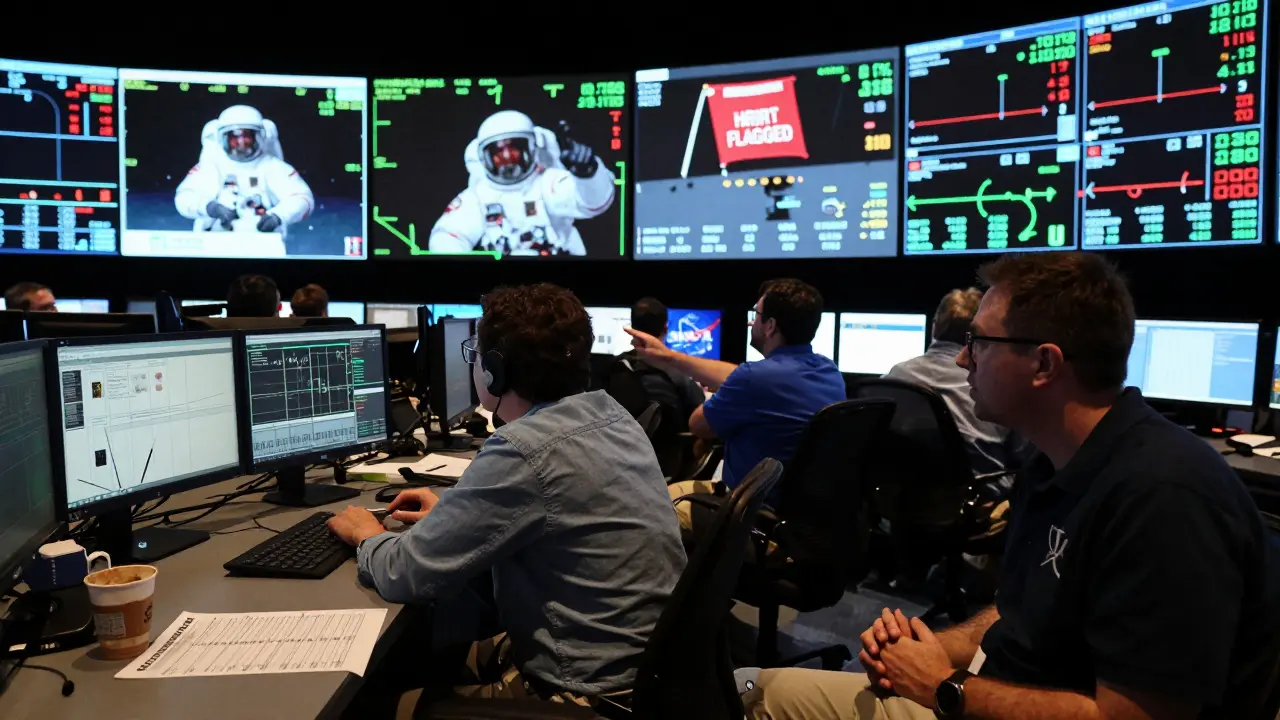
When you think about sending humans into space, you might picture astronauts floating in zero gravity or stepping onto the Moon. But behind every crewed launch is a hidden system of rules, tests, and approvals that exist for one reason: to keep people alive. Human-rating standards aren’t just guidelines-they’re the legal and technical backbone that turns a machine into a life-supporting vehicle. Without them, spaceflight would be a gamble. With them, it’s a calculated, rigorously monitored endeavor.
What Exactly Is Human-Rating?
Human-rating is the formal process of certifying that a spacecraft, rocket, or system can safely carry people. It’s not about being "good enough"-it’s about being reliable enough to handle failure without killing the crew. NASA developed this framework after the Challenger and Columbia disasters. The lessons were brutal: if you don’t design for failure, failure will kill you.
Today, human-rating means meeting over 300 core safety requirements under NASA-STD-3001 and NASA-STD-8719.29. These aren’t suggestions. They’re mandatory. Every critical system-life support, power, communications, abort mechanisms-must have backups. If one part fails, another must take over instantly. The goal? A maximum 1 in 500 chance of losing a crew member during launch or re-entry. That’s stricter than commercial aviation standards.
It’s not just about hardware. Human factors matter too. Seats must be positioned so astronauts can reach controls during high-G maneuvers. Displays must be readable under stress. Even the shape of a handhold is studied. NASA’s own research shows that 40% of in-flight errors stem from poor interface design, not technical failure. That’s why human-rating includes MIL-STD-1472, the military standard for human-systems engineering.
The Regulatory Framework: Who’s in Charge?
NASA doesn’t just set standards-it enforces them through a tightly structured chain of command. At the top is the NASA Associate Administrator for Space Flight (AA for OSF). This person has the final authority to certify any vehicle as human-rated. No flight happens without their signature.
Below them, the Associate Administrator for Safety and Mission Assurance (AA for SMA) reviews every human-rating plan. They decide whether any requirements can be adjusted-or "tailored." Tailoring isn’t a loophole. It’s a controlled exception. For example, if a new material reduces mass but doesn’t compromise safety, the AA for SMA can approve its use. But every change must be documented, justified, and signed off by the Chief Health and Medical Officer (CHMO) too.
The Human-Rating Independent Review Team (HRIRT) is the watchdog. Made up of engineers, safety experts, and former astronauts, they don’t work for the program team. They’re independent. They dig into software code, test logs, failure simulations, and even crew training records. Their job? To find what the program team missed. In 2021, HRIRT flagged a flaw in Orion’s parachute deployment sequence that had been overlooked for 18 months. That discovery delayed the Artemis I launch-but saved lives.
The 300% Rule: Why Human-Rating Costs So Much
Robotic missions need to survive. Human-rated missions need to survive-and bring people home. That difference changes everything.
Dr. James V. Hart, former Chief Engineer at Johnson Space Center, pointed out in a 2022 report that human-rated systems require about 300% more verification steps than uncrewed ones. Why? Redundancy. Testing. Monitoring. Escape systems. Every component has to be proven under extreme conditions: vacuum, radiation, vibration, thermal shock, and failure cascades.
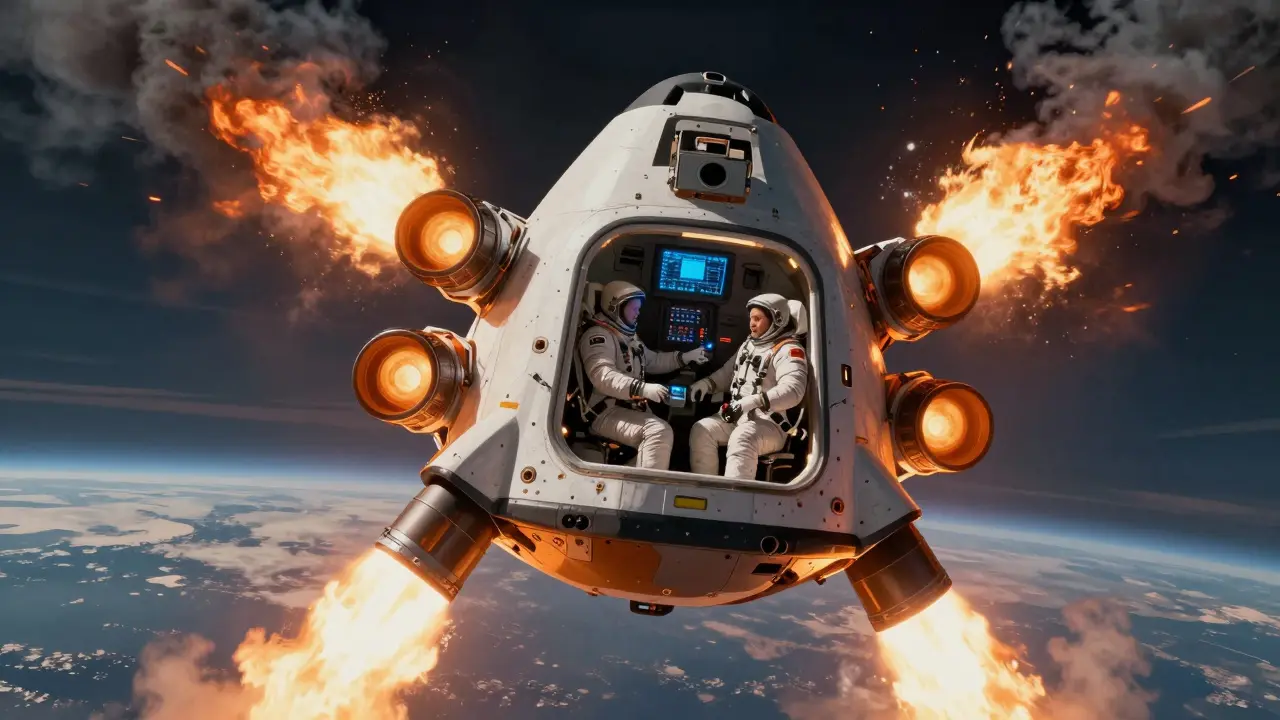
Take the abort system. For a robotic probe, if the rocket explodes, you lose data. For a crewed mission, you lose people. So every human-rated vehicle must have an abort system that works from liftoff to orbit-even during engine failure, structural breakup, or fire. SpaceX’s Crew Dragon has eight SuperDraco engines embedded in its walls. Boeing’s Starliner uses a separate launch abort system with three solid rocket motors. Both had to pass over 100 ground tests and simulations just to prove the abort system could save lives under 20 different failure scenarios.
And it’s not just hardware. Software must be certified to Level A-the highest safety level under DO-178C. That means every line of code is traced, tested, and reviewed by multiple independent teams. A single bug in the guidance system could mean the difference between a safe landing and a fatal crash. That’s why software verification alone can take years.
Health Risks: The Invisible Threats
Space isn’t just dangerous because of explosions. The biggest threats are slow, silent, and invisible.
NASA’s Human System Risk Board tracks 36 health risks. The top three:
- Acute Radiation Syndromes-1 in 250 missions could expose crew to lethal radiation doses during solar storms.
- Visual Impairment and Intracranial Pressure-1 in 50 missions result in fluid shifts that swell the optic nerve, blurring vision permanently.
- Crew Medical Events-1 in 10 missions will involve a serious medical issue: heart rhythm problems, kidney stones, or infections.
That’s why NASA-STD-3001 Volume 2 sets strict limits: no more than 50 millisieverts of radiation per year, and 250 millisieverts for the lens of the eye per mission. Crew members get medical scans before, during, and after flight. Medications are pre-loaded for emergencies. Even dental health is monitored-pressure changes can cause severe tooth pain in space.
And then there’s the psychological toll. Isolation, confinement, disrupted sleep cycles, and constant danger. NASA now requires crew members to undergo psychological screening every six months during training. They use VR simulations to test how they react under stress. It’s not just about being tough. It’s about being predictable under pressure.
Commercial Crew: The New Players
When SpaceX and Boeing started building crew capsules, they didn’t start from scratch. They used NASA’s human-rating rules as their blueprint. But they didn’t follow them exactly.
Dr. Patricia C. Robertson noted in a 2024 study that Boeing’s Starliner required 127 more verification tests than Crew Dragon. Why? Starliner’s design was based on older Apollo-era architecture. Crew Dragon, built from the ground up with modern avionics and software, had fewer legacy constraints. That gave SpaceX an edge in speed and cost.
But both had to meet the same federal standards. The FAA’s 14 CFR Part 460 requires commercial operators to prove crew members can survive 4g of acceleration during launch and 6g during abort. That’s tougher than most fighter jets. SpaceX had to redesign Crew Dragon’s seats after early tests showed astronauts couldn’t maintain consciousness during simulated aborts.
And cost? Human-rating adds about $450 million to a spacecraft’s price tag and stretches development by 22 to 30 months. That’s why only six vehicles have ever been certified: Soyuz, Shenzhou, Crew Dragon, Starliner, Orion, and Tianhe. The rest? Too expensive, too risky, or too slow.
The Future: From Rules to Real-Time Monitoring
The current system is rigid. It’s based on fixed requirements: "The cabin pressure must not exceed 0.5 psi." But what if the crew is healthy? What if their vitals show they can handle more stress?
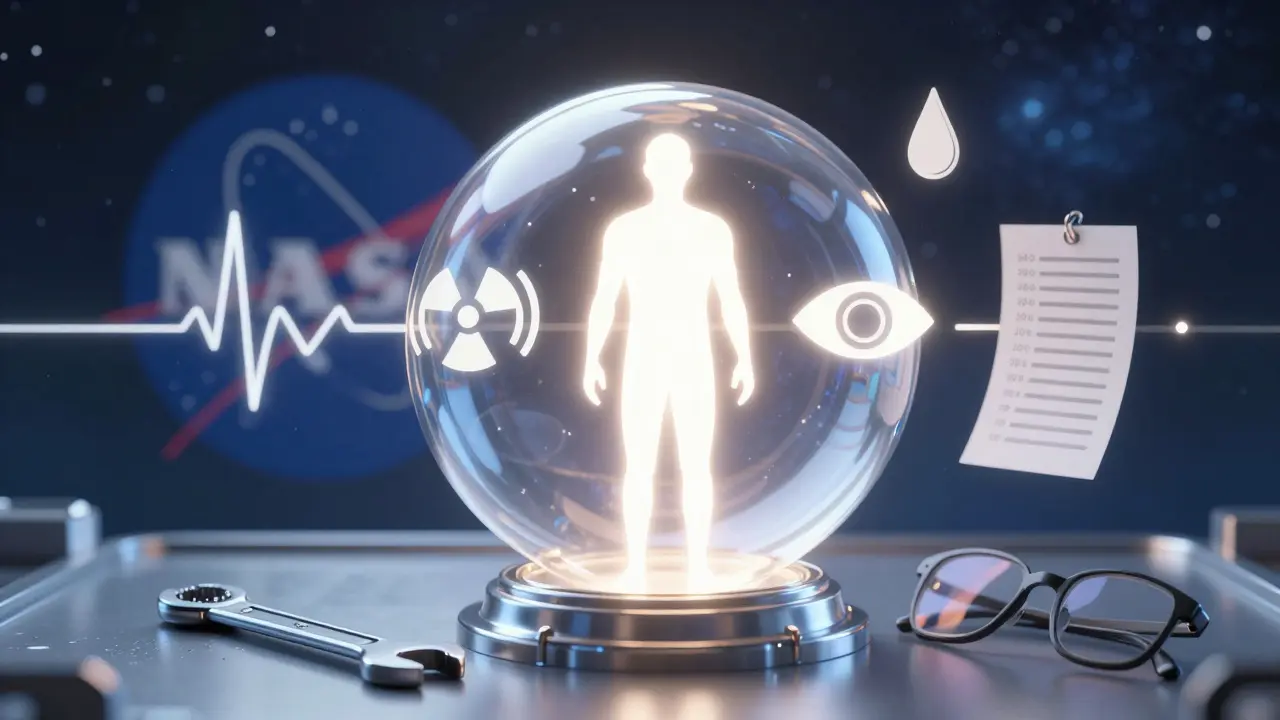
NASA is testing something called the Dynamic Human Rating framework. Instead of locking in safety margins at design, it uses real-time data from astronauts’ wearables-heart rate, blood pressure, oxygen levels, even eye movement-to adjust safety protocols on the fly. If an astronaut’s stress markers spike during a maneuver, the system could automatically reduce G-forces or delay a burn.
By 2030, experts predict human-rating will shift from prescriptive rules to performance-based outcomes. Instead of asking, "Did you test the abort system 50 times?" the question will be, "Did the system save lives in every simulated scenario?"
That’s a big change. But it’s necessary. As missions go farther-to the Moon, then Mars-the old checklist approach won’t cut it. We can’t test every failure mode on Earth. We’ll need systems that adapt, learn, and respond to real human conditions in real time.
Why This Matters
Human-rating isn’t just about engineering. It’s about ethics. Every time a rocket lifts off with people aboard, society is making a promise: we will do everything in our power to bring you home.
That promise is kept not by luck, but by thousands of hours of testing, millions of lines of code, and a regulatory system that refuses to cut corners. It’s slow. It’s expensive. It’s frustrating for engineers. But it’s the only way we can look an astronaut in the eye before launch and say, "We’ve done everything we can."
The next time you see a crewed launch, don’t just cheer the rocket. Remember the people behind the rules-the safety officers, the medical teams, the reviewers who stayed up all night checking a single valve’s tolerance. They’re the real heroes of human spaceflight.
What is the main goal of human-rating standards?
The main goal is to ensure that spacecraft and systems can safely carry humans by minimizing the risk of loss of crew to no more than 1 in 500 during critical flight phases. This is achieved through redundancy, fault tolerance, life support reliability, and rigorous testing of all systems under failure conditions.
Who has the final authority to certify a spacecraft as human-rated?
The NASA Associate Administrator for Space Flight (AA for OSF) holds the final authority to certify any spacecraft as human-rated. They must approve all human-rating plans, charter the Independent Review Team, and verify compliance before any crewed mission can proceed.
How do human-rating requirements differ from regular spacecraft certification?
Human-rating requires approximately 300% more verification steps than robotic missions. It adds mandatory redundancy, crew escape systems, human factors engineering, medical monitoring, and full failure-mode testing. Robotic missions only need to survive; human-rated systems must survive and bring people home-even when things go wrong.
What are the top three health risks for astronauts on crewed missions?
The top three health risks are: Acute Radiation Syndromes (1 in 250 mission probability), Visual Impairment and Intracranial Pressure (1 in 50), and Crew Medical Events like heart arrhythmias or infections (1 in 10). These are tracked and mitigated through NASA-STD-3001, medical screenings, and onboard health systems.
Why did Boeing’s Starliner need more tests than SpaceX’s Crew Dragon?
Starliner was based on older Apollo-era designs with legacy components, requiring more verification to meet modern human-rating standards. Crew Dragon was built from scratch using modern digital systems, which allowed for faster integration and fewer compatibility issues. As a result, Starliner underwent 127 additional human-rating tests to prove safety.
Will human-rating standards change in the future?
Yes. NASA is developing a Dynamic Human Rating framework that shifts from fixed rules to real-time, data-driven safety. Instead of rigid limits, future systems will adjust based on live astronaut health data-like heart rate, stress levels, and radiation exposure-to optimize safety without unnecessary conservatism. This approach will be critical for deep space missions to Mars.
16 Responses
Human-rating isn't just engineering-it's a moral contract with the people who climb aboard. We're not just building rockets; we're building promises. And every valve, every wire, every line of code? It's a whisper: 'I won't let you die.' That's the real weight behind those 300+ standards.
It's beautiful, in a grim way. The fact that we can look at a human life and say, 'This is worth the cost,' is what separates us from the machines we send to Mars.
And yet... we still cut corners. Always have. Always will. But at least now, we're honest about the cost.
My brother works in aerospace safety. He says the real heroes are the engineers who stay up until 3am checking if a bolt's torque spec is off by 0.02 Nm. No one sees them. No one cheers them. But they’re the ones keeping the astronauts alive.
It’s quiet work. But it’s everything.
So let me get this straight. We spend $450 million and 30 months just so people don’t die… but we still send them to space? What a brilliant use of resources.
Next up: mandatory oxygen masks on roller coasters. Because why not?
Honestly i never thought about how much work goes into making sure people dont die in space
like the seats being designed so you dont pass out during abort? that’s wild
and the dental thing? yeah i guess pressure changes would wreck your teeth
we take so much for granted
Every time I see a launch I think about how many people had to die before we got this far. Not just the astronauts, but the engineers, the testers, the ones who got fired for asking too many questions. The system isn’t perfect-it’s built on blood. And sweat. And sleepless nights. And grief.
And now we’re talking about real-time monitoring? Like we’re gonna track their vitals like a Fitbit? What if the system fails? What if the data’s wrong? What if they’re just tired and it thinks they’re in distress? We’re turning humans into sensors. And that’s the real danger.
They say we’re protecting lives. But are we just making them more predictable? More controllable? Less… human?
It is profoundly disingenuous to suggest that human-rating standards are somehow unique to NASA. The European Space Agency, Roscosmos, and CNSA all maintain equivalent, if not more stringent, regulatory frameworks. The notion that this is an American innovation is not only inaccurate-it is culturally myopic.
Furthermore, the use of the term 'ethical promise' is a rhetorical flourish, not a technical reality. The standards are codified, quantifiable, and enforceable-not moral imperatives.
One must be careful not to anthropomorphize bureaucracy.
They say 1 in 500 chance of death? That’s a lie. The real number is 1 in 2. They just hide the bodies. Look at the Shuttle. Look at Soyuz. Look at the ‘accidents’ they never talk about.
And don’t get me started on the ‘abort system.’ That’s just a fancy way of saying ‘we’re gonna blow you out of the sky if it goes wrong.’
They’re not keeping you safe. They’re keeping you quiet.
Why do you think they need so many backups? Because the government doesn’t trust the engineers. Or the contractors. Or the astronauts. Or even themselves.
Every single requirement? A reaction to a cover-up. Every test? A response to a lie.
They don’t want to keep you alive. They want to make sure if you die, they can point at a checklist and say ‘we followed the rules.’
That’s not safety. That’s liability.
The conceptual evolution from prescriptive to performance-based human-rating is not merely a technical advancement-it represents a paradigmatic shift in epistemological frameworks governing risk mitigation in extreme environments. The transition from static thresholds to dynamic, biometrically-informed adaptive protocols necessitates a reconfiguration of ontological assumptions regarding human-machine symbiosis.
Moreover, the integration of real-time physiological telemetry introduces a hermeneutic layer wherein the astronaut’s biological state becomes not merely a variable, but a constitutive element of the safety architecture itself.
This is not simply innovation-it is the emergence of a new epistemic regime in aerospace ethics.
Well said. This is the kind of work that deserves more attention.
They say 1 in 500 but what about the 1 in 1000 who come back with brain damage from radiation? What about the ones who never get to tell their kids they’re okay? The standards are a lie. They’re designed to make the public feel safe so they keep funding it.
And don’t even get me started on the fact that the same people who approve these systems are the ones who get bonuses if the launch happens on time.
It’s all a show.
Man i never realized how much of this is about trust
like the HRIRT team? They’re not just checking boxes-they’re saying ‘i believe you care enough to get this right’
and that’s rare
we need more of that in everything
so the dental thing? yeah i had a toothache once and it was bad but in space?? yikes
and the vr stress tests?? i bet that’s wild
imagine being stuck in a dark room for hours while your brain thinks you’re falling
they really think of everything
It’s disgusting how we glorify this. We send people into space because it’s ‘bold,’ but we don’t even fix the air quality in our own cities. We pour billions into making sure astronauts don’t die, while children in Flint still drink poison. This isn’t heroism-it’s hypocrisy dressed in a NASA jacket.
And don’t tell me it’s ‘necessary.’ It’s a distraction. A shiny toy to keep us from seeing the rot beneath.
America built this. The best. The toughest. The smartest. Other countries? They copy. They lag. They whine about ‘ethics’ while we make history.
Stop comparing. We’re not just launching rockets-we’re launching the future.
And no one else can do it like we do.
And that’s the real tragedy: we’ve built a system so good, so reliable, that we’ve forgotten how fragile it all is. We treat human-rating like a solved problem. But it’s not. It’s a living thing. Every launch is a new experiment. Every astronaut is a variable we can’t fully control.
That’s why we need the HRIRT. That’s why we need the slow, boring, unglamorous checks.
Because if we ever stop believing in the weight of a single life… we stop being human.