
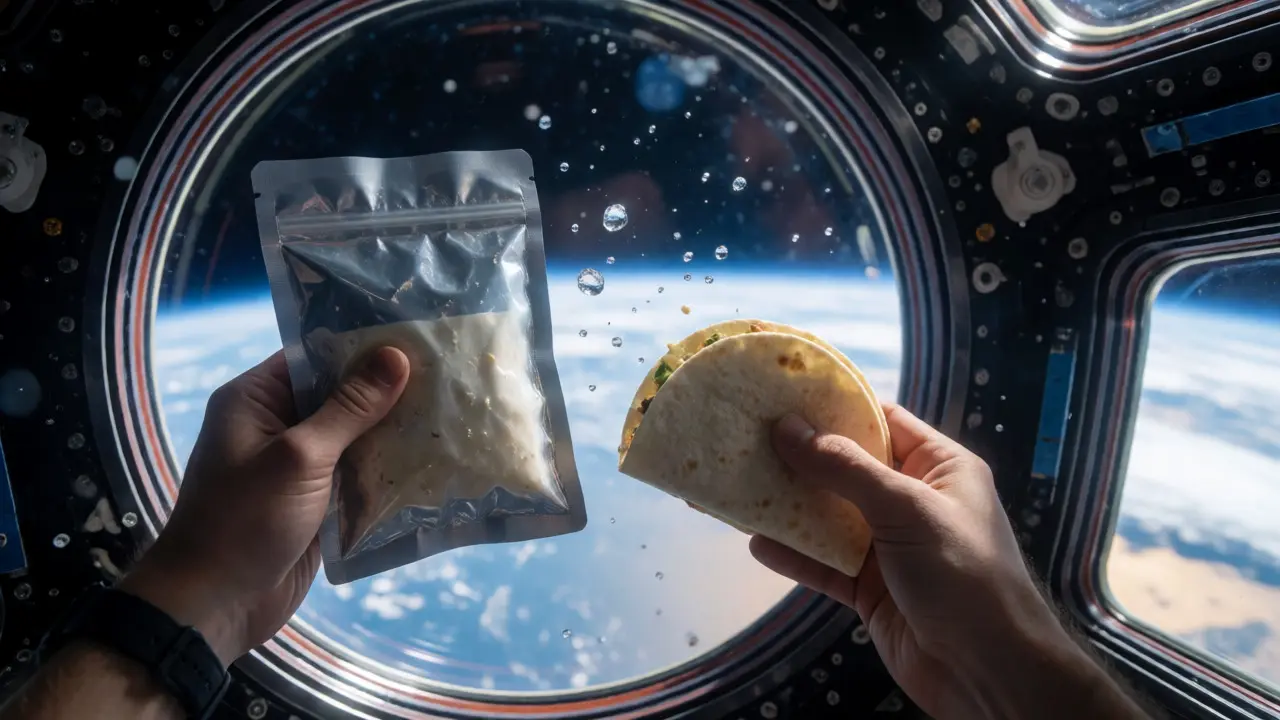
You’ve booked the ticket. You’ve done the centrifuge training. You’re ready to float above Earth. But have you thought about what happens when nature calls-or when it’s time for lunch? Most space tourists focus on the view from the cupola or the thrill of launch. Few realize that eating and bathing in microgravity is a logistical puzzle that requires strict adherence to new rules.
If you are planning a trip to the International Space Station (ISS) or a similar orbital habitat, you need to adjust your expectations. There are no showers. There are no plates. And yes, you will be drinking recycled urine. This guide breaks down exactly what you’ll eat, how you’ll clean up, and why every crumb matters.
The Reality of Eating in Zero-G
Forget the romantic idea of a floating dinner plate. In orbit, gravity doesn’t pull food down; it stays where you put it. If you take a bite of a dry cookie, those crumbs don’t fall to the floor-they drift into your nose, your eyes, or worse, into sensitive electronics. A single stray breadcrumb can short-circuit a control panel or cause an infection if inhaled.
Because of this, standard bread is banned. It creates too many crumbs. Instead, astronauts and tourists use tortillas. They hold fillings together without shedding particles. The NASA Space Food Systems Laboratory in Houston develops these constraints, ensuring every item meets safety standards. Your meals come in sealed pouches or trays with Velcro strips to keep them anchored to your lap or the wall.
Taste perception changes in space, too. Fluids shift toward your head due to lack of gravity, causing congestion that dulls your sense of smell and taste. That’s why hot sauce is a staple. NASA reports that condiments like salt and pepper aren’t available as crystals because they would float away. Instead, they come in liquid gels. Expect your food to be heavily seasoned to compensate for the physiological changes in your body.
What’s on the Menu?
The good news? Variety has improved dramatically since the early days of spaceflight. Today, the ISS menu offers over 200 distinct items. This includes thermostabilized entrées (heat-treated and sealed) and freeze-dried foods that you rehydrate with water.
| Food Type | Preparation Method | Examples | Why It Works |
|---|---|---|---|
| Thermostabilized | Reheat in food warmer | Beef stew, shrimp cocktail, lasagna | Long shelf life, no refrigeration needed |
| Freeze-Dried | Add water via nozzle | Vegetable soup, scrambled eggs, coffee | Lightweight, compact storage |
| Natural Form | Eat directly | Candy, nuts, dried fruit, cookies | No preparation required, low crumb risk |
| Interpack | Eat directly | Fruit bars, granola bars | Sticky texture prevents drifting |
Space tourists often get access to special menus. In 2021, Japanese entrepreneur Yusaku Maezawa brought canned Japanese dishes like boiled mackerel in miso to the ISS. These "comfort foods" are crucial for morale. If you’re traveling with a private company like SpaceX or Axiom Space, you might even customize some snacks, though all items must pass rigorous safety checks for packaging and stability.
Hygiene: No Showers, Just Sponge Baths
Here is the biggest shock for first-time visitors: there are no showers. Water doesn’t flow down in microgravity; it forms wobbling spheres that stick to surfaces. Imagine trying to rinse shampoo out of your hair while those droplets float around your face. It’s messy and dangerous for equipment.
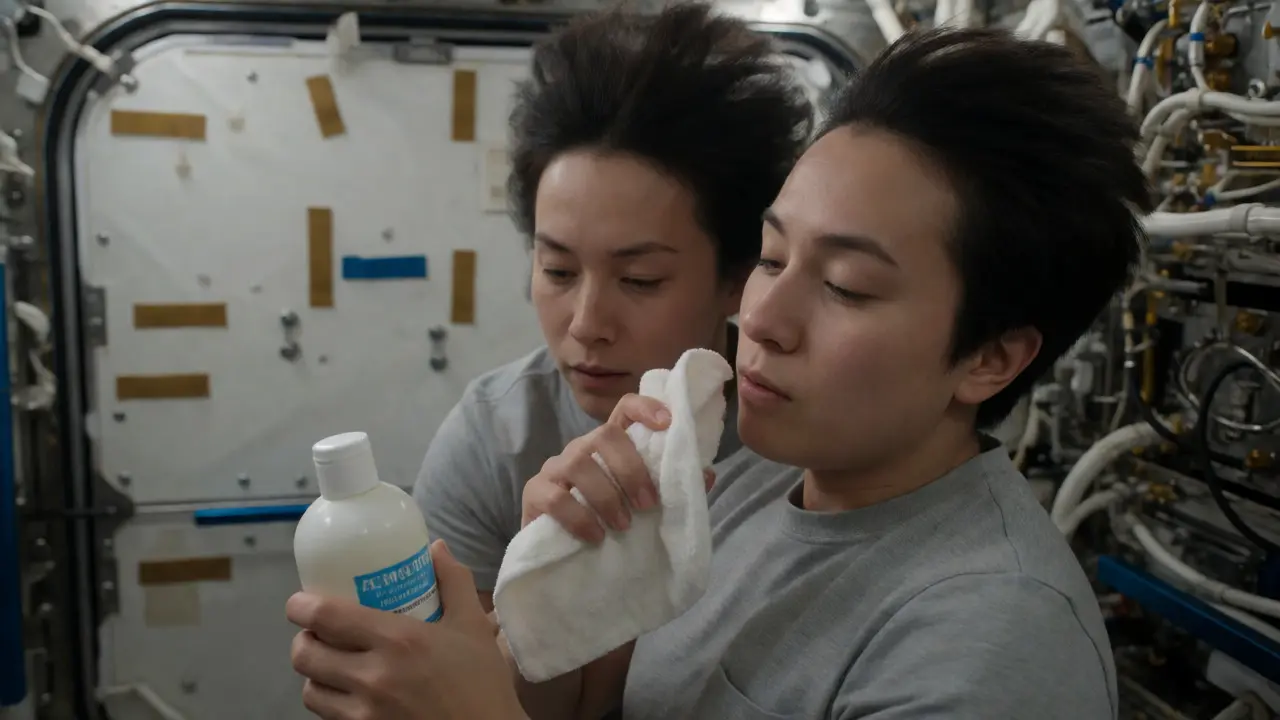
Instead, you take a sponge bath. You receive a sealed kit containing pre-moistened washcloths with soap or body wash. You add a small amount of water from a dispenser to soak the cloth, then wipe yourself down. For hair, you use no-rinse shampoo. You massage it into your scalp, towel off, and let it air dry. There is no running water, no drain, and no privacy curtain-just efficiency.
Toothbrushing follows similar logic. You cannot spit toothpaste into a sink. Most crew members swallow the foam after brushing, using a specialized edible toothpaste. Others squeeze excess paste back into the tube or onto a towel. Every drop of water used for hygiene is captured by towels and processed through the station’s recycling system.
The Toilet Experience
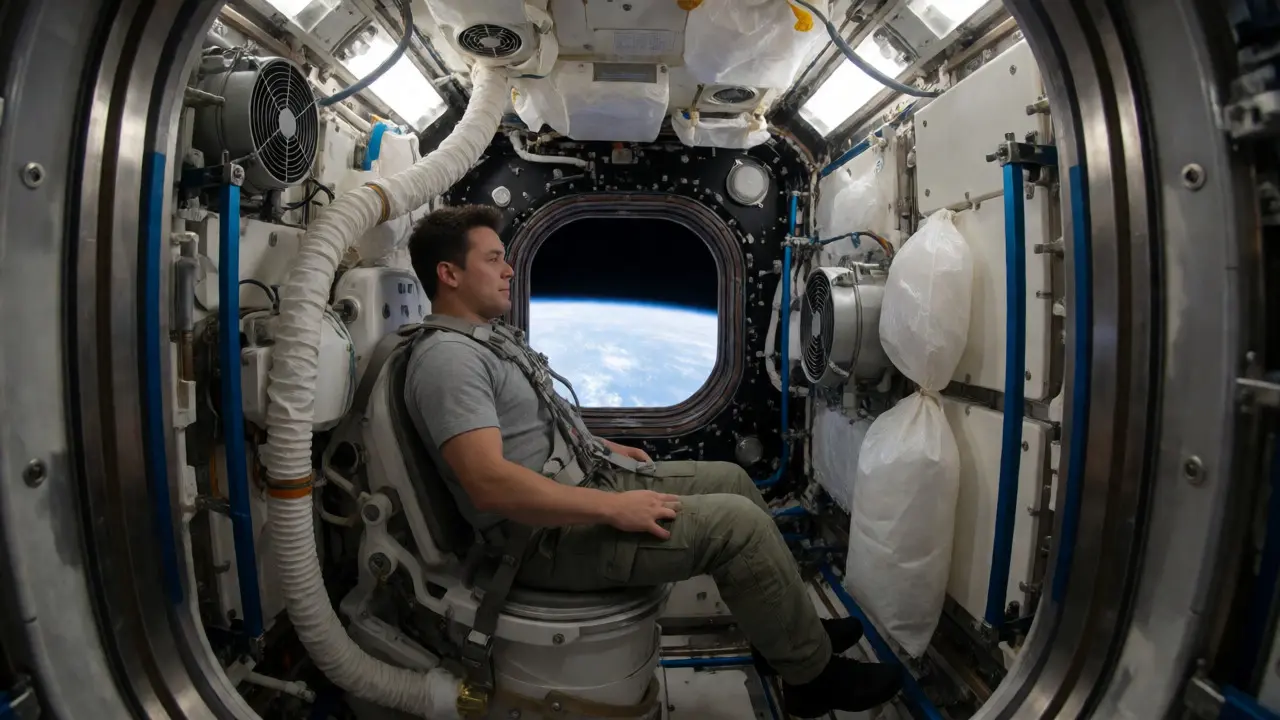
Using the bathroom in space is a mechanical process, not a passive one. The ISS toilet uses airflow instead of gravity. When you sit on the seat, you must secure yourself with straps to prevent drifting away. The system relies on fans to create suction.
For urination, men use a funnel adapter attached to a hose, while women use a specific interface designed for female anatomy. Both connect to a vacuum line that pulls waste away immediately. For solid waste, you place a specially designed bag inside the bowl. Afterward, you seal the bag and dispose of it in a waste compartment. These bags are eventually loaded into cargo ships that burn up upon re-entry.
On newer spacecraft like SpaceX’s Dragon capsule, the toilet design is slightly different but still relies on vacuum technology. It is located near the observation dome, offering a unique-if unusual-view during use. Note that you cannot wash clothes in space. You wear garments until they are dirty, then discard them. Pack light and choose synthetic fabrics that resist odor.
Water Recycling: From Sweat to Coffee
You might hesitate before drinking your morning coffee, knowing its origin. On the ISS, water is precious. Launching a liter of water costs thousands of dollars. To manage this, the Environmental Control and Life Support System (ECLSS) recovers more than 90% of all moisture aboard.
This system collects urine, sweat, exhaled breath, and even the moisture from your sponge bath towels. It purifies this mixture through filtration, distillation, and chemical treatment. The result is potable water cleaner than most tap water on Earth. So, when you rehydrate your freeze-dried soup, you are likely drinking water that was once someone else’s sweat. It’s a closed loop, essential for long-duration missions and increasingly important as tourist numbers grow.
Packing Tips for Orbital Comfort
Your packing list will look different from a typical travel itinerary. Since you can’t do laundry, bring enough base layers for the duration of your stay. Choose materials that wick moisture and resist bacterial growth. Avoid cotton, which holds sweat and takes forever to dry in the low-airflow environment of a spacecraft.
- Snacks: Bring personal comfort items like candy-coated chocolates or dried fruit. Check with your provider for approved brands.
- Personal Hygiene: While kits are provided, some travelers prefer their own unscented wet wipes for quick clean-ups.
- Restraints: Ensure your sleeping bag or restraint system fits well. Poor sleep leads to fatigue, making hygiene routines harder to manage.
Remember, every item you bring adds mass to the launch vehicle. Weight limits are strict. Coordinate closely with your mission specialist to ensure your personal items meet size and weight restrictions.
Psychological Impact of Routine
Don’t underestimate the mental aspect of these constraints. Eating alone in a small cabin, unable to enjoy the aroma of fresh-baked bread, can feel isolating. Sharing a meal with crewmates helps combat this. Many stations encourage communal dining times, even if everyone is tethered to a table.
Special occasions matter. Birthdays and holidays are celebrated with gourmet treats, sometimes delivered by resupply ships. These moments break the monotony of routine maintenance and exercise. As space tourism expands, expect more personalized culinary experiences, including culturally specific menus tailored to international guests.
Can I bring my own food to space?
Yes, but it must be approved. Items generally need to be commercially packaged, shelf-stable, and non-crumbly. Fresh fruits and vegetables are usually restricted due to spoilage risks and potential mold spores that could affect air quality. Always check with your mission provider for specific guidelines.
How do you handle menstrual hygiene in space?
Female astronauts and tourists use tampons or sanitary pads. Tampons are preferred because they are compact and easy to dispose of in the waste system. Pads require careful management to prevent loose pieces from floating away. Waste disposal follows the same protocol as other solid waste.
Does food taste bad in space?
It doesn't taste "bad," but it tastes less intense. Fluid shifts in microgravity cause nasal congestion, reducing your ability to smell, which significantly impacts flavor perception. This is why spicy foods and strong condiments are popular among crew members.
Is the recycled water safe to drink?
Absolutely. The water purification systems on the ISS produce water that meets or exceeds EPA standards for drinking water. The process involves multiple stages of filtration, carbon absorption, and iodine addition to kill bacteria. Astronauts drink it daily without issue.
What happens if I spill water in zero gravity?
The water will form floating spheres due to surface tension. You must catch these droplets quickly with a towel or your mouth. If left unchecked, they can drift into electrical components, causing shorts, or contaminate air filters. Crews are trained to chase and contain spills immediately.
10 Responses
they dont tell you the water tastes like recycled sweat and i bet they hide the real radiation stats too
its all a big experiment on us poor tourists while the elites sip fresh rainwater in their bunkers
omg this is so fascinating 🤯 i never realized how much fluid shifts in your head causing that congestion 😵💫 it makes sense why hot sauce is key then right?? its like our senses are literally turned off by gravity loss 🌌 do you think future tech will fix the taste buds issue or are we stuck with spicy food forever? 🥺✨ also the toilet suction thing sounds terrifying but kinda cool tbh 🚽💨
LISTEN UP! If you want to survive up there you need to stop worrying about the view and start worrying about your hydration cycle. The ECLSS system is not just plumbing; it is life support. You drink what you excrete because launch costs make hauling water impossible. Accept it. Embrace the loop. Your body adapts faster than you think. Focus on the engineering marvel rather than the gross factor. That mindset shift is what separates successful astronauts from those who panic. Train hard. Hydrate smart. Float proud.
Actually, the ban on bread isn't just about crumbs. It's about particulate matter entering the air filtration systems which can clog HEPA filters over time. Tortillas have been standard since Apollo for structural integrity reasons. Also, liquid salt and pepper aren't just for convenience; solid crystals would float into eyes and cause corneal abrasions. The no-rinse shampoo contains mild surfactants that don't require water extraction, saving weight. Every detail here is calculated for mass efficiency and safety redundancy. Most people miss the engineering rationale behind these 'quirks'.
great breakdown of the daily routine constraints
one thing worth noting is that the psychological impact mentioned at the end is often underestimated by first-time visitors
communal dining helps mitigate isolation but the lack of sensory variety can still lead to appetite fatigue after a few weeks
bring strong spices if you can get them approved
I simply cannot believe how insensitive this guide is...!!!
The idea of swallowing toothpaste foam is absolutely disgusting, and frankly, barbaric!!!
Why must we sacrifice basic human dignity for the sake of saving a few liters of water???
It feels like corporations care more about profit margins than the mental well-being of their customers.
We deserve better hygiene standards, period!!!
End of discussion.
Haha oh wow so basically you pay millions to eat rehydrated soup and wipe yourself with a wet cloth while floating around like a confused fish 🐟🤣 honestly sounds like a luxury camping trip gone wrong but hey if the view is nice I guess I can handle the smell of recycled sweat ☕😂 keep smiling and don’t forget your Velcro slippers!! 👟✨
hey everyone remember that adaptation is part of the journey
the discomfort fades once you get into the rhythm of the day
focus on the incredible opportunity to see earth from above
you got this!
adapt to breathing recycled air full of mold spores yeah right
they say its clean but who tests it really?
i bet its just filtered through some cheap carbon block that needs replacing every week
keep telling yourselves it tastes like tap water
im gonna bring my own bottled water and hide it in my sleeping bag
dont trust the loop
ugh wait yall r talking abt hygiene like its a choice?? lol
its physics baby!! u cant have running water w/o gravity duh
if u hate it so much stay on earth where u can waste water all u want
space tourists gotta suck it up (pun intended)
btw tortillas r actually pretty good n u can wrap whatever in em
stop being dramatics ppl its an adventure!! 🚀💪