
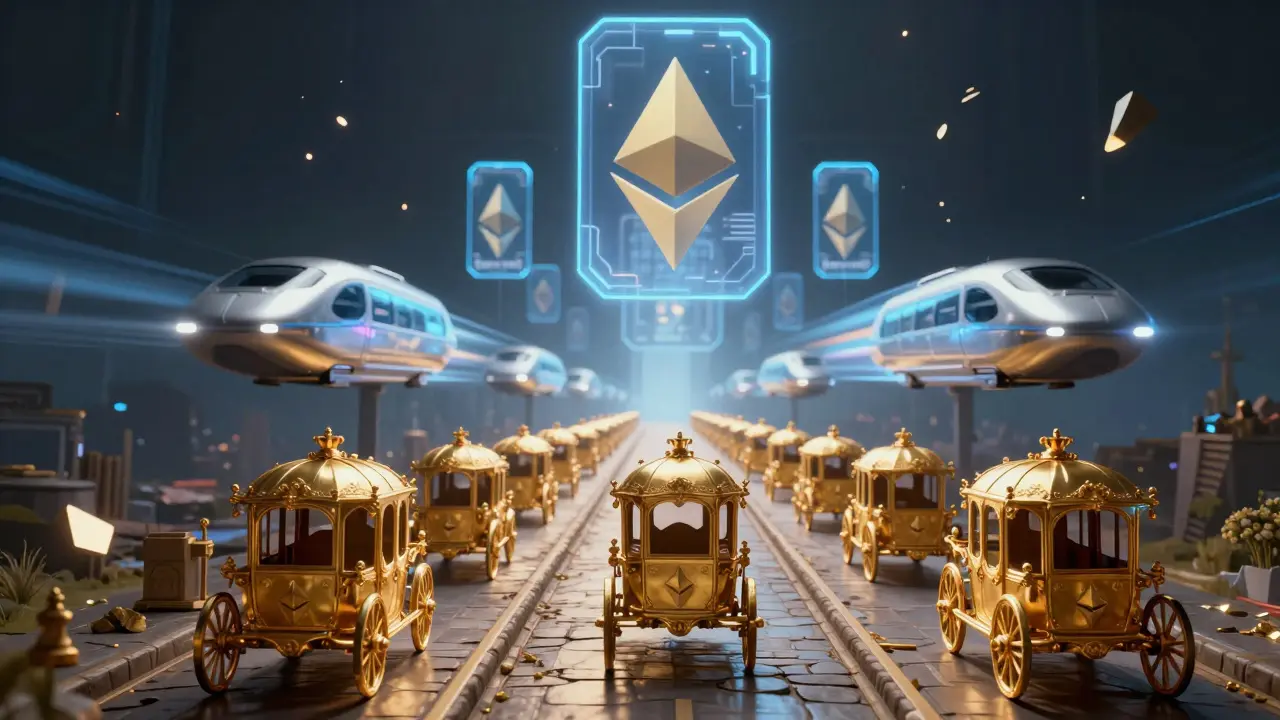
Imagine trying to run a global financial system on a road that only allows 30 cars per second. That's essentially what happened to the Ethereum mainnet during its peak congestion. Gas fees soared, and simple transactions took forever. This bottleneck created the "scalability trilemma"-the idea that you can't have security, decentralization, and speed all at once. But here is the trick: you don't actually have to choose. By moving the heavy lifting off the main road and onto high-speed express lanes, we get the best of both worlds. This is exactly how Ethereum Layer 2 is a set of protocols built on top of the Ethereum base layer that process transactions off-chain while anchoring their security to the main blockchain.
By 2026, this ecosystem has shifted from a theoretical experiment to a powerhouse. We are now seeing total value locked (TVL) across these networks exceeding $18.7 billion. While the main Ethereum chain still handles about 15-30 transactions per second (TPS), the collective power of Layer 2s has pushed throughput over 4,000 TPS. For the average person, this means the difference between paying $50 for a swap and paying less than $0.25.
How Layer 2s Actually Work
The core idea is simple: stop doing everything on the main chain. Think of the Ethereum Mainnet as a high-security vault (Layer 1) and Layer 2 as a fast-paced ledger where people trade all day. At the end of the day, the ledger just sends a summary of the final balances back to the vault. You get the speed of a private database but the ironclad security of the world's most decentralized smart contract platform.
To make this happen, different networks use different "math" to prove that the off-chain transactions are legit. Depending on which one you use, you're trading off either time or computational complexity.
| Architecture | Security Logic | Withdrawal Speed | Key Examples |
|---|---|---|---|
| Optimistic Rollups | Assumes honesty; uses fraud proofs | ~7 Days | Arbitrum, Optimism, Base |
| ZK-Rollups | Mathematical validity proofs | Near-Instant | zkSync, StarkNet, Scroll |
| Sidechains | Independent validator sets | Minutes to Hours | Polygon PoS |
| Validiums | ZK-proofs + Off-chain data | Fast | ImmutableX |
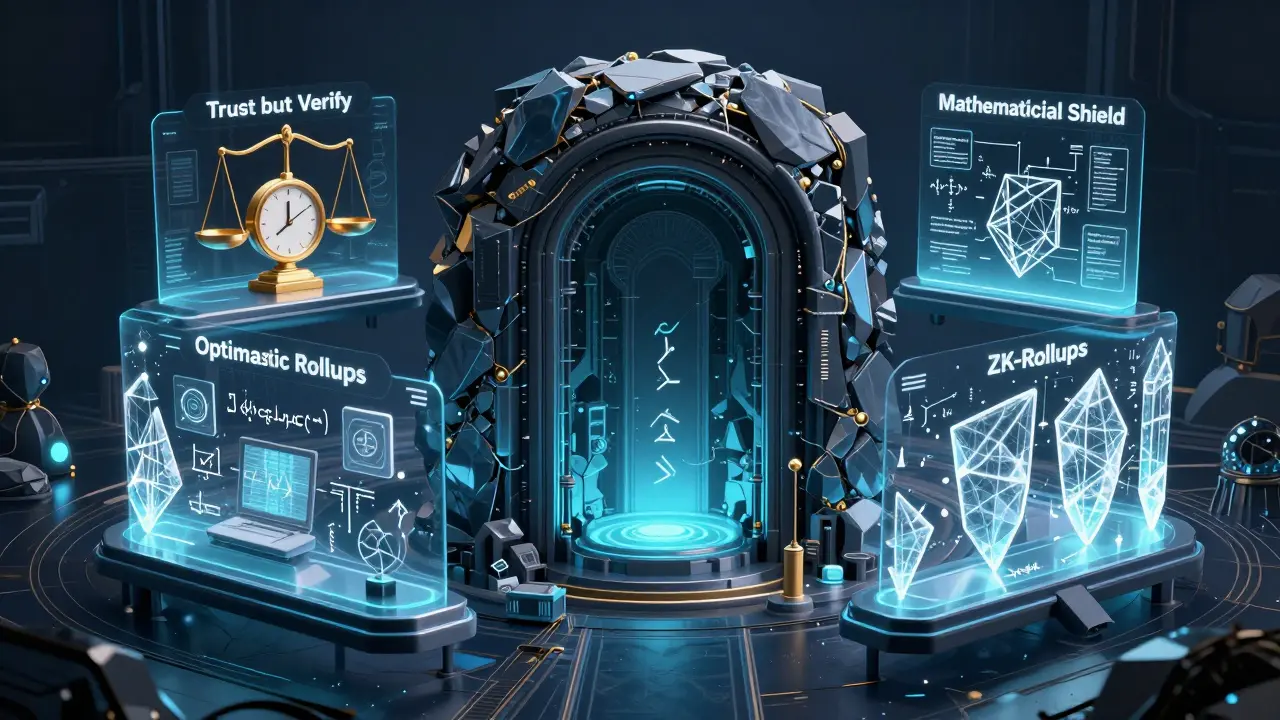
Optimistic Rollups: The "Trust but Verify" Approach
Optimistic Rollups are scaling solutions that assume transactions are valid by default and only perform computations if someone challenges a transaction. This is why they are called "optimistic." Instead of proving every single move with a complex math equation, they just post the data. If a validator notices something fishy, they can trigger a "fraud proof."
The trade-off here is the challenge period. Because the network needs time to allow someone to spot a fake transaction, withdrawing funds back to Layer 1 usually takes about seven days. Despite this, Arbitrum is a leading optimistic rollup that has become a dominant L2 hub due to its high developer adoption and EVM compatibility. It's currently the go-to for complex DeFi protocols because it behaves almost exactly like the main Ethereum network, making it easy for developers to migrate their apps without rewriting everything.
Zero-Knowledge (ZK) Rollups: The Mathematical Shield
If Optimistic Rollups are like a courtroom where you're innocent until proven guilty, ZK-Rollups are like a digital notary who proves your identity instantly using a secret key. They use Zero-Knowledge Proofs, which are cryptographic methods that allow one party to prove to another that a statement is true without revealing any information beyond the validity of the statement itself.
Because the proof is mathematical, there is no need for a 7-day waiting period. Once the proof is accepted by the main chain, the transaction is final. This makes ZK-Rollups incredibly attractive for high-frequency trading or gaming where waiting a week to move your assets isn't an option. We're seeing this play out in networks like StarkNet and Polygon zkEVM, which provide a bridge between absolute security and instant usability.
Sidechains and Validiums: The High-Speed Alternatives
Not every scaling solution is a "rollup." A Sidechain is a separate blockchain that runs parallel to the main chain and has its own consensus mechanism. Think of the Polygon PoS network. It doesn't inherit Ethereum's security directly; instead, it has its own set of validators. This makes it incredibly cheap and fast, but if the sidechain's validators fail, the main Ethereum chain can't magically save your funds.
Then we have Validiums, which are essentially ZK-Rollups that don't put all their data on the main chain. Instead, they use a "Data Availability Committee" to keep track of the info. This is a huge win for gaming platforms like ImmutableX, where the volume of NFT mints and trades is so high that putting every single piece of data on Ethereum would be too expensive, even for a rollup.
The Enterprise Perspective: Square Pegs and Round Holes
For big companies, the public Ethereum mainnet is often too chaotic and expensive. However, they still want the trust and liquidity that comes with the Ethereum brand. Layer 2s act as a bridge. They allow a corporation to run a semi-private environment-essentially a high-performance database-that still connects to the broader DeFi asset classes.
By using an L2, an enterprise can maintain its own compliance and privacy rules while still allowing its users to move assets into the global Ethereum ecosystem. This symbiotic relationship helps Ethereum grow because it brings in institutional capital without clogging the main chain with corporate bookkeeping.

Managing the Risks: What Could Go Wrong?
No system is perfect. When you move your assets to an L2, you're trusting a few specific things. First, there's the bridge security. If the smart contract that locks your funds on Layer 1 to mint them on Layer 2 gets hacked, the L2 is basically a house with no foundation.
Second, there is the sequencer risk. Most L2s use a "sequencer" to order transactions. Currently, many of these are centralized. If the sequencer goes offline, you might experience delays in sending transactions. While the community is moving toward decentralized sequencing, this remains a critical point of failure for some networks.
Finally, you have to consider data availability. If a network stores its data off-chain (like in a Validium) and that data is lost or withheld by the committee, you might find it impossible to prove you own your assets, even if the ZK-proof says you do.
Do I need to move my funds to Layer 2 to use Ethereum apps?
You don't have to, but you'll likely want to. Using the mainnet for every single transaction is incredibly expensive. Moving your funds to an L2 like Arbitrum or Base allows you to interact with decentralized applications (dApps) for a fraction of the cost while still being able to move those assets back to the main chain whenever you want.
Which is safer: Optimistic or ZK-Rollups?
Both are very secure, but they rely on different things. ZK-Rollups are mathematically secure from the start, meaning they don't rely on anyone's honesty. Optimistic Rollups rely on a "challenge period" where validators check for fraud. In a practical sense, both are vastly safer than sidechains because they settle their final state on the Ethereum mainnet.
Why does it take 7 days to withdraw from some L2s?
This specifically applies to Optimistic Rollups. Because they assume transactions are valid without proving them immediately, they create a window for anyone to prove a transaction was fraudulent. This 7-day window ensures that no one can steal funds by lying about the state of the ledger and then quickly withdrawing them before anyone notices.
Can I use the same wallet for L1 and L2?
Yes. Since most Layer 2 solutions are EVM-compatible, you can use the same address (and the same private key) across Ethereum, Arbitrum, Optimism, and Base. You just need to switch the network in your wallet settings to see the tokens held on that specific layer.
What happens if an L2 network goes offline?
If it's a true rollup, your funds are not lost. Because the transaction data is posted to the Ethereum mainnet, there are "forced exit" mechanisms. You can essentially bypass the L2's sequencer and tell the mainnet contract to give you your funds back, though this process is more technical and slower than a normal withdrawal.
Next Steps for Users
If you're just starting out, the best move is to experiment with a small amount of ETH. Try bridging a few dollars to Arbitrum or Base to see how the speed differs from the mainnet. If you're a developer, look into the Polygon zkEVM or StarkNet documentation to understand how to implement ZK-proofs in your apps.
For those managing larger portfolios, remember to diversify where you hold your assets. Don't put everything into a single L2; instead, spread your liquidity across a few different rollup architectures to mitigate the risk of a specific bridge or sequencer failure.
7 Responses
It is frankly exhausting how the average retail investor believes that a sidechain is a rollup just because the marketing team says so. Most people here simply do not grasp the fundamental difference in trust assumptions. I find it quaint that we are still debating this in 2026 while the real architects have already moved on to more sophisticated primitives. The lack of rigor in these discussions is a tragedy of the highest order.
One must ponder the ethical implications of centralizing sequencers in the name of efficiency... Is speed truly a virtue if it comes at the cost of our collective autonomy!!! We sacrifice the sacred pillar of decentralization for the convenience of a few cents in gas fees... It is a moral failing of the current era!!!
OH MY GOD, the bridge security part literally gave me chills! Imagine waking up and realizing your funds are just... gone because some contract had a bug! It's absolutely terrifying but also kind of thrilling that we're living through this evolution! I'm literally shaking just thinking about the volatility of these L2s during a major hack event!
Hey everyone! Just wanted to add that if youre new to bridging, always use the official bridge first even if its a bit more expensive. Some of the third party bridges have had some glitches in the past, so just be careful! Its a great way to learn how the funds move from L1 to L2 without losing too much. You can also check out some community guides on how to avoid common mistake's when swapping networks in Metamask! Hope this helps you all get started safer!
This is very good. I like it.
The naive assumption that the average user even comprehends the difference between a ZK-proof and a fraud proof is staggering... one wonders why we even bother with such granular distinctions when the vast majority of the herd simply chases the lowest fee regardless of the systemic risk involved... it is a cycle of ignorance that repeats every single bull market, regardless of the technological leaps we claim to have made... an endless loop of mediocrity!!!
Let's be real, both the ZK and Optimistic camps are just trying to solve the same problem in different ways, and we should probably stop acting like one is a total failure compared to the other. As long as the funds are secure and the fees stay low, the end user doesn't actually care about the math under the hood. Let's just focus on getting the UX right so normal people can actually use this stuff without needing a computer science degree.