
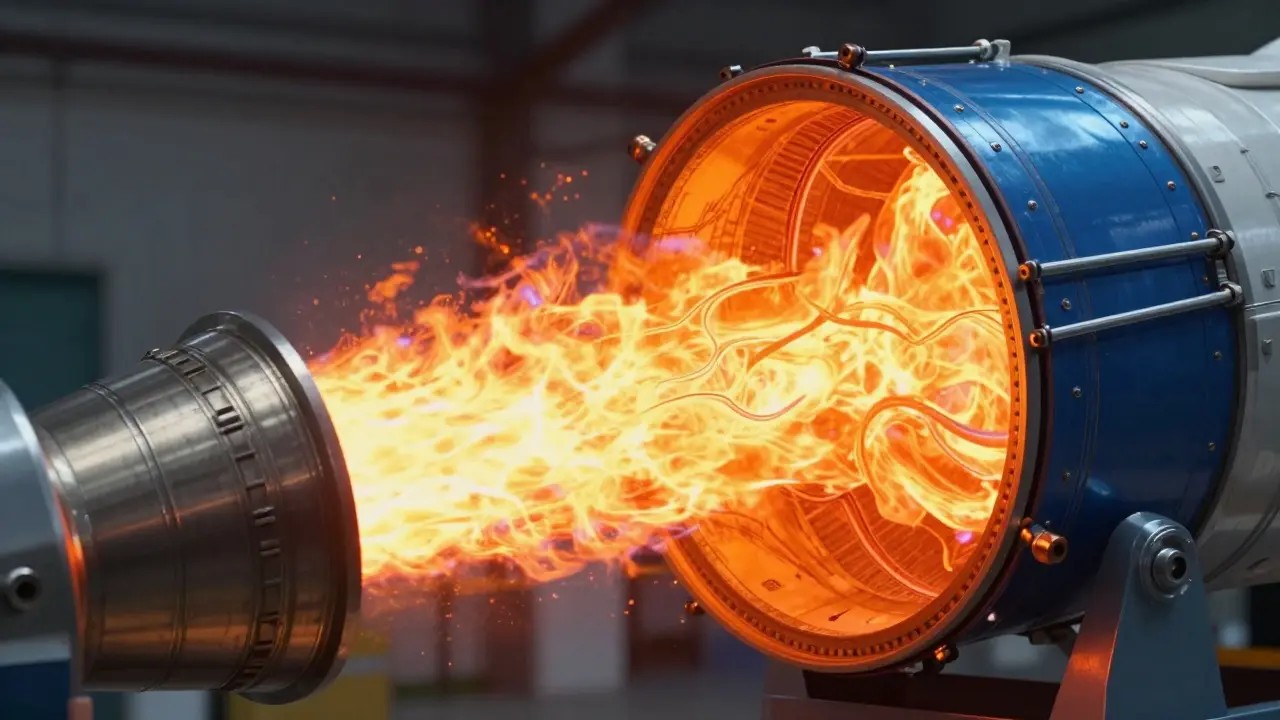
Imagine squeezing a balloon until it bursts. Now imagine doing that inside a metal tube while the air inside is burning at 3,500 Kelvin. That is essentially what happens inside a rocket engine's combustion chamber. The pressure inside this chamber-known as chamber pressure-is the single most critical number an engineer tweaks to get more thrust out of less fuel. But there is a hard wall you cannot push through: the materials holding that pressure together will melt, crack, or explode if you go too far.
We are standing at the edge of that wall today. Modern engines like SpaceX’s Raptor operate at pressures that would have seemed impossible just two decades ago. Yet, despite these leaps, we haven’t seen a linear increase in performance for every unit of pressure added. Why? Because physics and metallurgy play a brutal game of tug-of-war. Let’s look at how high pressure drives performance, where the material limits lie, and why the industry has settled on a specific "sweet spot" for modern rockets.
The Physics of Pushing Harder
To understand why engineers obsess over chamber pressure, you have to look at the basic equation for thrust. Thrust comes from two things: the speed at which gas exits the nozzle (exhaust velocity) and the mass of that gas. Chamber pressure directly controls both.
When you increase the pressure in the combustion chamber, you force more propellant through the injector per second. This increases the mass flow rate. Think of it like turning up the tap on a hose; higher pressure means more water comes out. In a rocket, this translates to higher thrust. For example, moving from a low-pressure engine to a high-pressure one can nearly double the thrust without changing the physical size of the engine significantly.
But the real prize is specific impulse (Isp), which is the rocket equivalent of miles per gallon. Higher chamber pressure allows the exhaust gases to expand more efficiently in the nozzle. According to data from Sutton and Biblarz’s Rocket Propulsion Elements, increasing chamber pressure from roughly 3 MPa to 20 MPa can improve vacuum specific impulse by 5-15%. That might sound small, but in spaceflight, a 10% gain in efficiency means you can carry significantly more payload or reach orbit with less fuel.
- Mass Flow: Higher pressure forces more propellant through the throat, increasing thrust density.
- Expansion Ratio: High pressure prevents flow separation in large nozzles, allowing better performance in a vacuum.
- Engine Size: You can build a smaller, lighter engine that produces the same thrust as a larger, lower-pressure competitor.
This is why the trend in rocket history has always been upward. Early engines were weak because they couldn’t hold much pressure. Today’s giants are powerful because they squeeze that pressure to the absolute limit of their materials.
A History of Squeezing More Out of Less
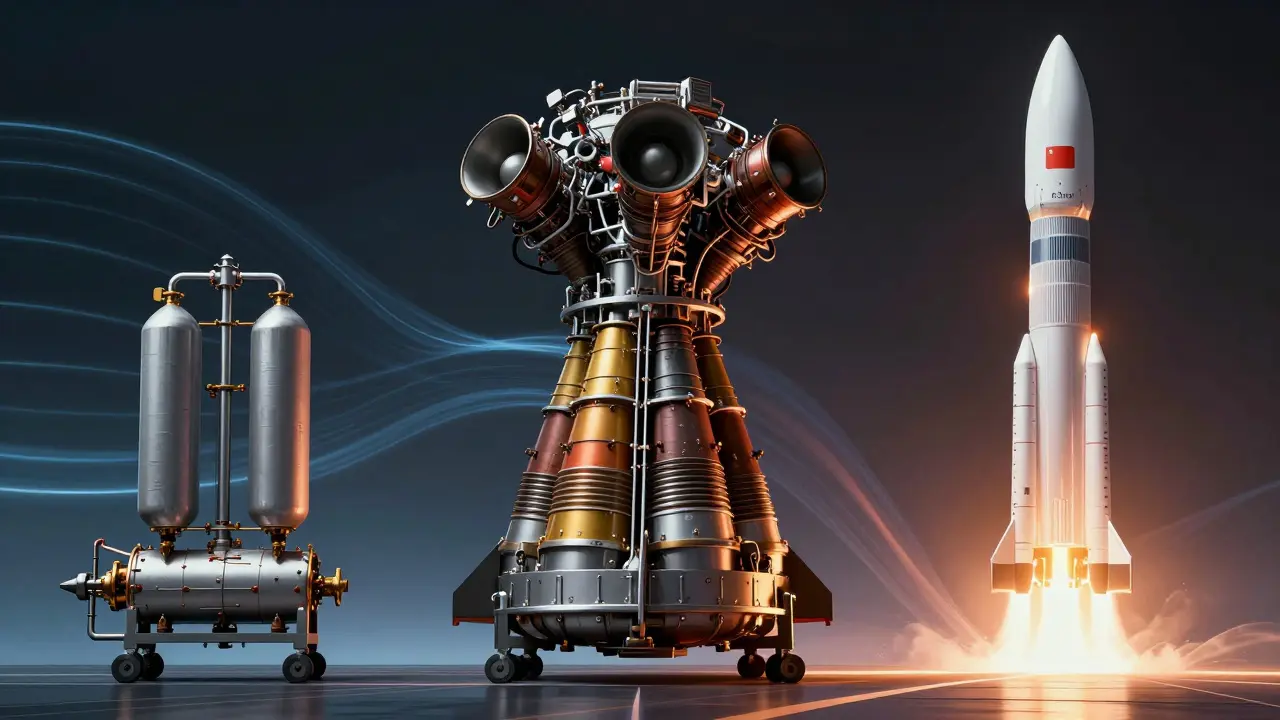
The journey from rudimentary tubes to high-pressure powerhouses shows how technology dictates pressure limits. In the 1920s, Robert H. Goddard’s early liquid-fuel engines operated at a mere 1-5 bar. They used pressurized tanks rather than pumps, so they were limited by how strong those tanks could be without becoming impossibly heavy.
The first major leap came with the V-2 rocket in 1944. Designed by Wernher von Braun’s team, it reached about 15 bar (1.5 MPa). This was achieved by introducing turbopumps-turbines driven by gas generators that forced propellant into the chamber. It was a huge step, but still modest by today’s standards.
Then came the Apollo era. The F-1 engine, which powered the Saturn V, operated at about 7.0 MPa (70 bar). It was massive, using RP-1 kerosene and liquid oxygen. Around the same time, Soviet engineers were pushing boundaries with the NK-33, reaching nearly 15 MPa using a staged combustion cycle. This cycle recycles all propellant through the main chamber, making it more efficient but harder to control.
The real revolution happened with the Space Shuttle Main Engine (RS-25). Introduced in the 1970s, it ran on hydrogen and oxygen at a staggering 20.6 MPa (206 bar). This required a fuel-rich staged combustion cycle, where the fuel burns partially before entering the main chamber. It set a benchmark for decades.
| Engine | Era | Cycle Type | Chamber Pressure | Key Innovation |
|---|---|---|---|---|
| Goddard Liquid (1930s) | Early | Pressure-fed | ~1-2 bar | First liquid fuel use |
| V-2 (A-4) | 1944 | Gas Generator | ~15 bar | Turbopump introduction |
| F-1 | 1960s | Gas Generator | ~7.0 MPa | Regenerative cooling scale-up |
| RS-25 (SSME) | 1970s+ | Fuel-Rich Staged Combustion | ~20.6 MPa | High-efficiency hydrogen cycle |
| RD-180 | 1990s+ | Ox-Rich Staged Combustion | ~26.7 MPa | Oxygen-rich turbomachinery |
| Raptor 2 | 2020s | Full-Flow Staged Combustion | ~30 MPa | Additive manufacturing & full-flow cycle |
Today, SpaceX’s Raptor 2 pushes this further, operating around 30 MPa (300 bar) with test targets up to 35 MPa. This represents the current frontier of operational chemical propulsion.
The Material Wall: Stress, Heat, and Fatigue
If higher pressure is so good, why not just keep raising it? The answer lies in the materials science of the combustion chamber. The chamber walls face two enemies: mechanical stress and thermal flux.
Mechanically, the chamber is a cylinder under immense internal pressure. The hoop stress-the force trying to tear the cylinder apart sideways-is calculated simply: stress equals pressure times radius divided by wall thickness. If you want to increase pressure without making the wall infinitely thick (which adds dead weight), you need stronger materials.
For a large engine like Raptor, maintaining structural integrity at 30 MPa requires precise engineering. Using Inconel 718, a nickel-based superalloy, designers must ensure the yield strength isn’t exceeded. At room temperature, Inconel 718 has a yield strength of around 600 MPa. But inside an engine, temperatures soar. At 700-800°C, that strength drops sharply, sometimes below 400 MPa. This means the metal is working near its breaking point during every flight.
Then there is heat. The combustion gases are hotter than the melting point of steel. To survive, engines use regenerative cooling. Cold propellant flows through thousands of tiny channels machined into the chamber wall, absorbing heat before being injected into the fire. In high-pressure engines, heat fluxes can reach 30-80 MW/m² near the throat. That is enough energy to melt copper instantly if not managed perfectly.
Modern chambers often use a composite structure: a thin inner liner made of copper alloys (like CuCrZr or NARloy-Z) for excellent heat conduction, surrounded by a thicker outer jacket of stainless steel or nickel alloy for structural strength. SpaceX uses additive manufacturing (3D printing) to create complex cooling channel geometries that maximize surface area and heat transfer efficiency. Even then, burn-through remains a risk, as seen in early Raptor tests.
Combustion Stability and Turbomachinery Limits
It’s not just about holding the pressure; it’s about keeping the fire stable. Higher chamber pressure amplifies acoustic modes inside the chamber. Small vibrations can grow into violent oscillations known as "screech" or "chug." The F-1 engine famously suffered from high-frequency instability that destroyed test articles in seconds. Engineers had to add baffles and redesign injectors to dampen these waves.
At 30 MPa, the risk is even higher. The injection velocity of propellants is much faster, leaving less time for mixing. If the mixture isn’t perfect, combustion becomes uneven, leading to hot spots that erode the chamber wall. This requires incredibly precise injector design and extensive testing to map out safe operating envelopes.
Furthermore, getting that propellant into the chamber requires turbopumps capable of generating pressures well above the chamber pressure. To maintain flow against a 30 MPa chamber, plus losses in the cooling channels and injectors, pumps may need to discharge at 400-500 bar. This demands rotors spinning at tens of thousands of RPM, made from ultra-high-strength steels, with seals that must withstand extreme erosion and oxidation. The power required to drive these pumps scales with pressure, meaning the turbines themselves become massive and complex.
Why Not Go Higher? The Diminishing Returns
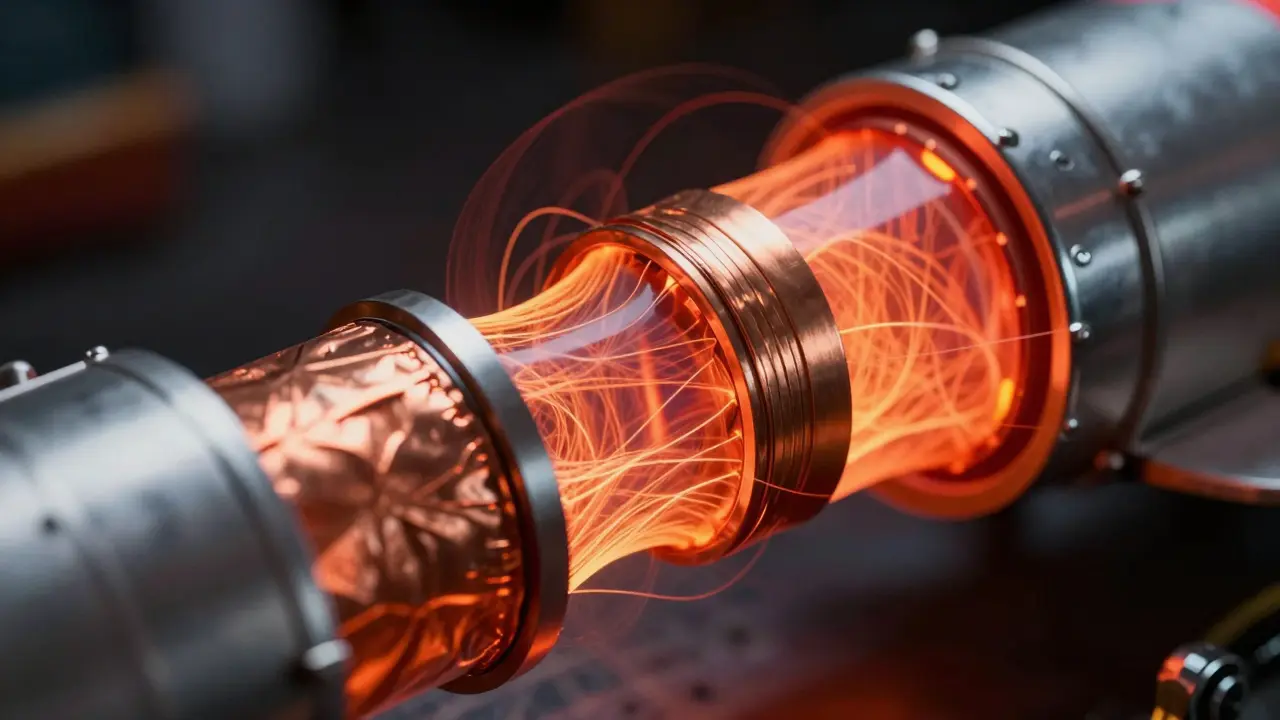
You might wonder, if we can hit 30 MPa, why not 50 MPa? The law of diminishing returns kicks in hard. While theoretical performance continues to improve with pressure, the practical gains shrink while costs and risks skyrocket.
Going from 1 MPa to 10 MPa might yield a 20-25% gain in specific impulse. But going from 10 MPa to 30 MPa yields only an additional 5-10%. Meanwhile, the structural mass, cooling complexity, and turbomachinery power requirements grow nearly linearly-or worse.
Most experts, including those cited in NASA design handbooks, identify 10-25 MPa as the practical optimum for large chemical rockets. Beyond this, the engine becomes disproportionately heavy and expensive. For example, the RS-25 cost tens of millions of dollars per unit due to its high-pressure reusable design. In contrast, SpaceX’s Merlin 1D, operating at a more modest ~9.7 MPa, is designed for rapid, low-cost production. It sacrifices some efficiency for reliability and affordability.
However, for fully reusable vehicles like Starship, the economics shift. If an engine flies dozens of times, the initial development cost is amortized. Higher pressure allows for smaller, lighter stages, reducing launch mass and increasing payload capacity. This justifies the complexity of Raptor’s 30 MPa operation. Blue Origin’s BE-4, targeting ~13-14 MPa, takes a different approach, prioritizing robustness and simpler oxidizer-rich staging over maximum pressure.
Future Frontiers: Materials and Manufacturing
Can we break the 30 MPa barrier? Possibly, but it will require new materials. Ceramic Matrix Composites (CMCs) are being researched for their ability to withstand temperatures above 2000°C without active cooling. A 2018 study by Safran and ONERA showed SiC/SiC CMCs retaining tensile strengths of 200-400 MPa at 1400°C. While promising, their brittleness makes them unsuitable for high-pressure chambers right now. They are more likely to appear in nozzle extensions first.
Transpiration cooling-bleeding propellant through porous walls-could also help manage heat fluxes, allowing higher pressures without melting the liner. Additive manufacturing continues to evolve, enabling thinner walls and more efficient cooling channels. These technologies might push practical limits to 35-40 MPa in the next decade, but for now, 30 MPa remains the king of commercial launch vehicles.
What is the highest chamber pressure ever achieved in a rocket engine?
As of 2026, SpaceX’s Raptor 2 engine holds the record for widely reported operational chamber pressures, running at approximately 30 MPa (300 bar), with test targets reaching up to 35 MPa (350 bar). This is significantly higher than previous records held by the RS-25 (~20.6 MPa) and RD-180 (~26.7 MPa).
Why doesn't everyone use the highest possible chamber pressure?
Higher chamber pressure increases structural stress, thermal loads, and turbomachinery complexity. The performance gains (specific impulse) diminish after about 20-25 MPa, while costs and failure risks rise sharply. Lower-pressure engines are cheaper, simpler, and more reliable for many applications.
How does chamber pressure affect specific impulse (Isp)?
Higher chamber pressure allows for more efficient expansion of exhaust gases in the nozzle, particularly in a vacuum. This can increase specific impulse by 5-15% when moving from low-pressure (3 MPa) to high-pressure (20+ MPa) regimes, assuming other factors remain constant.
What materials are used in high-pressure rocket chambers?
High-pressure chambers typically use a dual-layer design: an inner liner of copper alloys (like CuCrZr or NARloy-Z) for heat resistance and an outer shell of nickel-based superalloys (like Inconel 718) or stainless steel for structural strength. Additive manufacturing is increasingly used to create complex cooling channels within these materials.
Is there a theoretical limit to chamber pressure?
There is no strict theoretical limit, but practical limits are imposed by material strength, cooling capabilities, and turbopump power. Current engineering consensus suggests 30-40 MPa is the near-term ceiling for chemical rockets, beyond which the cost and risk outweigh the marginal performance benefits.