
Imagine holding the keys to a million-dollar safe in your pocket. Now imagine losing that pocket. For Bitcoin holders, this isn't a hypothetical thriller plot; it's a daily risk. The difference between keeping your wealth and watching it vanish forever comes down to two things: your seed phrase and, if you use one, your passphrase. These aren't just random words or passwords. They are the mathematical foundation of your financial sovereignty.
If you have ever wondered how a simple list of twelve words can control billions of dollars, or why experts scream at you never to type them into a computer, you are in the right place. We will break down exactly how these mechanisms work, why they are designed this way, and most importantly, how to recover your wallet without getting scammed.
The Core Mechanism: What Is a Seed Phrase?
At its heart, a seed phrase, also known as a recovery phrase or mnemonic code, is a human-readable backup of your digital identity. It is not a password you create. It is generated by your wallet software using a cryptographically secure random number generator. This process converts raw entropy-pure randomness-into a sequence of words from a standardized list.
This standard is called BIP-39. Launched years ago, BIP-39 became the universal language for self-custody wallets. It defines a list of 2,048 specific English words (and translations in other languages) chosen to avoid confusion. Words like 'cat' and 'bat' might look similar, but the BIP-39 list ensures every word is distinct enough to minimize typos. When your wallet generates a 12-word phrase, it is encoding 128 bits of entropy. That sounds abstract, but it means there are approximately $3.4 \times 10^{38}$ possible combinations. To put that in perspective, guessing your seed phrase randomly is statistically more likely than winning the lottery every day for the rest of the universe's life.
Why words instead of numbers? Because humans are bad at remembering long strings of hexadecimal characters like 'a4f8b2...'. We are good at remembering stories or sequences of common words. A phrase like 'hotel obvious agent lecture gadget evil jealous keen fragile before damp clarify' is easier to write down on paper than a 64-character hex string. But remember: the order matters. If you swap 'hotel' and 'obvious', the math breaks, and you access a different, empty wallet.
How Recovery Actually Works: HD Wallets and Derivation
You might think your seed phrase creates one address. It doesn't. It creates a master key that can generate thousands. This is thanks to Hierarchical Deterministic (HD) wallet technology, defined by standards like BIP-32 and BIP-44.
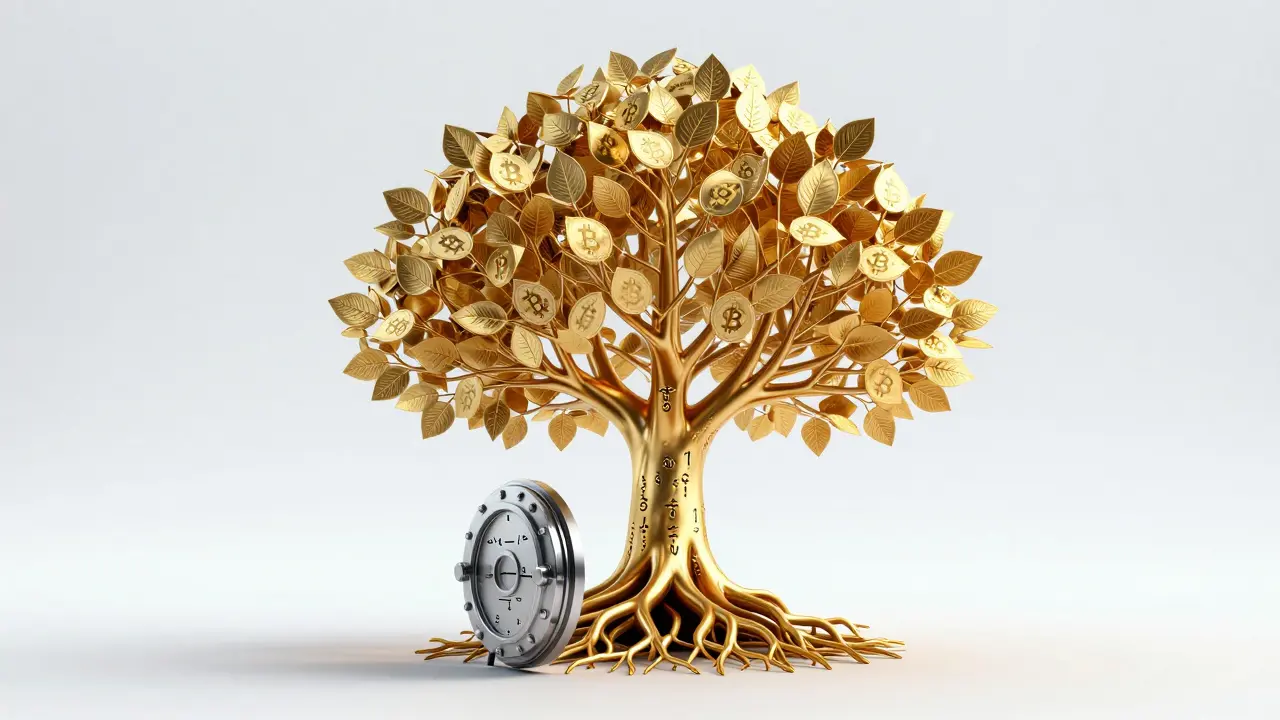
Think of your seed phrase as the root of a massive tree. From that single root, the wallet derives a trunk (your master key), branches (accounts), and leaves (individual addresses). When you send Bitcoin to a new address, your wallet generates it from the seed. You don't need to back up each new address separately. You only need the root. This is why restoring your wallet on a new device works so smoothly. You enter the same 12 or 24 words, and the wallet rebuilds the entire tree structure, revealing all your previous addresses and balances.
This architecture solves a major problem in early cryptocurrency history. Before HD wallets, if you lost a single private key, you lost those funds forever, and managing dozens of keys was a nightmare. Now, one piece of paper holds everything. However, this convenience brings responsibility. If someone gets that paper, they get the whole tree.
The Power of the Passphrase: The "25th Word"
Here is where many users make a critical mistake: assuming the seed phrase is the only secret. BIP-39 allows for an optional addition called a passphrase. Often called the "25th word," this is a custom string of text you choose and add to your seed phrase during the derivation process.
Mathematically, the passphrase is combined with your mnemonic words through a key-stretching function (PBKDF2). The result? A completely different root seed. If you enter your 12 words without the passphrase, you access Wallet A. If you enter your 12 words with the correct passphrase, you access Wallet B. Wallet B has entirely different addresses and private keys. An attacker who steals your seed phrase but doesn't know your passphrase will see an empty wallet (Wallet A) and leave, thinking nothing is there.
This feature enables plausible deniability. Imagine you are forced to hand over your backup under duress. You give them the seed phrase. They import it and see a small balance-a decoy wallet. Your real assets remain hidden in the wallet protected by the passphrase. This is not science fiction; it is a practical security layer used by high-net-worth individuals and privacy advocates. However, the trade-off is severe: if you forget the passphrase, no one-not even the wallet developer-can help you. There is no "forgot password" link for cryptographic secrets.
| Feature | Seed Phrase (Mnemonic) | Passphrase |
|---|---|---|
| Origin | Generated by wallet (random) | Chosen by user (custom) |
| Format | 12 or 24 words from BIP-39 list | Any text, symbols, length |
| Function | Creates the primary wallet tree | Shifts to a hidden/alternative tree |
| Recovery Risk | Loss = permanent loss of funds | Loss = funds inaccessible but seed remains valid for default wallet |
| Security Role | Primary authentication | Secondary layer / Plausible deniability |
Common Recovery Scenarios and Pitfalls
Recovering a wallet sounds simple: enter words, get money. In practice, human error causes most failures. Let’s look at three common scenarios.
Scenario 1: The Forgotten App. You wrote down your seed phrase five years ago on a napkin. You no longer remember which app you used. Good news: because BIP-39 is a standard, you can import that phrase into almost any modern non-custodial wallet (like MetaMask, Trust Wallet, or Electrum). As long as you didn’t use a custom derivation path or a passphrase, the funds will appear. The wallet software doesn't matter; the math does.
Scenario 2: The Missing Passphrase. You recall using a passphrase, but you’ve forgotten what it was. You enter your 12 words, and the wallet shows zero balance. Panic sets in. Unfortunately, there is no brute-force method here. Unlike a 4-digit PIN, a passphrase can be anything. If it was complex, recovering it is computationally impossible. The best advice? If you suspect you used a passphrase but can't recall it, try variations. But realistically, if the passphrase is gone, those specific funds are locked until you remember.
Scenario 3: The Typo. You misread 'slip' as 'skip'. The wallet accepts the input (because 'skip' is also in the BIP-39 list) but generates a different set of keys. You see an empty wallet. Always double-check your writing against the original source. Use metal plates or engraved backups to prevent fading ink from causing misreads later.
Storage Best Practices: Avoiding Digital Traps
The biggest threat to your seed phrase isn't a hacker breaking into a supercomputer; it's malware on your laptop or a phishing site. Never store your seed phrase digitally. No screenshots, no cloud notes, no email drafts, no password managers. If it touches the internet, it is vulnerable.
Physical storage is king. Write it down on paper immediately after generation. Then, consider durability. Paper burns, rots, and fades. Many users now use stainless steel plates or titanium cards designed specifically for seed phrases. You punch or stamp the words into the metal. This protects against fire, water, and physical decay. Keep this backup in a secure location, like a safe deposit box or a home safe.
If you use a hardware wallet like Ledger or Trezor, the device itself does not store your seed phrase permanently in a readable format. It stores the derived keys. The seed phrase is your emergency exit. Treat it accordingly.
Beware of Recovery Scams
Desperation makes people vulnerable. If you lose access to your wallet, you will likely encounter "recovery services" online. Here is the hard truth: No legitimate service can recover your funds if you do not have the seed phrase or passphrase.
Scammers pose as experts, claiming they can "hack" the blockchain or "reverse" transactions. They ask for your seed phrase to "verify" your ownership. The moment you give them those words, they drain your wallet. There is no such thing as a blockchain recovery wizard. Only you hold the keys. If you have partial data (e.g., you remember 11 of 12 words), specialized software might help, but this is rare and requires technical skill. For 99% of cases, if you don't have the full phrase, the funds are lost. Do not pay anyone to tell you this.
Future-Proofing Your Crypto Assets
As we move through 2026, the infrastructure for Bitcoin custody continues to mature. While BIP-39 remains the dominant standard, new methods like Shamir's Secret Sharing (SSS) are gaining traction. SSS splits your seed into multiple parts, requiring a threshold (e.g., 3 out of 5) to reconstruct it. This eliminates the single point of failure of one piece of paper. However, for most users, mastering the basic seed phrase and passphrase combination is sufficient and widely supported.
Remember, self-custody is not just about technology; it's about discipline. Test your backup. Once a year, take your seed phrase to a clean, offline device and restore a test wallet. Send a tiny amount of Bitcoin to it. Verify you can spend it. This ritual ensures that when disaster strikes, you won't discover your backup is illegible or incomplete.
Can I change my seed phrase?
No, you cannot change the words of an existing seed phrase. Each seed phrase corresponds to a specific set of private keys. If you want a new seed phrase, you must create a new wallet, generate a new phrase, and transfer your funds from the old wallet to the new one. The old wallet then becomes obsolete.
Is a 24-word seed phrase more secure than a 12-word one?
Technically, yes. A 12-word phrase offers 128 bits of entropy, while a 24-word phrase offers 256 bits. However, 128 bits is already considered unbreakable by current and foreseeable computing power. The extra security of 24 words is mostly relevant for protecting against theoretical future quantum attacks or extreme state-level adversaries. For most users, a well-protected 12-word phrase is sufficient.
What happens if I lose my hardware wallet but keep the seed phrase?
You can buy any compatible hardware wallet (or use a software wallet) and restore your funds by entering your seed phrase. The hardware device is just a tool to sign transactions securely; the actual ownership resides in the seed phrase. Just ensure you enter the phrase into a trusted device to avoid malware theft.
Can I use a passphrase with any wallet?
Not all wallets support passphrases. Most hardware wallets (like Ledger and Trezor) and advanced software wallets (like Electrum) support BIP-39 passphrases. Simpler mobile apps may not expose this feature to users. Check your wallet's documentation before relying on a passphrase for security.
Should I share my seed phrase with family members?
Sharing increases risk. If you must, consider splitting the responsibility. For example, keep 6 words yourself and give the other 6 to a trusted family member, requiring both to recover funds. Alternatively, use a multi-signature setup where multiple keys are needed to authorize transactions, eliminating the need to share a single seed phrase.
9 Responses
The sheer audacity of trusting a piece of paper with your life savings is almost poetic in its simplicity. It reminds me of the old days when keys were physical objects you could actually hold, not some abstract digital ghost haunting your server logs. We have built this entire financial sovereignty on the premise that humans are terrible at remembering things but excellent at losing them. The passphrase feature is essentially a cryptographic magic trick that separates the decoy from the treasure, and it is brilliant. Most people treat their seed phrases like they are storing laundry lists, which is exactly why the scams exist. You cannot emphasize enough that if it touches the internet, it is already compromised. The metal plates are expensive but worth every penny because fire does not care about your blockchain holdings.
oh look another article telling us to buy metal plates instead of just using a hardware wallet properly lol. the whole 'passphrase' thing is just paranoia dressed up as security for people who think they are smarter than the algorithm. nobody needs plausible deniability unless they are hiding something illegal so maybe focus on that aspect rather than pretending everyone is a privacy advocate. also saying 'guessing your seed phrase is statistically impossible' is fine but what about the guy who writes his words on a sticky note and puts it under his keyboard? that is where the real risk lies not some supercomputer brute forcing entropy. stop making it sound like a thriller movie and start acting like adults.
Your understanding of cryptographic standards appears to be superficial at best. The BIP-39 standard is not merely a suggestion; it is a rigorous mathematical framework designed to mitigate human error through distinct lexical selection. To suggest that passphrases are unnecessary is to ignore the fundamental principle of defense in depth. In India, we understand the value of layered security because our infrastructure demands resilience against both technical failures and social engineering attacks. A passphrase adds an additional layer of entropy that transforms a 128-bit or 256-bit key space into an effectively infinite one, assuming the passphrase itself has sufficient complexity. Ignoring this mechanism is akin to locking your front door but leaving the back window wide open. One must adhere to the protocol precisely, without deviation, to ensure the integrity of the hierarchical deterministic wallet structure.
There is a profound existential dread in realizing that your entire net worth rests on twelve words written on a scrap of paper that could dissolve in rain or burn in a house fire. It is a testament to the fragility of modern trust structures. We have replaced banks with algorithms and ledgers with mnemonics, yet the human element remains the weakest link in the chain. The passphrase is not just a security feature; it is a philosophical statement about the nature of ownership and secrecy. It allows one to live a double life in the digital realm, presenting a facade of emptiness while harboring true wealth in the shadows. This duality is terrifying and beautiful all at once. We are playing god with money, creating systems that are mathematically perfect but socially catastrophic when users fail to comprehend their gravity.
I really appreciate how this article breaks down the technical aspects into something that feels manageable for those of us who are not computer scientists by trade, because it can be so overwhelming to try and navigate these new technologies alone. When I first started learning about self-custody, I was terrified of making a single typo that would cost me everything, and reading about the BIP-39 word list helped me understand why the specific words matter so much more than just random characters. It is comforting to know that there is a standardized system in place that protects us from simple errors like confusing similar-looking letters, although I still double-check every single word three times before I ever consider my backup complete. The section about the passphrase being the twenty-fifth word was particularly enlightening because I had never considered using it as a way to create a decoy wallet for situations where I might feel pressured to reveal my information. It makes me want to sit down tonight and test my own recovery process with a small amount of bitcoin just to ensure that I am doing everything correctly and that my metal plate is secure.
This is an exceptionally well-researched overview of the critical components involved in securing digital assets, and I commend the author for prioritizing clarity over sensationalism. It is imperative that individuals recognize the distinction between custodial and non-custodial solutions, as the responsibility shifts entirely to the user in the latter case. The explanation of Hierarchical Deterministic wallets provides necessary context for understanding why a single seed phrase can manage multiple addresses without compromising security. Furthermore, the warning regarding recovery scams is timely and essential, given the prevalence of malicious actors targeting distressed investors. One should always verify the legitimacy of any service claiming to offer blockchain recovery, as such claims are invariably fraudulent. Discipline and regular testing of backups are the only reliable safeguards against permanent loss.
Here in South Africa, we deal with power outages and bank runs regularly, so having control over your own money is not just a crypto bro fantasy, it is a survival skill. The idea that you need a million-dollar safe to protect your funds is laughable when you realize the safe is just a piece of paper in a tin box. But let us be honest, most people here will still screenshot their seed phrase and send it to their mom for safekeeping, which is exactly why the industry is flooded with lost coins. The passphrase feature is cool but mostly useful for people who actually have something worth hiding from the government or kidnappers. For the rest of us, just writing it down correctly is hard enough. Stop overcomplicating it and start practicing.
Look, the tech is solid but the user base is trash. Every time someone loses access, it is because they treated a cryptographic key like a password they forgot for Netflix. The article says do not store it digitally, yet I see people posting partial seeds on forums asking for help, which is just begging to get drained. The scammer section is accurate because desperation overrides logic ninety-nine percent of the time. If you cannot follow basic instructions to write twelve words on paper, you do not deserve to hold bitcoin. It is that simple. The market does not care about your excuses.
i totally agree with the bit about testing your backups because i made the mistake of assuming my first attempt was correct and then found out i had swapped two words when i tried to restore it later which was a nightmare to fix luckily i still had the original device but it showed me how easy it is to mess up even with careful writing. the metal plates are a great idea especially if you live in areas prone to floods or fires like we do sometimes here and it gives peace of mind knowing that your backup wont fade away over time like ink on paper tends to do after a few years. i think more people should just bite the bullet and invest in proper storage solutions rather than risking it all on a napkin that might end up in the recycling bin by accident.