
Imagine sending a single payment that generates as much carbon dioxide as a passenger seat on a flight from Amsterdam to New York. That is the reality for many Bitcoin transactions today. While the world debates whether digital assets are the future of finance, the environmental price tag of securing that network remains a massive, unresolved problem.
The core issue isn't just that Bitcoin uses electricity. It's how much it uses, and where that power comes from. The consensus mechanism known as Proof-of-Work (PoW) is a cryptographic process where miners compete to solve complex mathematical puzzles to validate transactions and secure the network. This design, introduced by Satoshi Nakamoto in 2008, was brilliant for security but inherently wasteful. As of mid-2026, the debate over its sustainability has moved from theoretical concerns to hard data, revealing a system that consumes country-scale energy levels while emitting millions of tons of greenhouse gases annually.
How Much Energy Does Bitcoin Actually Use?
Pinpointing the exact energy consumption of the Bitcoin network is notoriously difficult because mining operations are decentralized and often secretive. However, multiple independent studies converge on a staggering figure. In 2025, researchers at Cambridge Judge Business School estimated that the network consumed approximately 138 TWh (terawatt-hours) of electricity per year. To put that in perspective, this is roughly 0.5% of global electricity demand-enough to power an entire mid-sized industrialized nation like Poland or Finland.
Other estimates vary based on methodology. Polytechnique Insights reported figures between 155 and 172 TWh in late 2024, while more conservative analyses from the London School of Economics suggested around 63 TWh. Even taking the lower bound, the scale is immense. For comparison, Norway’s total national electricity consumption hovers around 127 TWh. Since 2023, Bitcoin’s annual usage has consistently rivaled or exceeded the power needs of countries with populations in the tens of millions.
| Entity | Estimated Consumption (TWh/year) | Source Context |
|---|---|---|
| Bitcoin Network | 63 - 172 | Varies by study (Cambridge, LSE, Polytechnique) |
| Norway | ~127 | National grid data |
| Finland | ~91 | National grid data |
| Poland | ~155-172 | National grid data |
This high energy demand is driven by the "hash rate"-the total computational power dedicated to solving blocks. As Bitcoin’s price rises, more miners join the network, increasing competition and forcing everyone to use more powerful, energy-hungry hardware. This creates a feedback loop: higher prices lead to higher hash rates, which lead to higher energy consumption. During bull markets in 2021 and 2024-2025, this effect was particularly pronounced, pushing emissions to record highs.
The Carbon Footprint: More Than Just Kilowatts
Energy consumption is only half the story. The environmental damage depends heavily on the source of that energy. If Bitcoin were powered entirely by solar or wind, its carbon footprint would be negligible. Unfortunately, the reality is far messier. The OECD’s 2022 assessment concluded that Bitcoin alone was responsible for about 65 MtCO2 (megatons of carbon dioxide equivalent) in emissions in 2021. Other studies place current annual emissions between 32 and 96 MtCO2e, depending on assumptions about the renewable energy mix.
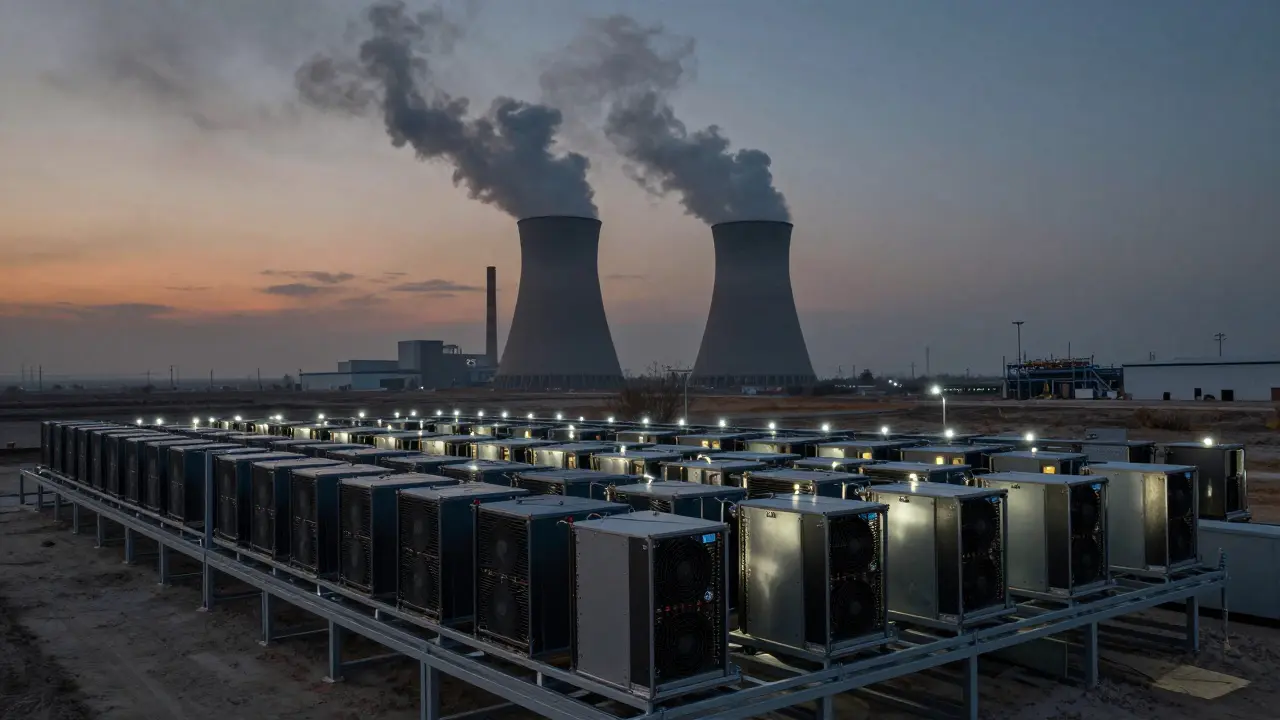
Why is the footprint so high? Because mining follows cheap power, not green power. Historically, large portions of the hash rate operated in regions reliant on coal-fired grids, such as Inner Mongolia before China’s 2021 crackdown, and later in parts of Kazakhstan and Texas. According to Digiconomist, the average carbon intensity of Bitcoin’s electricity rose from 478 gCO2/kWh in 2020 to over 557 gCO2/kWh in 2021. This is significantly higher than the global average grid intensity of roughly 400 gCO2/kWh.
The result is a per-transaction cost that shocks most observers. A single on-chain Bitcoin transaction can generate between 624 kg and 860 kg of CO2. That is orders of magnitude higher than traditional payment systems. Visa or Mastercard transactions emit grams of CO2, not kilograms. Even compared to other cryptocurrencies, Bitcoin stands out. After Ethereum transitioned to Proof-of-Stake in 2022, reducing its energy use by over 99%, Bitcoin’s PoW model appears increasingly archaic and inefficient by comparison.

Is Mining Becoming Greener?
Proponents of Bitcoin argue that the narrative of dirty energy is outdated. They point to recent data showing a shift toward sustainable sources. A 2025 analysis by the MiCA Crypto Alliance and Cambridge Centre for Alternative Finance found that 52.4% of Bitcoin mining electricity now comes from sustainable sources, including renewables and nuclear power. Specifically, 42.6% came from renewable generation like hydro, wind, and solar.
This is a significant improvement from earlier years, when renewable shares were estimated closer to 30-37%. Miners have become sophisticated energy traders, locating facilities near stranded energy sources-such as excess hydroelectric power in Sichuan, China, or flared natural gas in Texas-that would otherwise go to waste. By absorbing this "curtailed" energy, miners argue they provide an economic incentive to build more renewable infrastructure.
However, critics counter that nearly half of the network still relies on fossil fuels. When you consider that global electricity generation is still dominated by coal and gas, a 52% sustainable share means the remaining 48% is substantial. At 138 TWh total consumption, even a small percentage of fossil fuel use translates to millions of tons of emissions. Furthermore, the "stranded energy" argument faces scrutiny: does building mines solely to consume excess power justify the land use, water consumption, and electronic waste generated by ASIC hardware?
The Hidden Costs: Water and Hardware Waste
Beyond carbon, Bitcoin mining imposes other environmental burdens that rarely make headlines. One critical issue is water usage. Large-scale mining farms require massive cooling systems to prevent ASIC miners from overheating. A 2025 study published in *Scientific Reports* highlighted that Bitcoin mining exerts a negative impact on environmental sustainability through increased regional water stress. In arid regions like Texas or parts of Central Asia, drawing groundwater for cooling competes directly with agricultural and municipal needs.
Then there is the hardware lifecycle. ASIC (Application-Specific Integrated Circuit) miners are specialized machines designed for one task: hashing SHA-256. They become obsolete quickly as newer, more efficient models are released. This leads to a cycle of rapid disposal and e-waste. Unlike general-purpose computers, these devices cannot be repurposed. Millions of tons of rare earth metals, plastics, and circuit boards end up in landfills, leaching toxic materials into soil and waterways. The manufacturing footprint of producing new miners every few years adds another layer of hidden carbon debt that is often excluded from simple energy-consumption calculations.

Proof-of-Work vs. Proof-of-Stake: A Tale of Two Systems
To understand why Bitcoin’s footprint is so controversial, it helps to compare it with the alternative: Proof-of-Stake (PoS) is a consensus mechanism where validators are chosen to create blocks based on the amount of cryptocurrency they hold and are willing to 'stake' as collateral, rather than computational power.
PoS networks like Ethereum, Cardano, and Solana consume a fraction of the energy used by PoW networks. The ScienceDirect study noted that PoW transactions are approximately 27 times more carbon-intensive than PoS transactions. This efficiency gap has led regulators and environmentalists to question whether PoW is a viable technology in a climate-constrained world.
| Metric | Proof-of-Work (Bitcoin) | Proof-of-Stake (Ethereum post-merge) |
|---|---|---|
| Annual Energy Use | ~138 TWh | ~0.01 TWh (negligible) |
| CO2 per Transaction | ~625-860 kg | ~0.0002 kg (grams) |
| Hardware Requirement | Specialized ASICs (high e-waste) | Standard servers (low turnover) |
| Carbon Intensity Source | Highly dependent on grid mix | Minimal direct impact |
Bitcoin cannot switch to PoS without fundamentally altering its code and decentralization model, which many purists view as heresy. This ideological commitment to PoW locks Bitcoin into its high-energy path, regardless of technological advancements in efficiency. Every time miners buy more efficient hardware, the network difficulty adjusts, encouraging them to add more machines anyway-a phenomenon known as Jevons Paradox. Efficiency gains are offset by increased scale, keeping total energy use high.
Policy and Future Outlook
As we move through 2026, the pressure on Bitcoin to clean up its act is intensifying. The OECD has recommended that regulators consider differentiated taxation or energy-efficiency standards based on consensus mechanisms. Some jurisdictions are already restricting PoW mining due to grid strain. Conversely, regions with abundant renewable energy are actively recruiting miners to stabilize their grids.
For investors and users, the question is no longer just about financial returns but ethical alignment. UC Berkeley researchers calculated that between 2016 and 2018, each $1 of Bitcoin created caused approximately $0.49 in health and climate damages in the US alone. These externalities-who pays for the polluted air and strained water supplies-are not reflected in Bitcoin’s market price.
Unless the global electricity grid decarbonizes dramatically by 2030, or Bitcoin adopts a radical change in its protocol, its carbon footprint will remain in the range of 40-100 MtCO2 annually. That is enough to rival the emissions of medium-sized nations. The technology may be revolutionary, but the planet is paying the bill.
How much CO2 does one Bitcoin transaction produce?
Estimates vary, but a single on-chain Bitcoin transaction typically generates between 624 kg and 860 kg of CO2. This is comparable to driving a gasoline-powered car for 1,600 to 2,600 kilometers or occupying a seat on a long-haul international flight.
Is Bitcoin mining using renewable energy?
Yes, but not exclusively. As of 2025, approximately 52.4% of Bitcoin mining electricity comes from sustainable sources, including renewables and nuclear power. However, nearly half of the energy still comes from fossil fuels, primarily in regions with cheap coal or natural gas.
Why is Bitcoin’s energy use so high compared to other cryptocurrencies?
Bitcoin uses Proof-of-Work (PoW), which requires miners to perform billions of calculations to secure the network. This process is intentionally energy-intensive to prevent attacks. Most other major cryptocurrencies have switched to Proof-of-Stake (PoS), which uses negligible energy by validating transactions through held assets rather than computational power.
Does Bitcoin mining affect water resources?
Yes. Large mining farms require significant amounts of water for cooling their hardware. In drought-prone areas, this can contribute to local water stress, competing with agricultural and residential needs. Studies indicate a negative correlation between high mining activity and regional load capacity factors for water.
Can Bitcoin reduce its carbon footprint without changing its protocol?
Partially. Miners can relocate to regions with cleaner grids or use stranded renewable energy. However, because the network difficulty adjusts to maintain block times, efficiency gains often lead to more mining hardware being added, keeping total energy consumption high. Significant reduction likely requires broader grid decarbonization or a fundamental shift away from Proof-of-Work.