
When a spacecraft fails, when an astronaut is stranded in freezing waters or adrift in the desert, who is responsible for saving them? The answer isn’t just about bravery or technology-it’s written into international law. Since 1968, the Rescue Agreement is an international treaty that legally binds nations to rescue astronauts in distress and return them safely, no matter where they land. It’s one of the few space laws that has actually worked-saving lives, building trust, and keeping cooperation alive even during the Cold War.
What the Rescue Agreement Actually Says
The Rescue Agreement is a binding treaty under the United Nations that expands on Articles 5 and 8 of the 1967 Outer Space Treaty. It doesn’t just say "help if you can." It says: you must.
- Article 3 requires any country that learns astronauts are in distress to immediately take all possible steps to rescue them and give them aid-no excuses.
- Article 4 says rescued astronauts must be returned to their home agency as quickly and safely as possible.
- Article 5 covers space debris: if a satellite or rocket part crashes on your land, you must notify the launching country and help recover it if asked.
- Article 5(4) makes it clear: the country that launched the object pays for recovery costs.
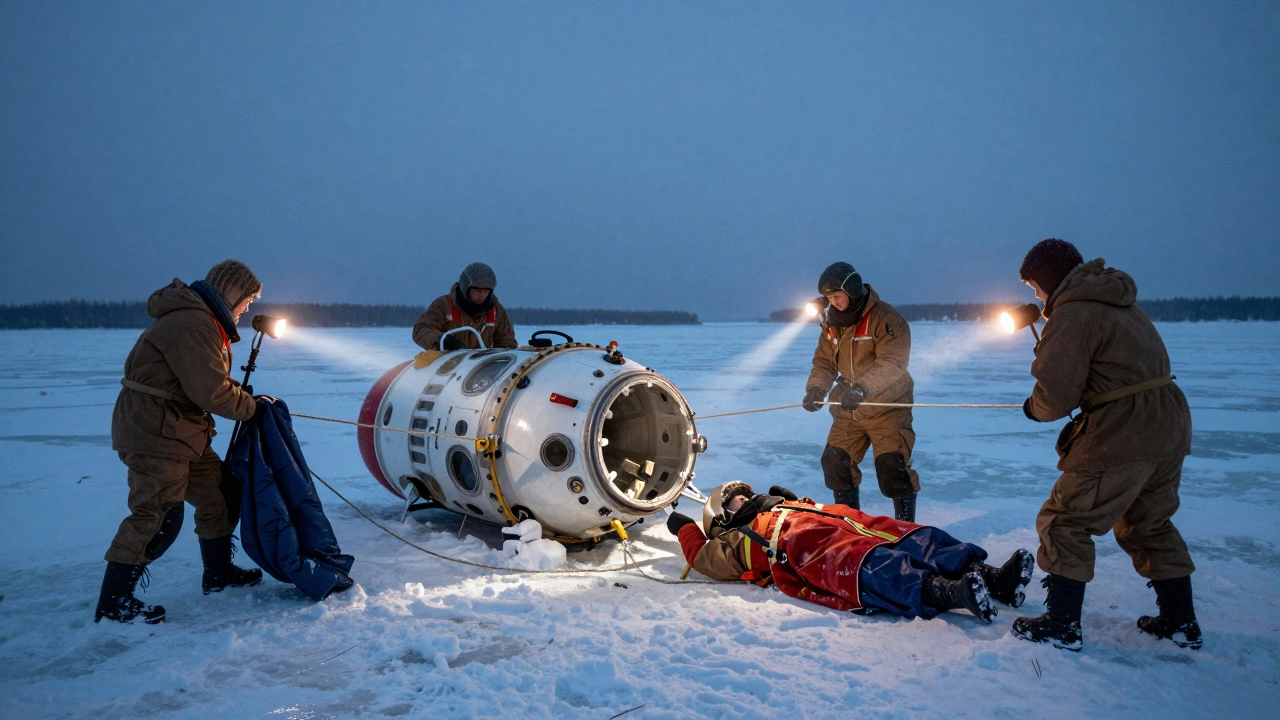
It doesn’t matter if the astronaut is American, Russian, Japanese, or from a country that’s never launched a rocket. The obligation applies to everyone in space. That’s why, in 1976, when Soviet cosmonauts landed in Lake Tengiz, Kazakhstan, after Soyuz 23’s parachute failed, rescue teams from across the USSR raced in-even through ice and snow-to pull them out within hours. No one asked who owned the spacecraft. They just acted.
Who Counts as an Astronaut?
Here’s the problem: the Rescue Agreement was written in the 1960s. Back then, only government-trained pilots and scientists went to space. Today, people like Richard Branson, Jeff Bezos, and paying tourists have flown. Are they "astronauts" under the law?
The treaty doesn’t define the word. That’s a huge gap. The Outer Space Treaty refers to "personnel of a spacecraft," but the Rescue Agreement uses "astronauts." That’s not the same thing. Legal scholars like Michael Listner warn this ambiguity could leave commercial spaceflight participants without guaranteed protection. If a tourist on a Blue Origin flight crashes in the ocean, does the U.S. have to coordinate with Brazil, Argentina, or South Africa to rescue them? The law doesn’t say.
And it’s not theoretical. In 2014, Virgin Galactic’s SpaceShipTwo crashed during a test flight. The FAA investigated, but there was no mention of international rescue coordination under the Rescue Agreement. Why? Because the company wasn’t required to follow it. No legal obligation existed for private companies to notify foreign governments or request help.
Real-World Examples That Prove It Works
The Rescue Agreement has never failed. It’s been tested-and passed-multiple times.
- Soyuz 23 (1976): Cosmonauts landed in a frozen lake in Kazakhstan. Soviet rescue teams, supported by local Kazakh authorities, retrieved them within hours. No nation refused help. No bureaucracy delayed it.
- Soyuz T-10 (1983): A rocket exploded on the launchpad. The escape tower pulled the crew clear seconds before blastoff. Soviet rescue teams were already in place, trained and ready. Both cosmonauts survived.
- Starliner Malfunction (2024): NASA astronauts Suni Williams and Butch Wilmore were stuck on the ISS for nine months after Boeing’s spacecraft failed. While not a traditional rescue, the international response followed the spirit of the Rescue Agreement: NASA, Roscosmos, and SpaceX coordinated logistics, supplies, and return plans. Russia didn’t refuse cooperation-even amid political tensions.
These aren’t accidents. They’re proof that the treaty works because nations trust it. Even rivals know: if they send someone to space, someone else will bring them home.
Where the System Is Falling Apart
But trust isn’t enough. The system has cracks.
First, costs are unclear. The treaty says launching nations pay for object recovery-but it says nothing about astronaut rescue. Who pays if a U.S. astronaut lands in the Sahara and needs a helicopter, medical team, and 10 days of care? The U.S.? The country where they landed? No one knows. That uncertainty could make countries hesitate to help.
Second, many countries don’t have the tools. A 2021 UNOOSA survey found 43% of state parties have no formal rescue protocols. Some have never trained their emergency services to handle space-related incidents. Others rely on handshakes with NASA or Roscosmos. That’s not a system-it’s a gamble.
Third, enforcement doesn’t exist. There’s no court, no fine, no penalty if a country ignores the agreement. It only works because nations want it to work. But in a world of rising geopolitical tension, that’s risky. In 2022, during a Soyuz landing anomaly, Russian and American officials didn’t coordinate at all-despite both being signatories.
What’s Being Done to Fix It
The space world knows the agreement is outdated. And change is coming.
- In April 2024, the UN Office for Outer Space Affairs launched the "Space Rescue Initiative," bringing together 47 countries and 12 private companies to draft new guidelines.
- The International Institute of Space Law published "Draft Articles on Space Rescue Operations" in January 2024, proposing a new definition: "spaceflight participant"-covering tourists, researchers, and commercial crew.
- NASA and ESA signed a joint rescue protocol in March 2024, creating shared procedures for handling emergencies involving commercial spacecraft.
- The Commercial Spaceflight Federation now has 17 companies following voluntary "Space Rescue Best Practices," including emergency notification systems and crew tracking.
But these are just steps. None are legally binding. Without a treaty update, the Rescue Agreement will keep working for government astronauts-but leave tourists, scientists on private missions, and even future lunar workers in legal limbo.
What’s at Stake
By 2030, experts predict up to 500 spaceflight participants could be flying annually. If one gets hurt, and no country is legally required to help, the consequences could be deadly-and politically explosive.
The Rescue Agreement was designed to prevent the worst-case scenario: an astronaut dying alone in a foreign desert, and no one stepping forward to help. That’s why it’s called the humanitarian cornerstone of space law. But today, that cornerstone is cracking under the weight of commercial expansion.
Space is no longer just for governments. It’s for businesses, tourists, and scientists from all over the world. The law needs to catch up. If it doesn’t, the next time someone gets stranded, the question won’t be "Can we rescue them?" It’ll be "Who’s legally responsible?" And that’s a question no one wants to answer.
Is the Rescue Agreement legally binding?
Yes. The Rescue Agreement is a binding international treaty under the United Nations. As of 2023, 105 countries have ratified it, making their obligations enforceable under international law. Even countries that signed but haven’t ratified are expected to follow its principles as customary international law.
Does the Rescue Agreement cover space tourists?
It’s unclear. The treaty uses the term "astronaut," but doesn’t define it. Legal experts argue that space tourists may not qualify under current wording, leaving them without guaranteed rescue rights. This ambiguity is a major concern as commercial spaceflight grows, and the UN is now working to clarify who counts as a protected person under the agreement.
Who pays for rescuing astronauts?
The treaty doesn’t say. It only requires launching nations to pay for recovering space objects. Rescue costs for astronauts-like medical care, transport, or equipment-are left undefined. This creates financial uncertainty and could discourage countries from helping, especially in remote or expensive locations.
Has the Rescue Agreement ever been ignored?
No rescue has ever failed due to refusal of help. But in 2022, during a Soyuz landing anomaly, Russian and U.S. officials didn’t coordinate, even though both are signatories. This suggests political tensions can override cooperation-even when the law says they shouldn’t.
What happens if a spacecraft lands in international waters?
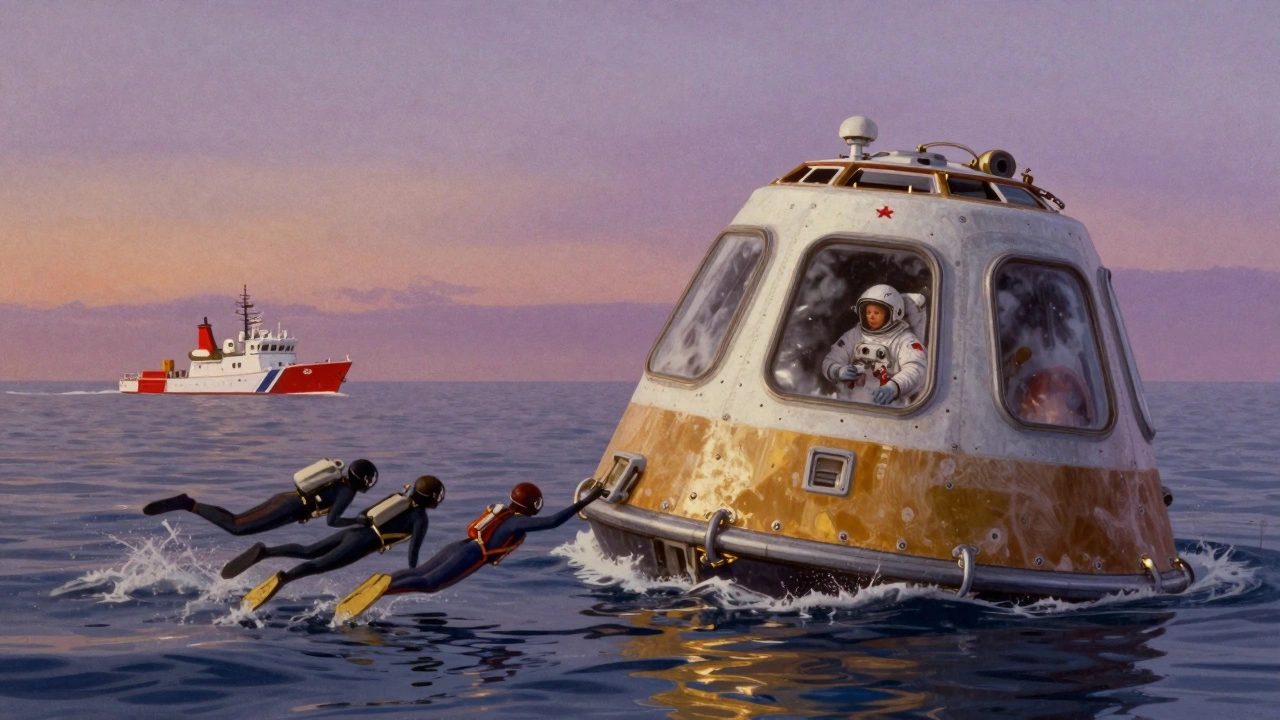
Any state party that is capable of assisting must do so. The treaty doesn’t require a country to act only if the landing is on its territory. If a capsule lands in the Pacific, any nation with the resources-like the U.S., Japan, or Australia-must respond. This global responsibility is what makes the agreement so powerful.
Are private space companies required to follow the Rescue Agreement?
No, not directly. The treaty binds governments, not companies. But governments are responsible for ensuring their private operators comply. For example, the U.S. requires commercial launch providers to have emergency plans under the Commercial Space Act. But enforcement varies widely, and many companies operate without clear legal obligations.
15 Responses
The Rescue Agreement is binding, clear, and has saved lives. The fact that we’re even debating whether tourists count shows how far we’ve drifted from the spirit of the thing.
It’s staggering, really, how a document drafted during the height of Cold War paranoia-when the very idea of space cooperation felt like a fantasy-has endured as one of the most elegant, humane instruments of international law. The language is deliberately broad, not because it was lazy, but because it was visionary: it didn’t tether itself to the astronauts of 1968, but to the *humanity* of anyone who ventures beyond the atmosphere. The omission of a definition isn’t a flaw-it’s an invitation for evolution. We’re now in the era where the line between pilot and passenger blurs, and the law must stretch to accommodate not just bodies, but the moral weight of their presence in the void. To reduce this to a semantic quibble over terminology is to miss the point entirely: if you’re in distress, in the silence of space or the frozen chaos of a remote landing, you don’t deserve a lawyer-you deserve a rescue team.
They dont want you to know this but the rescue agreement was never meant for humans its a cover for recovering alien tech and the astronauts are all actors the real crew never left earth the whole space program is a psyop and the rescue teams are just government contractors paid to pretend theyre saving people
Yeah man, I read this whole thing and honestly it’s wild how this treaty just… worked. No one’s ever refused. Even when the world was falling apart, they still pulled people out of lakes. That’s kind of beautiful, you know?
so like… if a rich dude on a blue origin flight crashes in the amazon do they just leave him? lol i hope not
It’s not about legality-it’s about morality. The fact that we even have to debate whether a paying customer deserves to be rescued reveals a terrifying moral decay in our collective ethos. We’ve turned space into a luxury experience, and now we’re asking whether the wealthy are worth saving. That’s not progress. That’s corruption.
Why should we help some russian cosmonaut get pulled out of a lake when our own tax dollars pay for their rockets? The rescue agreement is a joke and we should pull out
There is no excuse for not defining who counts as an astronaut. This isn’t a gray area-it’s negligence. And the fact that private companies are allowed to operate without clear legal obligations is a crime against safety. Someone is going to die because of this loophole, and when they do, the people who ignored it will be the ones who killed them.
I think the real win here is that even during all the political crap, people still showed up to help. That’s the kind of thing we should be building on, not arguing over
They’re using the rescue agreement to track us. Every time someone gets stranded they’re logging our location. The next thing you know they’ll be using it to control who gets to go to space. It’s all a surveillance program disguised as humanitarian aid
Think about it. We send people into the void, where no one can hear you scream, and we tell them, ‘Don’t worry, someone will come.’ But what if no one comes? What if the system fails? What if the world decides your life is too expensive to save? That’s not just a legal gap-that’s a spiritual collapse. We’ve outsourced our humanity to bureaucracy and now we’re surprised when it breaks. The stars don’t care about your contracts. They only care if you’re alive.
the article says 'astronauts' but then talks about 'spaceflight participants' that's not even close to the same word. this is why we need grammar police. its not a typo its a legal disaster waiting to happen
What’s fascinating isn’t that the agreement works-it’s that it works because people chose to honor it. Not because they were forced to, but because they believed in something bigger than politics. That’s rare. That’s sacred. We’re not just talking about laws here-we’re talking about trust. And trust, once broken, can’t be rewritten in a treaty. It has to be rebuilt, one rescue at a time.
so who pays for the rescue? the usa? the company? the person who crashed?
Oh, darling, it’s not just a loophole-it’s a class issue. The Rescue Agreement was written for astronauts, not for the nouveau riche who think space is their next vacation spot. We’ve turned the cosmos into a gated community, and now we’re shocked when the gatekeepers won’t let the hoi polloi in? How quaint. The real tragedy isn’t the legal ambiguity-it’s that we’ve forgotten that space belongs to everyone, not just those who can afford the ticket.