
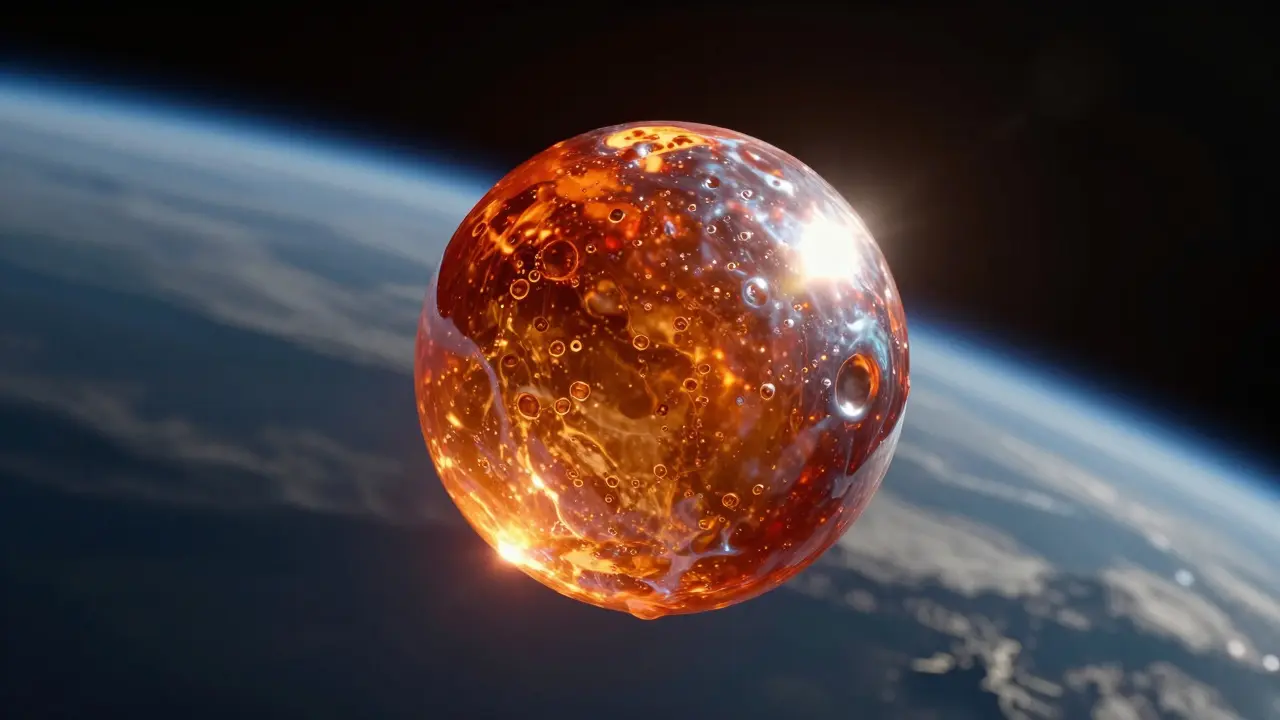
Imagine trying to weld a steel beam while floating in the vacuum of space. There is no gravity to pull the molten metal down into a neat puddle. Instead, the liquid metal wants to form a perfect sphere and float away. For decades, this simple physics problem stopped humans from building large structures directly in orbit. But as we look toward lunar bases and Mars missions, we can no longer afford to launch every single bolt and beam from Earth. We need to build things where they are used.
This is the core challenge of welding in microgravity, which is the set of fusion and solid-state processes adapted for environments with near-zero gravitational acceleration. It is not just about joining two pieces of metal; it is about mastering fluid dynamics, radiation safety, and thermal control in an environment that actively fights against traditional engineering methods. While mechanical fasteners like bolts have held the line for years, true structural integrity for massive space stations or antennas requires fusion welding. The technology exists, but it has remained largely experimental since the 1980s.
The Physics Problem: Why Welding Fails in Zero-G
To understand why space welding is so hard, you first have to forget how welding works on Earth. On our planet, gravity does a lot of heavy lifting. When you melt metal, gravity pulls the dense liquid downward, creating a stable pool. This allows the welder to control the shape and penetration depth simply by moving the torch along the joint. Convection currents-caused by the difference in density between hot and cold metal-also help mix the pool and remove impurities.
In microgravity, those forces vanish. Surface tension becomes the dominant player. Without gravity pulling it down, molten metal behaves like water droplets in a shower; it beads up into spheres. If you try to arc weld without shielding gas or containment, the molten pool can detach and float away as dangerous shrapnel. Furthermore, in the vacuum of space, metals boil at much lower temperatures, and gases expand rapidly, causing porosity (tiny bubbles) in the final weld if not managed correctly.
This shift in physics means that standard Gas Metal Arc Welding (GMAW), common in construction back home, is nearly impossible in open space. You cannot rely on a shield of argon gas because there is no atmospheric pressure to keep it in place around the weld zone. Instead, engineers must turn to techniques that do not require external shielding or that use focused energy beams capable of operating in a vacuum.
A Brief History: From Soyuz 6 to Salyut-7
The quest to weld in space began in the late 1960s during the height of the Space Race. The Soviet Union led the early charge, driven by the need to repair spacecraft in orbit. In October 1969, cosmonauts Georgy Shonin and Valeri Kubasov aboard Soyuz 6 performed the first cabin welding experiments. They used a device called Vulkan, which could perform electron-beam, arc, and pressure welding inside the pressurized cabin. It proved that joining metals was possible, but it was confined to the safe interior of the ship.
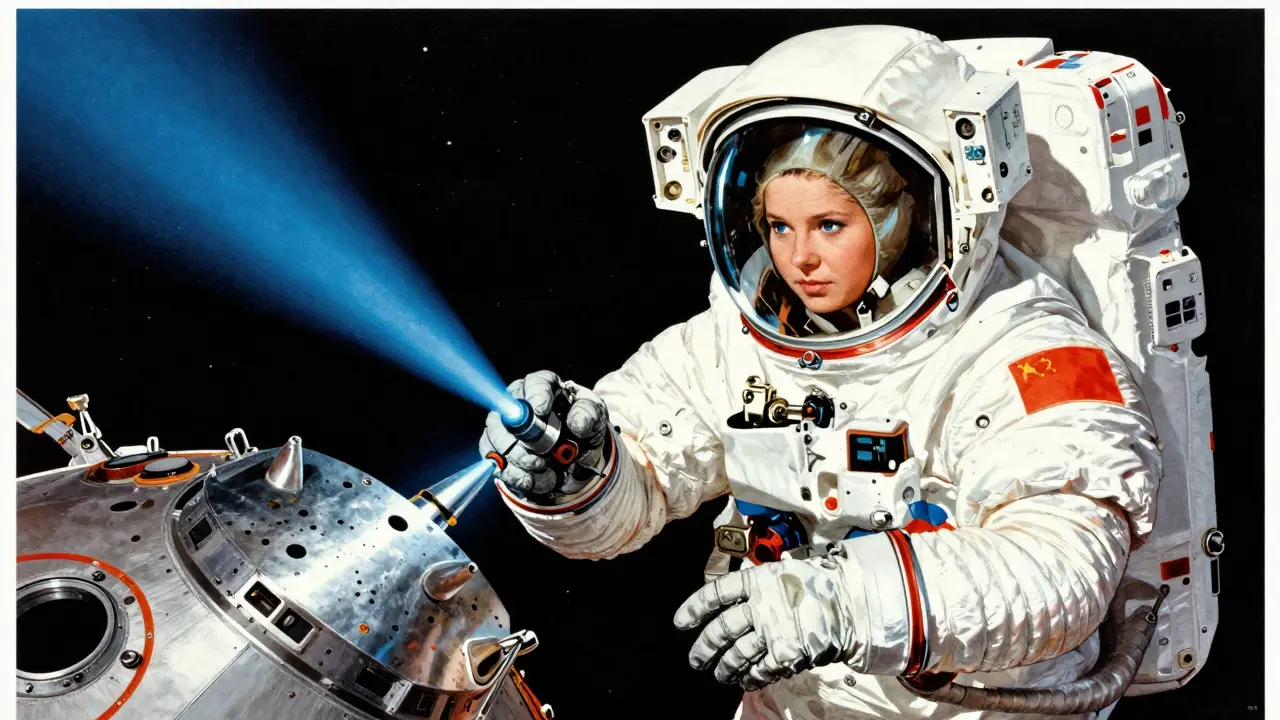
The real breakthrough came on July 25, 1984. Cosmonauts Svetlana Savitskaya and Vladimir Dzhanibekov performed the first-and so far, only-documented open-space welding during an Extravehicular Activity (EVA) at the Salyut-7 space station. They used the Universalny Rabochy Instrument (URI), a handheld electron-beam tool. Savitskaya cut titanium samples, welded specimens, and even applied silver coatings. Her post-flight assessment was famously confident: “The welded joints obtained in space are in no way inferior to good industrial samples on Earth.”
Despite this success, operational space welding stalled. NASA conducted similar experiments on Skylab in 1973 using electron-beam welding, showing that stainless steel and aluminum could be joined with properties comparable to ground-based welds. However, concerns over X-ray radiation generated by high-voltage electron guns led to the cancellation of planned manual welding projects for the International Space Station (ISS). Since 1984, no full-scale welds have been performed in open space, leaving a forty-year gap in practical application.
Key Techniques for Microgravity Joining
Because standard arc welding is too risky in a vacuum, researchers focus on three primary methods that thrive in low-pressure, zero-gravity environments.
- Electron Beam Welding (EBW): This uses a high-velocity stream of electrons to generate heat. It requires a vacuum, which space naturally provides. EBW offers deep penetration and high speed. The URI tool used on Salyut-7 relied on this principle. However, the main drawback is the generation of hazardous X-rays when the electron beam hits the target, requiring heavy shielding and keeping astronauts at a distance.
- Laser Beam Welding (LBW): Lasers offer remote energy delivery, meaning the power source doesn't have to be right next to the weld. This reduces the mass carried by the astronaut or robot. Experiments on parabolic flights have shown LBW can work on aluminum and titanium alloys. The challenge lies in plume formation-the vaporized metal creates a cloud that can scatter the laser beam or contaminate nearby optics.
- Electron Beam Freeform Fabrication (EBF3): Developed by NASA, this is less about joining two existing parts and more about additive manufacturing. It deposits wire feedstock layer by layer using an electron beam. Tests on NASA's KC-135A aircraft (which simulates microgravity via parabolic flight) showed that once the bead is deposited, gravity-induced sagging is negligible. This makes EBF3 ideal for printing replacement parts in orbit.
| Technique | Vacuum Requirement | Safety Risk | Best Use Case |
|---|---|---|---|
| Electron Beam (EBW) | Required | High (X-rays) | Deep penetration repairs |
| Laser Beam (LBW) | Preferred | Medium (Plume/Optics) | Remote robotic assembly |
| EBF3 (Additive) | Required | High (X-rays) | On-demand part fabrication |
| Brazing/Soldering | Not Required | Low | Joining dissimilar metals |
The Shift to Robotics and Additive Manufacturing
Why haven't we seen more welding on the ISS? The answer is risk management. Sending a human out for a six-hour EVA to perform a delicate welding task exposes them to extreme danger for a relatively small gain. Mechanical fasteners are boring, but they are reliable and reversible. If a bolt breaks, you replace it. If a weld fails, you might lose a module.
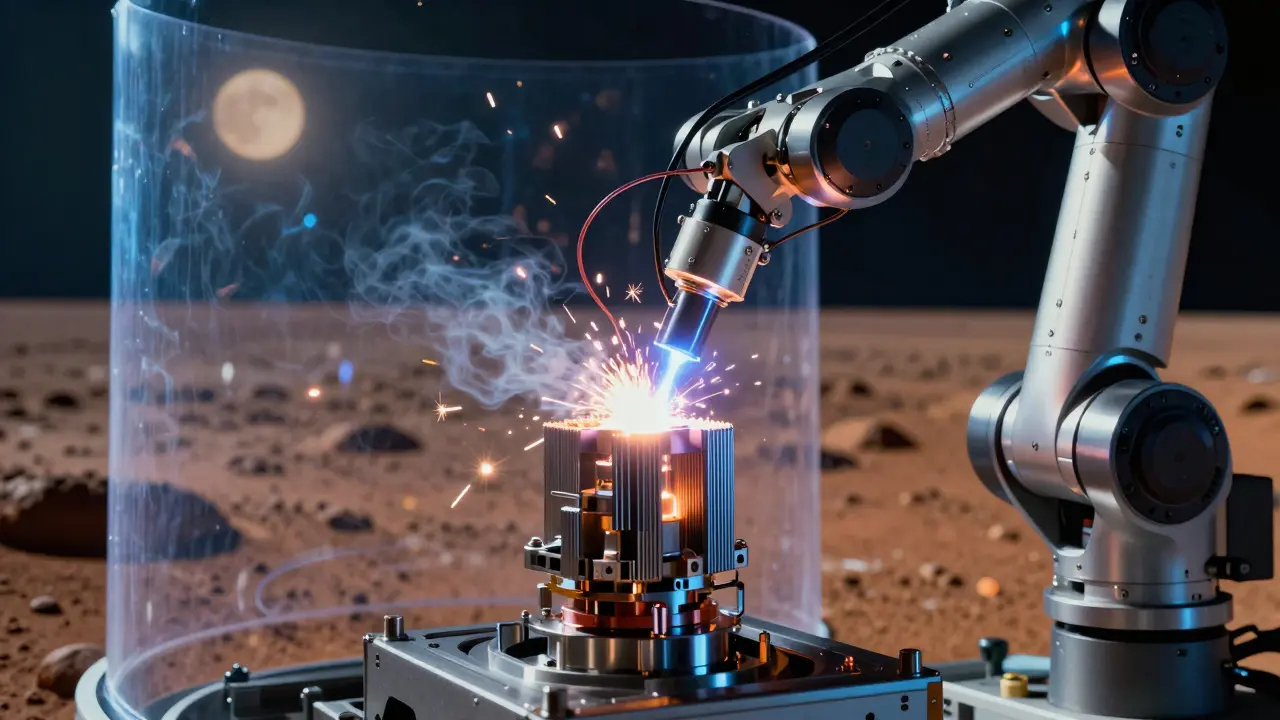
This reality has shifted the industry focus from manual welding to robotic In-Space Assembly and Manufacturing (ISAM). NASA’s recent reports emphasize autonomous systems. Robots don't care about X-ray exposure, nor do they get fatigued. They can operate continuously in the vacuum, using Laser Beam Welding or EBF3 to construct large solar arrays or habitat modules.
Companies are now working with NASA to qualify these processes for deployment beyond Low Earth Orbit. The goal is to send raw materials-coils of wire or sheets of metal-to the Moon or Mars and manufacture the infrastructure locally. This reduces the launch mass significantly. Launching a kilogram of payload to Mars costs tens of thousands of dollars; launching the same kilogram of finished structure is exponentially more expensive due to volume constraints. Local manufacturing solves this logistics nightmare.
Challenges Remaining in 2026
Even with advanced robotics, several hurdles remain. First is the issue of thermal management. In space, heat does not dissipate easily through convection. A welding process generates intense localized heat, which must be radiated away quickly to prevent damaging surrounding components or altering the metallurgical properties of the base metal.
Second is contamination. Molten metal splatter and vapor plumes can coat sensitive instruments, solar panels, or visors. On Earth, wind or ventilation clears this debris. In space, that debris floats forever until it settles on something critical. Effective capture systems or directional shielding are essential.
Finally, there is the lack of standardized protocols. Because there have been no operational welds since 1984, there is no extensive database of long-term performance data for space-welded joints under cyclic thermal loading and atomic oxygen erosion. Engineers must rely on simulations and short-duration parabolic flight tests, which only provide seconds of microgravity per drop. Building confidence in these technologies requires years of rigorous testing before we trust them with crew habitats.
Conclusion
Welding in microgravity is technically feasible, as proven by Soviet and American experiments over half a century ago. However, the transition from experimental curiosity to industrial necessity is slow. As we move toward permanent lunar presence and deep-space exploration, the ability to join materials in situ will become non-negotiable. The future belongs not to astronauts holding welding torches, but to autonomous robots utilizing electron beams and lasers to build the infrastructure of the solar system, one layer at a time.
Can you use standard arc welding in space?
No, standard arc welding is extremely difficult in open space. It relies on shielding gases (like argon) to protect the molten pool from oxidation. In a vacuum, these gases disperse instantly, leading to poor weld quality and potential explosion of the molten metal. Additionally, the lack of gravity causes the molten pool to form spheres and float away rather than staying in the joint.
What happened to the welding experiments on the International Space Station?
While limited soldering and brazing experiments have occurred on the ISS, no full-scale fusion welding has been performed since the 1980s. Plans for manual electron-beam welding were canceled primarily due to safety concerns regarding X-ray radiation exposure to astronauts. Current research focuses on robotic additive manufacturing rather than manual welding.
How does Electron Beam Freeform Fabrication (EBF3) work?
EBF3 is an additive manufacturing process developed by NASA. It uses a high-energy electron beam to melt metal wire feedstock, depositing it layer by layer to build 3D structures. It operates in a vacuum, making it ideal for space. Tests show that in microgravity, the deposited beads hold their shape well due to surface tension, allowing for precise fabrication of replacement parts in orbit.
Why is surface tension important in microgravity welding?
On Earth, gravity pulls molten metal down. In microgravity, surface tension is the dominant force acting on the liquid metal. It causes the molten pool to minimize its surface area, forming a sphere. Welding processes must account for this by controlling the energy input and geometry to ensure the metal wets the joint properly instead of balling up and detaching.
When was the last time welding was done in open space?
The last documented open-space welding occurred on July 25, 1984, during the Salyut-7 mission. Cosmonauts Svetlana Savitskaya and Vladimir Dzhanibekov used the URI electron-beam tool to weld titanium and stainless steel samples during an EVA. No subsequent missions have performed similar fusion welding tasks in open space as of 2026.
12 Responses
The physics of surface tension dominating over gravity is such a fascinating pivot point for engineering. We take convection for granted here on Earth, but in space, the fluid dynamics become purely capillary-driven. It makes you realize how much our current industrial methods are just lucky accidents of planetary mass rather than fundamental truths of material science.
wait so they literally just stopped welding in space for like 40 years?? that seems insane to me. i mean sure x-rays are bad but come on we have robots now right? why not just slap a lead apron on the bot and let it go to town. feels like bureaucracy killed progress again
oh please dont act like american engineering is the only thing that matters here. the soviet union did this first with vulkan and uri tools decades ago while nasa was still playing catch up with basic life support systems. typical western amnesia ignoring the actual pioneers who figured out electron beam welding in vacuum conditions long before anyone else cared about it
I cannot even begin to process the sheer audacity of floating molten metal spheres!!! It’s terrifyingly beautiful! Imagine the precision required to keep that liquid from becoming shrapnel!! The fact that Svetlana Savitskaya handled an electron-beam tool during an EVA is absolutely mind-blowing!! She must have had nerves of steel!! I’m shaking just thinking about the thermal management challenges!!
they say its for safety but its really because big aerospace contractors want to sell more replacement parts instead of fixing things in orbit. if you can weld it yourself you dont need to buy their proprietary bolts. its a classic planned obsolescence scheme wrapped up in 'risk management' jargon. wake up sheeple
I guess I never thought about how the lack of gravity would make the metal ball up like water droplets. It makes sense when you break it down. The part about X-ray radiation stopping the manual welding projects on the ISS is pretty interesting though. Seems like a valid concern for astronauts.
We need to stop letting fear dictate our exploration capabilities! Yes, radiation is a risk, but we have shielding technology! We have robotics! If we don't master in-space manufacturing now, we will never achieve sustainable lunar bases! Let's push through these hurdles together!
The metallurgical implications of porosity due to rapid gas expansion in a vacuum are often underestimated by laymen. Furthermore, the plume interference in Laser Beam Welding creates a significant optical attenuation issue that requires sophisticated real-time feedback loops to mitigate. It is not merely 'hard'; it is a complex multi-physics problem requiring advanced control theory.
silence speaks volumes. the void does not care about your welding torch. perhaps the delay is not failure but patience. nature has its own time for fusion.
One must consider the existential weight of constructing habitats in the void. To weld in microgravity is to impose order upon chaos without the crutch of terrestrial inertia. It is a philosophical act as much as an engineering one. We are learning to build where nothing holds us down.
You people are missing the obvious point. Mechanical fasteners are reliable because they are simple. Welding introduces variables that can fail catastrophically. Until robotic systems are proven to be 100% autonomous and error-free, relying on fusion welding for critical habitat structures is negligent. Stick to bolts until the tech matures.
it's hilarious how everyone gets excited about 'building in space' without realizing that launching the raw materials is still a logistical nightmare. you think printing a part on mars saves money? try getting the titanium coils there in the first place. the whole premise is flawed because the launch costs haven't dropped enough to make local manufacturing viable yet. stop dreaming and look at the economics.