

Imagine trying to shield your crew from the relentless bombardment of cosmic rays without adding a single kilogram of "dead weight" to your spacecraft. That’s the core problem engineers at NASA and ESA have been wrestling with for decades. Traditional shielding materials like aluminum add mass but do nothing else. They just sit there, heavy and passive. But what if the water you need to drink could also be the wall that saves your life?
This isn't science fiction; it's an architectural strategy known as Water Walls. By integrating water tanks directly into the structural walls of space habitats, designers turn a life-support necessity into a powerful radiation shield. It’s a clever play on physics and logistics that could define how we build bases on Mars or ships bound for Jupiter.
The Physics: Why Water Beats Aluminum
You might think metal is the obvious choice for shielding. After all, we use lead in hospitals and steel in nuclear plants. But space radiation is different. It consists largely of high-energy protons and heavier ions from galactic cosmic rays (GCR) and sudden bursts from solar particle events (SPE). When these particles hit heavy nuclei like aluminum, they shatter into secondary particles-neutrons and gamma rays-that can actually increase the biological damage inside the hull.
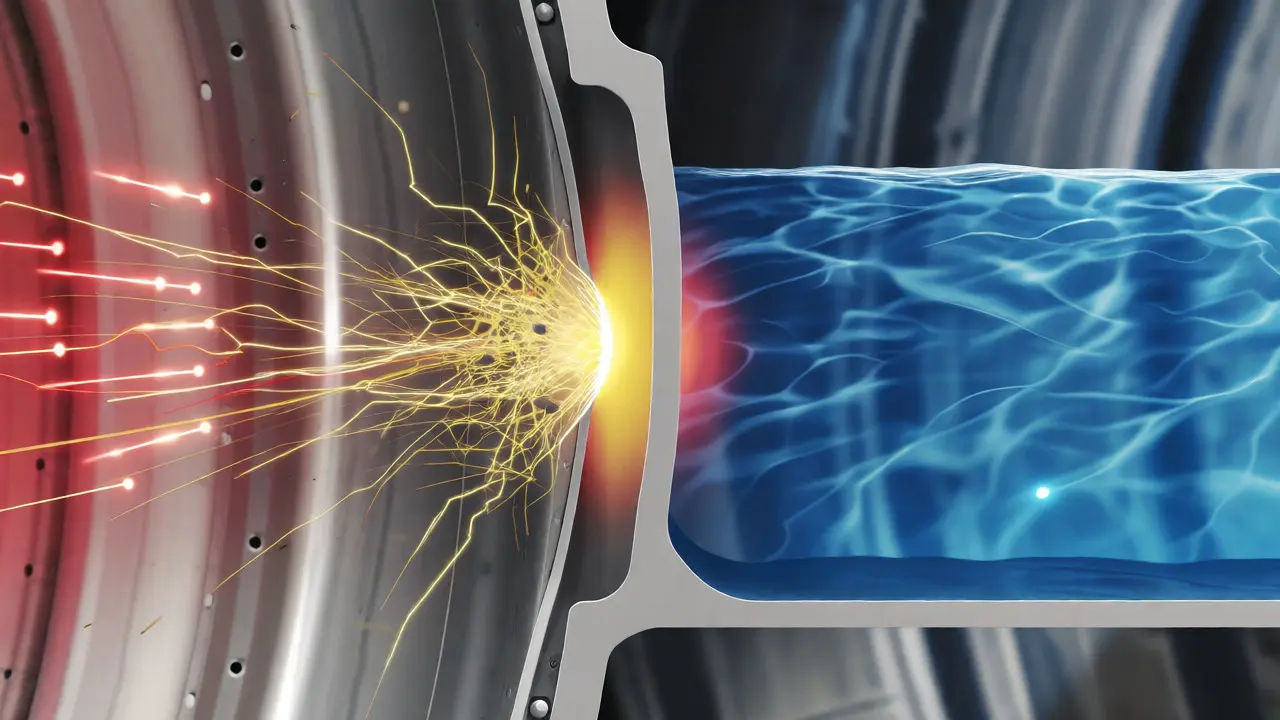
Water is a hydrogen-rich compound that excels at absorbing energetic particles through elastic collisions rather than fragmentation. Hydrogen atoms are small, so when a fast-moving proton hits one, it transfers energy efficiently without creating a shower of dangerous secondary radiation. According to studies by the European Space Agency (ESA), water has about 20% better proton stopping power per unit mass than aluminum. This means for every kilogram of shielding you carry, water protects you more effectively against the most common threat in deep space.
Beyond physics, there’s the logistical genius of dual-use. A spacecraft already needs thousands of kilograms of water for drinking, hygiene, and cooling systems. If you store that water in thin bladders floating in the cabin, it takes up valuable volume. If you integrate it into the walls, you solve two problems at once: storage and protection.
From Storm Shelters to Structural Walls
The idea didn’t appear overnight. It evolved through three distinct phases of engineering thought.
- The Safe Haven Era (1999): Early concepts focused on temporary shelters. The TransHab program proposed a cylindrical tank, roughly 3.35 meters in diameter, where astronauts could huddle during intense solar storms. It was a dedicated bunker, not part of the daily living space.
- The Integrated Wall Concept (2011-2012): Engineers realized why waste space? Studies showed that filling membrane bags embedded in inflatable habitat walls could provide continuous protection. A 2011 AIAA paper demonstrated that a 30 cm thick water wall could extend mission duration by 20% while keeping exposure within safe limits.
- The Multifunctional Architecture (2019-Present): Today, the focus is on total system integration. NASA’s recent reports describe water cells that handle air revitalization, waste processing, and thermal control simultaneously. These aren't just shields; they are the lungs and kidneys of the ship, wrapped around the crew like a protective cocoon.
This shift reflects a deeper understanding of risk management. Relying on separate systems for life support and shielding creates multiple points of failure. A unified system reduces complexity and increases redundancy.
| Shielding Type | Primary Mechanism | Mass Efficiency | Dual-Use Capability | Best Application |
|---|---|---|---|---|
| Aluminum Hull | Electron scattering / Ionization | Low (creates secondary neutrons) | Structural only | Low Earth Orbit (LEO) |
| Polyethylene | Hydrogen absorption | High | None (dead weight) | Long-duration transit |
| Integrated Water Walls | Hydrogen absorption + Thermal sink | Very High (dual-use mass) | Life Support, Cooling, Drinking | Mars Transit & Surface |
| Regolith Cover | Absorption & Scattering | Moderate (requires excavation) | Thermal insulation | Permanent Surface Bases |
Designing the Habitat: Thickness Matters
How much water do you actually need? It depends on the threat. For a short trip to the Moon, a few centimeters might suffice. For a three-year round trip to Mars, you need serious depth.
NASA modeling suggests that a 3.5 cm water layer can reduce radiation dose by about 72%. Increase that to 7 cm, and the reduction jumps to nearly 93%. Most modern habitat designs aim for a baseline of 10 cm (4 inches) of water integrated into the outer shell. This thickness provides a robust defense against Solar Particle Events, which are the acute danger during spacewalks or unshielded operations.
However, this comes at a cost. Adding a 10 cm water wall around crew quarters adds approximately 2,650 kg (5,842 lbs) of mass. In launch economics, every kilogram costs thousands of dollars. So, the trade-off is clear: you save money on dedicated shielding hardware but pay for the launch mass of the water itself. The key is that you’re buying water anyway, so the marginal cost of using it as a shield is near zero.
Engineering Challenges: Fluid Dynamics in Zero-G
It’s not as simple as pouring water into a bag. In microgravity, water doesn’t settle. It floats in blobs, sticks to surfaces, and makes mixing with air tricky. If you try to fill a wall tank, bubbles get trapped, reducing shielding effectiveness and potentially causing pressure issues.
To solve this, engineers developed capillary-based tanks. These use special mesh structures that separate gas and liquid phases without needing bladders. The water stays where you want it, even when the ship accelerates or rotates. Recent prototypes show promise, but long-term reliability over multi-year missions remains a test area. Leaks in a standard tank are annoying; leaks in a structural wall could compromise both shielding and habitability.
There’s also the issue of consumption. As astronauts drink the water, the shield gets thinner. Designers must account for this dynamic change. Some concepts propose using wastewater or greywater for shielding, replenishing the volume as fresh water is consumed, ensuring the wall thickness remains constant throughout the mission.

Mars Habitats: Ice as Armor
On the Martian surface, the rules change slightly. You don’t need to launch the water; you can mine it. Here, the concept evolves into architectural forms like igloos or double-walled domes. An inner chamber for living is surrounded by an annular space filled with ice or water. Since Mars lacks a global magnetic field, this layer acts as a primary barrier against GCR.
Architects from Embry-Riddle University have proposed designs where wastewater tanks form the outer shell of the habitat. This turns waste management into active protection. During the day, the water absorbs heat, keeping the interior cool. At night, it releases heat, preventing freezing. It’s a passive thermal regulation system powered by the same physics that stops radiation.
The Verdict: Is It Ready for Flight?
As of late 2026, no crewed mission has flown with full-scale Water Walls. We have tested components, simulated environments, and built ground prototypes. The technology is mature enough for architecture studies but hasn't seen operational deployment in deep space.
Critics point out the risks: potential leaks, microbial growth in stagnant water, and the sheer volume required. Proponents argue that the alternative-carrying tons of inert polyethylene or relying on fragile electronic shielding-is less reliable. Given the success of similar fluid-management technologies on the International Space Station, the path forward looks promising.
If we want humans to live on Mars for months at a time, we can’t afford to waste mass. Every drop of water counts twice: once for survival, once for safety. Integrating tanks into habitat walls isn't just an engineering trick; it’s a fundamental shift toward efficient, sustainable space exploration.
Why is water better than aluminum for shielding?
Water contains hydrogen, which is highly effective at slowing down high-energy protons found in space radiation. Unlike aluminum, which can fragment cosmic rays into harmful secondary particles, water absorbs them cleanly. Additionally, water serves as a life-support resource, making its mass "useful" rather than dead weight.
How thick does a water wall need to be?
For significant protection against Solar Particle Events, a thickness of 10 cm (about 4 inches) is often recommended. Modeling shows that even 3.5 cm can reduce radiation dose by 72%, while 7 cm can achieve nearly 93% reduction. Thicker walls offer diminishing returns but are crucial for long-duration missions beyond Earth's magnetosphere.
What happens if the water leaks?
Leakage is a primary engineering concern. Modern designs use bladderless capillary tanks to prevent sloshing and ensure stable containment. In case of a breach, the water would likely vaporize or freeze depending on temperature, requiring rapid repair protocols. Redundancy in tank segmentation helps isolate failures to prevent catastrophic loss of shielding.
Can we use recycled water for shielding?
Yes, and this is a key advantage. Greywater or treated wastewater can serve as shielding mass. This allows the habitat to maintain constant shield thickness even as fresh drinking water is consumed. It integrates waste processing directly into the structural protection of the crew.
Is this technology used on the ISS?
Not fully. The ISS uses localized water storage for emergency storm shelters, but it does not employ integrated Water Walls as a primary structural shield. The station relies more on its orbital altitude within the Van Allen belts for protection. Future deep-space habitats will require the integrated approach due to higher radiation levels.