
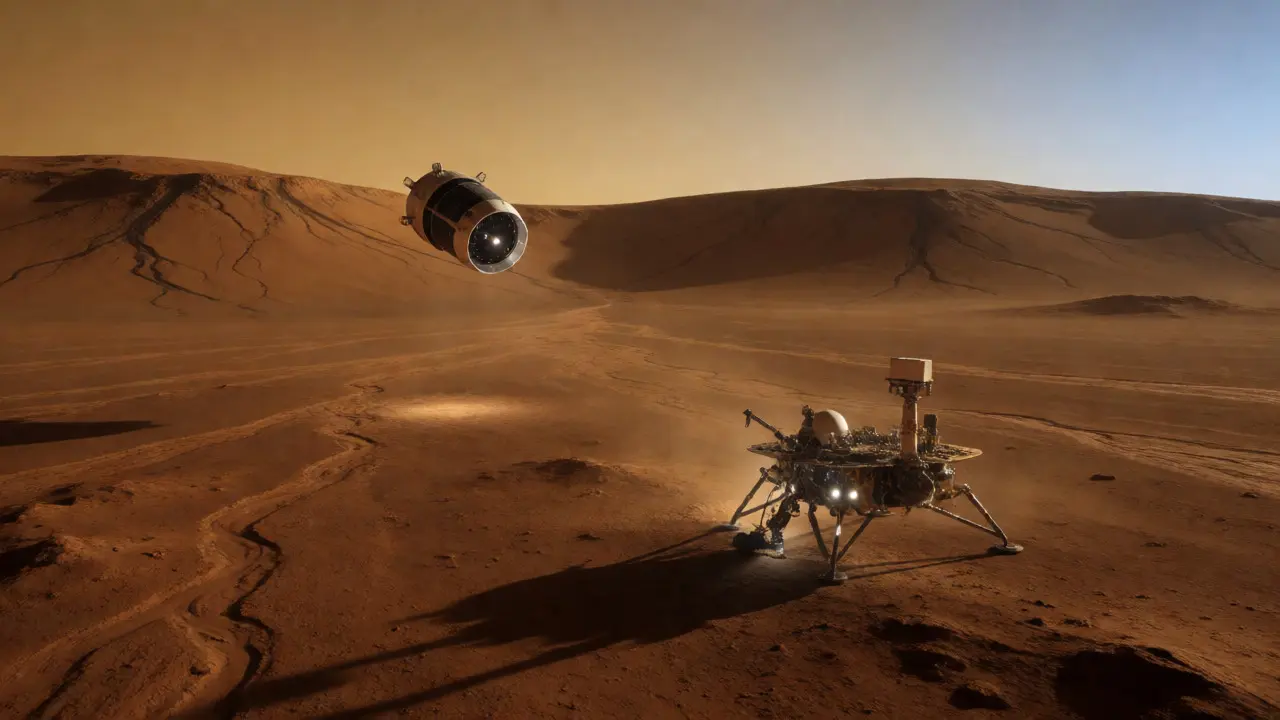
You might think finding water on Mars is a solved problem. After all, we’ve seen pictures of polar caps since the 1970s. But here’s the twist: knowing water is there isn’t enough. The real challenge is getting it out of the ground without melting your equipment or wasting years of mission time. As we look toward human missions in the late 2030s, Water on Mars has shifted from a scientific curiosity to a critical engineering resource. It’s not just about drinking; it’s about breathing, fueling rockets, and shielding astronauts from radiation. This article breaks down how we actually find this water, the tech needed to pull it from the Martian soil, and what we do with it once it’s in hand.
The Detection Puzzle: From Orbit to Seismology
Finding water on Mars wasn’t a single "eureka" moment. It was a slow accumulation of evidence across five decades. It started with Mariner 9, which arrived in 1971 and photographed valley networks that looked suspiciously like ancient riverbeds. But those were ghosts of the past. Proving water exists *now* required different tools.
In 2002, NASA’s Mars Odyssey spacecraft changed the game. Its Gamma Ray Spectrometer detected hydrogen-rich soil over areas the size of the United States. Hydrogen is a key component of water, so this was a massive clue. Then came the Phoenix lander in 2008. It didn’t just guess; it dug. When its robotic arm scooped up soil and heated it, water vapor released at 0°C confirmed ice just centimeters below the surface.
But what about liquid water? That’s where things get tricky. In 2015, the Mars Reconnaissance Orbiter (MRO) spotted dark streaks called Recurring Slope Lineae (RSL). Spectral analysis suggested these were flows of salty brine-water mixed with perchlorates that stays liquid even in freezing temperatures. More recently, in 2024, data from the InSight lander’s seismometer hinted at something deeper: liquid water trapped in rock cracks 10-20 km underground. This suggests Mars might have a hidden hydrosphere, but accessing it is currently beyond our reach.
Where Is the Water Actually Hiding?
Not all Martian water is created equal. If you’re planning a base, you need to know exactly where to dig. Here’s the breakdown of the three main sources:
| Source Type | Depth/Location | Accessibility | Extraction Difficulty |
|---|---|---|---|
| Polar Ice Caps | Surface to hundreds of meters | High volume, but extreme cold and seasonal darkness | Moderate (requires heating large volumes) |
| Mid-Latitude Buried Ice | 1-3 meters below surface | Prime target for human bases; easier logistics | Low to Moderate (shallow drilling) |
| Hydrated Minerals | Bound in clays/salts across surface | Widely available but low concentration | High (requires high heat to break chemical bonds) |
| Deep Crustal Reservoirs | 10-20 km depth | Inaccessible with current tech | Extreme (deep drilling challenges) |
For now, mid-latitude buried ice is the sweet spot. It’s close to the equator, where solar power works best, and it’s shallow enough to drill into without needing massive infrastructure. Polar caps are tempting because they’re huge, but the long winter nights make them risky for early missions. Hydrated minerals are everywhere, but you’d need to process tons of dirt to get a few liters of water, which is energy-intensive.
How Do We Get It Out? The RedWater Concept
Digging a hole on Mars isn’t like digging in your backyard. The gravity is only 38% of Earth’s, the pressure is near-vacuum, and if you expose ice to sunlight, it sublimates-turning straight from solid to gas-instead of melting. So, how do engineers plan to extract water?
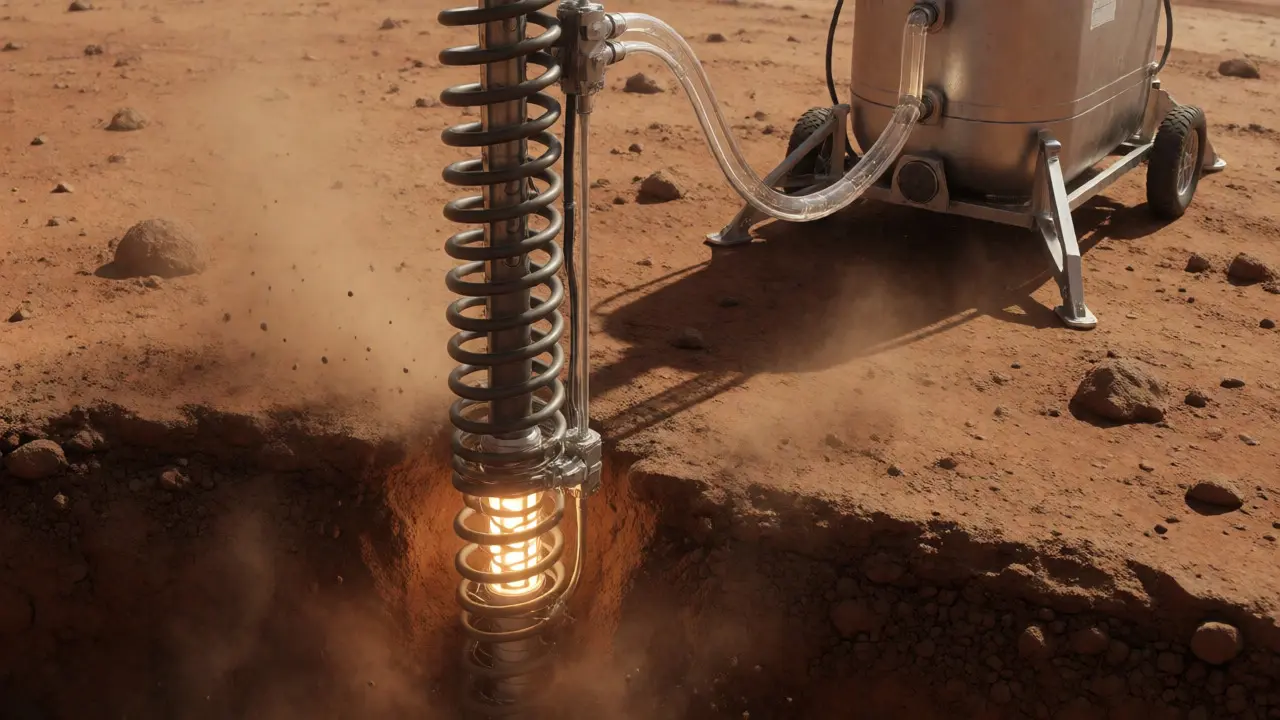
Enter systems like RedWater, developed by Honeybee Robotics. This isn’t a shovel; it’s a closed-loop mining system. Imagine a coiled tube drill that penetrates the regolith until it hits an ice layer. Instead of bringing chunks of ice to the surface, the system installs tubing into the borehole. A downhole heater warms the ice to around 100-150°C, creating a small pool of liquid water underground. Pumps then circulate this water up to mobile tanks on the surface.
This method minimizes the amount of material you have to move. You’re not excavating cubic meters of dirt; you’re pumping liquid. The RedWater system has reached Technology Readiness Level 6, meaning it’s been tested in relevant environments on Earth. It’s designed to extract tens of tons of water from a single deposit, which is enough to support a crew for months.
Why Bother? Utilization Beyond Drinking
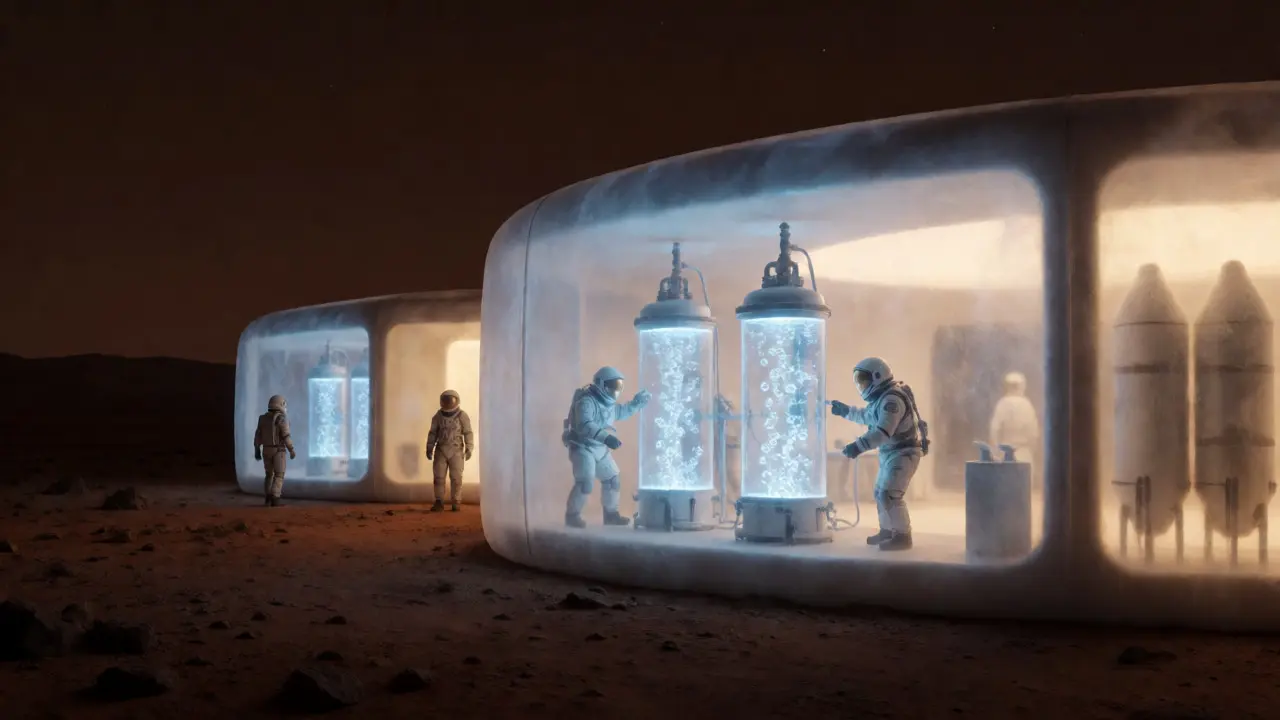
Once you’ve got the water, what do you do with it? Drinking is obvious, but that’s the least valuable use case. In space, mass is money. Launching water from Earth costs thousands of dollars per kilogram. Producing it on Mars saves billions.
- Life Support: Water is split via electrolysis into oxygen for breathing and hydrogen for fuel. One liter of water can provide enough oxygen for one person for several days.
- Propellant Production: Using the Sabatier reaction, astronauts can combine hydrogen (from water) with carbon dioxide (from the Martian atmosphere) to create methane. Methane and oxygen are clean-burning rocket fuels. This allows return trips to Earth without carrying all the fuel there.
- Radiation Shielding: Mars lacks a global magnetic field, exposing the surface to harsh cosmic rays. Storing water in walls around habitats acts as excellent radiation shielding. It’s heavy, cheap, and effective.
Think of water as a universal solvent and a battery. It keeps you alive, powers your car, and protects your house. On Mars, it’s the ultimate multi-tool.
The Road Ahead: Risks and Realities
We aren’t there yet. The biggest hurdle isn’t science; it’s reliability. Drilling on Mars means dealing with unknown soil properties. What if the ice is harder than expected? What if dust clogs the pumps? Every failure mode must be engineered out before a human sets foot on the planet.
Power is another constraint. Heating subsurface ice requires significant energy. Solar panels work during the day, but Mars has dust storms that can block sunlight for weeks. Nuclear fission reactors, like NASA’s Kilopower project, are being considered to provide consistent power for continuous extraction operations.
Finally, there’s the regulatory and ethical layer. Where do we mine? We don’t want to contaminate potential life zones. The deep reservoirs found by InSight might harbor microbial life. Mining too aggressively could destroy evidence of biology before we even find it. Balancing resource needs with planetary protection is a delicate act.
Is there liquid water on Mars right now?
Yes, but mostly in the form of brines. Salty water can remain liquid at lower temperatures due to perchlorate salts. There is also strong radar evidence suggesting a stable subglacial lake beneath the south polar cap, though this remains debated.
Can humans drink water directly from Mars?
No. Martian water contains toxic perchlorates and other chemicals. It must be processed, filtered, and purified through an ISRU plant before it is safe for consumption.
How much water does a Mars mission need?
A crew of four might need roughly 10-15 kg of water per day for drinking, hygiene, and food prep. However, producing propellant for the return trip requires hundreds of tons, making ISRU essential for sustainability.
What is ISRU?
ISRU stands for In-Situ Resource Utilization. It refers to technologies that collect, treat, and use resources found on other planets, such as extracting water from ice or generating oxygen from the atmosphere.
Why is mid-latitude ice better than polar ice for bases?
Mid-latitudes offer more consistent sunlight for solar power, milder temperatures, and easier access to ice that is often shallower (1-3 meters) compared to the deep layers at the poles.
14 Responses
It is utterly absurd to suggest that we are anywhere near ready for this. The engineering challenges alone are insurmountable with current technology and the hubris of these space agencies is frankly disgusting
You think a drill will just work on Martian regolith without failing immediately? You think the power requirements for heating subsurface ice won't drain every battery in seconds? This article reads like science fiction masquerading as analysis because it ignores the brutal reality of mechanical failure in vacuum conditions
OH MY GOD!!! Did anyone else notice how they conveniently left out the fact that NASA has been hiding data about subglacial lakes for DECADES?!
They tell us it's "debated" but we all know what that means! It means THEY KNOW IT'S THERE AND THEY DON'T WANT US TO KNOW BECAUSE OF THE ALIENS OR WHATEVER IS DOWN THERE!!!
I am so angry right now... I can feel my blood pressure rising just reading this sanitized propaganda!! Why do they always use words like "hinted at" instead of just admitting the truth?? They are lying to us... They are ALWAYS lying to us!!!
Contrarian take: We don't need water extraction tech, we need better rockets.
Stop obsessing over ISRU when the real bottleneck is launch mass from Earth. If you can get the payload ratio down by another 20% you can just bring the water. This whole "digging holes" narrative is a distraction from the fact that chemical propulsion is archaic.
The RedWater concept is cute but ultimately irrelevant if you can't get the heavy machinery there reliably. Focus on the launch vehicle not the shovel.
Actually the RedWater system isn't just a shovel its a closed loop thermal exchange unit.
The key innovation here is minimizing material transport. On Mars moving dirt costs energy due to low gravity friction issues and dust contamination. Pumping liquid is far more efficient.
TRL 6 means it has been tested in relevant environments which is significant. Most concepts die at TRL 3 or 4. Honeybee Robotics has done solid work here.
Also note the perchlorate issue mentioned later. That's not just a drinking problem its an industrial corrosion problem too. Your pumps seals and valves need to handle aggressive oxidizers. That adds weight and complexity that the article glosses over slightly.
Love the enthusiasm Chris! But let's be real here.
The perchlorate thing is a huge deal. It's not just about filtering it out for drinking. It affects the electrolysis efficiency for making oxygen and hydrogen.
If your feedstock is dirty your output gas purity drops. That ruins your propellant quality. So yeah TRL 6 is great but scaling that up while dealing with Martian dust storms that block solar panels for weeks? That's the nightmare scenario.
Kilopower reactors are cool but they aren't flight ready yet either. So we are basically waiting on two unproven technologies to converge simultaneously. Optimistic timeline maybe? 😂
Great breakdown of the different sources.
Mid latitude ice really is the sweet spot for early missions. Polar caps have extreme seasonal variations that complicate power generation and thermal management.
Hydrated minerals are abundant but the energy cost to liberate that water is prohibitive for large scale ISRU. You end up spending more energy breaking bonds than you gain in usable water.
Deep crustal reservoirs are interesting scientifically but practically inaccessible for the next few decades. Focusing on shallow buried ice allows for simpler drilling rigs and less infrastructure overhead.
This is such a helpful read. I had no idea about the specific temperature ranges for the RedWater heater.
It makes sense that they heat it underground to avoid sublimation losses. Super smart design choice.
Thanks for explaining why mid-latitude is better than polar. I always assumed poles were the obvious choice because of the visible ice caps.
interesting stuff
the radiation shielding part is underrated
water walls are genius
simple effective cheap
So excited for this future! 🚀
Imagine being able to breathe air made from Martian water! That feels so magical and possible.
The idea that one liter provides enough oxygen for days gives me hope that we can actually live there long term.
We are going to make it happen!
Let's keep the momentum going team!
ISRU is the backbone of sustainable exploration. Without it we are just tourists.
With it we become residents.
Every successful test brings us closer to calling Mars home.
Believe in the process believe in the engineers.
they say its debated
but i saw the leak from 2018
they found the lake
and they buried it
why would they hide a lake?
what is living in there?
i bet its something big
something that doesn't want us digging holes
we are poking the bear
literally
Good points on the reliability risks.
Dust is the enemy. It gets into everything. Seals bearings electronics.
We need robust filtration systems on the intake side of any mining rig. Otherwise you replace parts every sol instead of every year.
Maintenance in a suit is miserable. Minimizing human intervention is key. Automation is non negotiable.
USA built this tech. USA leads the way.
Other countries are playing catchup.
NASA is doing God's work.
Keep pushing forward America.
Wait did u mention sabatier reaction?
Thats combining H2 from water with CO2 from atmosphere to make methane.
Right?
Cause if so thats huge for return trips.
U dont need to bring fuel back.
Just bring the empty tanks and fill em up.
Saves so much mass.
Is the tech ready tho?
Seems kinda finicky with catalysts.