

When your oil rig is 200 miles offshore, your mine is deep in the Amazon, or your bank branch sits on a remote Pacific island, cell towers and fiber cables don’t reach. That’s where VSAT networks come in. These aren’t sci-fi gadgets-they’re real, working systems powering critical business operations today. Built on geostationary satellites orbiting 35,786 kilometers above the equator, VSAT (Very Small Aperture Terminal) networks deliver secure, high-uptime internet to places where nothing else can.
What Exactly Is a VSAT Network?
A VSAT network is a satellite-based communication system made up of small dish antennas (usually under 3 meters wide) at remote locations, connected to a central hub via geostationary satellites. Unlike consumer satellite internet, enterprise VSAT is built for reliability, security, and control. It’s not just about browsing the web-it’s about running SCADA systems, syncing cloud apps, monitoring pipelines, and keeping remote teams connected. These systems use two main setups: star topology, where every remote site talks to a central hub, and mesh topology, where sites can talk directly to each other. Star is common for general internet access; mesh is used when you need fast, direct communication between field sites-like a fleet of trucks coordinating logistics in real time.Why Enterprises Choose VSAT Over Terrestrial Options
You might ask: why not just use 5G or fiber? The answer is simple-availability. Fiber doesn’t run through jungles, deserts, or open oceans. 5G towers need power, backhaul, and maintenance crews. VSAT doesn’t. It works anywhere with a clear view of the sky. BusinessCom Networks reports uptime exceeding 99.5% for enterprise VSAT, with some contracts guaranteeing 99.9%. That’s better than most terrestrial networks in remote areas. For industries like energy, mining, and maritime, downtime isn’t just costly-it’s dangerous. A SCADA system failure in a substation or offshore platform can trigger safety shutdowns, environmental risks, or even loss of life. VSAT doesn’t just survive in harsh environments-it thrives. Viasat’s IoT VSAT platform is specifically engineered to handle industrial control data under extreme weather, electromagnetic interference, and long-distance signal delays. That’s why companies like Shell, BHP, and Maersk rely on it.Speed, Latency, and the LEO Challenge
Here’s the trade-off: geostationary satellites are reliable, but they’re far away. Signals take about 0.25 seconds to travel up and back. That’s noticeable in video calls or real-time trading. For most enterprise apps-email, ERP, cloud backups-it’s fine. For live video conferencing or online gaming? Not so much. That’s where Low Earth Orbit (LEO) constellations like Starlink and OneWeb come in. They orbit just 1,200 kilometers up, cutting latency to 20-50 milliseconds. BusinessCom Networks even launched BusinessCom OneWeb, a dedicated enterprise LEO service with SLAs and unlimited bandwidth. But here’s the catch: LEO satellites move fast. You need dozens of them in the sky at once to keep coverage steady. VSAT on geostationary satellites? One satellite covers a third of the planet. No handoffs. No signal drops. For fixed sites like a remote research station or a mining camp, that consistency matters more than raw speed. And bandwidth? It’s improving fast. High Throughput Satellites (HTS) with spot-beam technology now deliver gigabit speeds to individual terminals. Viasat’s IoT VSAT plans offer up to 1 Mbps in each direction on bulk contracts-enough for dozens of sensors, cameras, and control systems.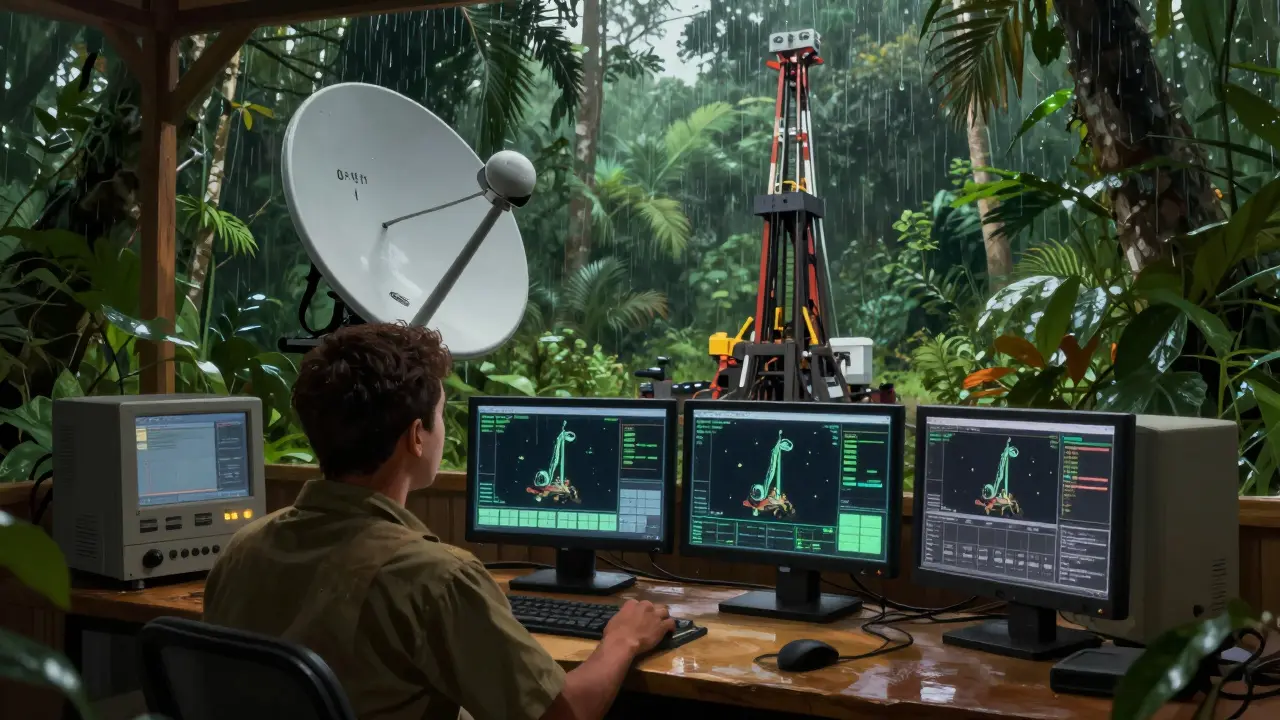
Security and Control: Enterprise-Grade Protection
Enterprise VSAT isn’t just about speed. It’s about control. Unlike public internet connections, VSAT networks are private. Data doesn’t travel over shared cables or public routers. It goes straight from your site to your hub via encrypted satellite links. Viasat and BusinessCom Networks both offer end-to-end encryption, network segmentation, and edge firewalls. You can isolate critical systems-like a refinery’s control network-from general office traffic. Real-time monitoring tracks link status and sends alerts the moment something goes down. No waiting for a technician to notice a broken cable. This level of security is why VSAT is mandated in sectors like defense, banking, and healthcare. NELCO’s enterprise solutions emphasize compliance with global regulations, making it easier for companies to meet data sovereignty and operational safety standards.Who’s Using VSAT Today?
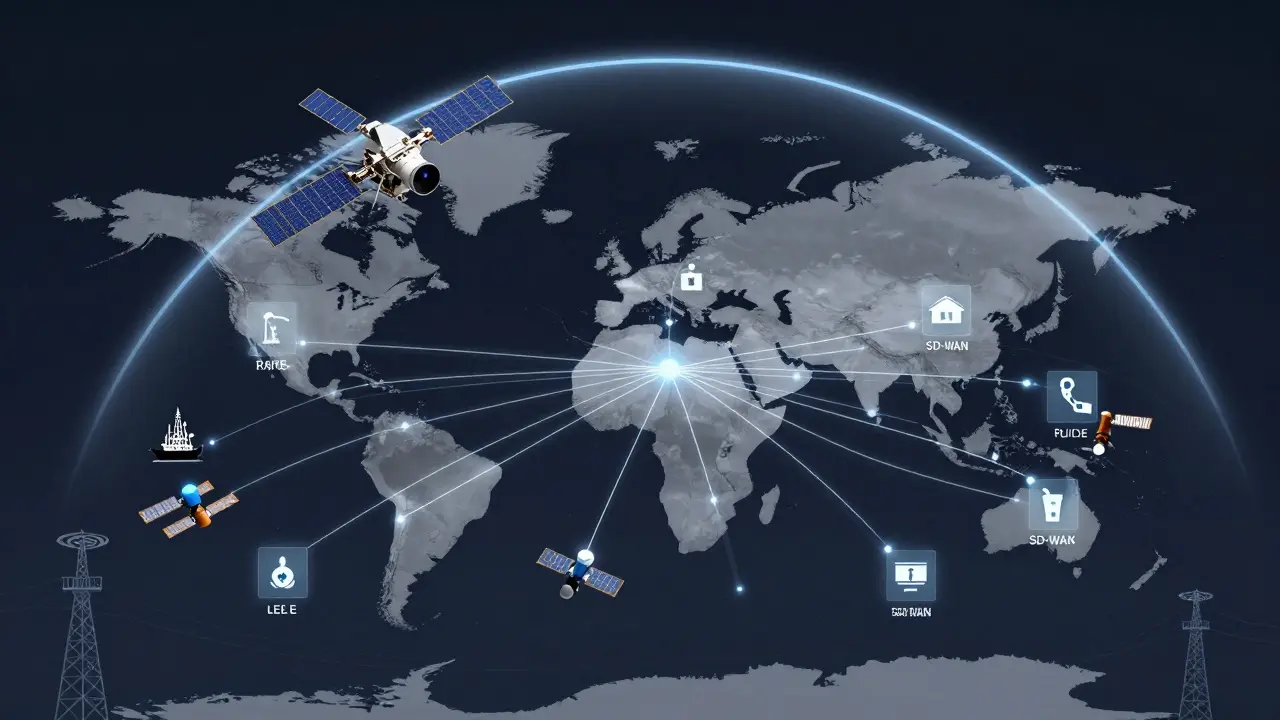
It’s not just big corporations. Small and medium enterprises (SMEs) now make up 57.2% of the VSAT market revenue, according to Future Market Insights (2025). Why? Because affordable, scalable plans are now available. Here’s how different industries use it:- Energy: Monitoring oil pipelines, wind farms, and substation sensors with real-time telemetry.
- Maritime: Connecting cargo ships, offshore platforms, and research vessels with voice, video, and data.
- Mineral Extraction: Running GPS tracking, drone surveys, and automated drilling controls in remote mines.
- Healthcare: Enabling telemedicine in rural clinics across Africa and Southeast Asia.
- Finance: Keeping ATMs and branch networks online in islands and desert towns.
Implementation: What You Need to Get Started
Setting up a VSAT network isn’t plug-and-play, but it’s not rocket science either. You need:- A satellite dish (size depends on location and bandwidth needs)
- A modem and indoor unit (IDU) to convert signals
- Network management software for monitoring and traffic shaping
- Professional installation-especially in windy, rainy, or mountainous areas
The Future: Hybrid Networks and SD-WAN
The next phase isn’t VSAT vs. LEO. It’s VSAT + LEO + fiber + 5G-all managed together. Enter SD-WAN (Software-Defined Wide Area Network). This tech lets enterprises dynamically route traffic across multiple connections. Critical data? Sent via VSAT for reliability. Streaming video? Sent via LEO for speed. Backup connection? Fiber when available. Viasat and SES are already integrating SD-WAN into their platforms. Gartner recommends this hybrid approach for any enterprise with operations in multiple environments. It’s not about picking one technology-it’s about using the right tool for each job.Is VSAT Right for You?
Ask yourself these questions:- Do you have sites where fiber or cellular is unreliable or nonexistent?
- Is downtime costing you money, safety, or compliance?
- Do you need encrypted, private communication for industrial systems?
- Are you managing sensors, cameras, or control systems remotely?
How fast is enterprise VSAT internet?
Enterprise VSAT speeds range from 64 kbps for basic telemetry to over 100 Mbps for high-throughput sites. Most businesses use plans between 2 Mbps and 50 Mbps. High Throughput Satellites (HTS) now enable gigabit-level connections in select regions. Speed depends on the satellite, dish size, and whether you have dedicated or shared bandwidth.
Is VSAT better than Starlink for enterprise use?
It depends. Starlink (LEO) offers lower latency and higher peak speeds, making it great for video and cloud apps. But VSAT on geostationary satellites offers consistent, uninterrupted coverage from a single satellite. For fixed sites like oil rigs or mines, VSAT’s reliability wins. For mobile or rapidly changing locations, LEO is better. Many enterprises now use both-VSAT for critical systems, Starlink for general use.
What’s the latency of geostationary VSAT?
Geostationary VSAT has a round-trip latency of about 500-700 milliseconds due to the 35,786 km distance to the satellite. This is noticeable in video calls and real-time applications but acceptable for email, file transfers, ERP systems, and remote monitoring. For latency-sensitive tasks, hybrid setups with LEO or terrestrial backup are recommended.
Can VSAT handle SCADA and ICS systems?
Yes. Viasat’s IoT VSAT platform is specifically designed for industrial control systems (ICS) and SCADA. It supports secure, encrypted transmission of sensor data, valve controls, and alarm signals-even under harsh conditions. Many energy and mining companies use VSAT as their primary link for critical infrastructure monitoring because of its uptime and security.
How much does enterprise VSAT cost?
Costs vary by bandwidth, number of sites, and service level. A basic 2 Mbps shared plan starts around $1,000-$2,000 per month. Dedicated bandwidth plans for critical operations can range from $3,000 to $10,000+ monthly. Installation fees are typically $5,000-$15,000. Most providers offer 24/7 monitoring and SLAs, so you’re paying for reliability, not just bandwidth.
Do I need a special license to use VSAT?
In most countries, the VSAT provider handles regulatory compliance-including frequency licensing and satellite coordination. As an enterprise customer, you don’t need to apply for licenses yourself. But you should confirm your provider is certified in your region and follows local telecom regulations, especially for critical infrastructure.
Can VSAT work in bad weather?
Heavy rain or snow can cause brief signal loss, called rain fade. Modern VSAT systems use adaptive modulation and power control to minimize this. Most enterprise-grade systems maintain 99.5%+ uptime even in tropical climates. Proper dish alignment and radomes (protective covers) help reduce weather impact. For mission-critical sites, providers often include backup links or redundancy.
How long does VSAT installation take?
For a single site with standard equipment, installation takes 1-3 days. Complex deployments-like multi-site networks in rugged terrain-can take 2-6 weeks. This includes site surveys, customs clearance for equipment, dish mounting, alignment, and testing. Providers like BusinessCom Networks offer turnkey service, including trained technicians and post-installation support.
14 Responses
Had a friend working on an oil rig off Kerala last year. Said their VSAT was the only thing keeping them sane. No Netflix, sure, but they could call home and send updates. Made all the difference.
Let’s be real-satellites are so 2010. Starlink’s cheaper, faster, and doesn’t need a PhD to point a dish. Why are we still talking about geostationary?
Actually, Rohit, there’s a reason VSAT still matters. If you’re running a mine in Jharkhand or a clinic in Odisha, you need something that just works. Starlink drops when it rains. VSAT? Still there. It’s not about being cool-it’s about staying connected.
"Geostationary satellites orbiting 35,786 kilometers above the equator" - missing a comma after "kilometers." Also, "they’re real, working systems" - redundant. Should be "they’re real systems" or "they’re working systems." Fix your grammar before posting.
My uncle runs a small pharmacy on Andaman. VSAT connects his inventory system to the mainland. No more waiting weeks for stock updates. It’s not glamorous but it saves lives. More people should know this exists.
It is entirely inappropriate to refer to satellite technology as "sci-fi gadgets" in a professional context. Such colloquialisms undermine the technical rigor required in enterprise infrastructure discussions. Furthermore, the article contains multiple instances of improper article usage and inconsistent capitalization. This is unacceptable for a publication of this nature.
Wait-why are we letting corporations control satellite bandwidth? This is just another way for Big Space to spy on us. They’re tracking every sensor, every ATM, every clinic. Next thing you know, they’ll be using VSAT to manipulate weather. I’ve seen the documents.
It is imperative to clarify that the term "VSAT" stands for Very Small Aperture Terminal, and its usage as a noun to describe the entire network architecture is technically inaccurate. The network is a VSAT system, not a VSAT network. Furthermore, the claim that latency is "0.25 seconds" is misleading-it is approximately 250 milliseconds one-way, making the round-trip latency approximately 500 milliseconds, not 250. This is a critical distinction for any enterprise relying on real-time data. Additionally, the article erroneously conflates bandwidth with speed, a common but dangerous misconception in the industry. Proper terminology matters, especially when lives depend on the reliability of these systems.
Used to work in a remote telecom tower in Himachal. VSAT was our lifeline. No cell, no fiber, just sky and dish. We didn’t care about speed-we cared about uptime. Once, during a snowstorm, the only thing keeping our emergency radio alive was that satellite link. No drama. No panic. Just quiet, steady connection. That’s the real win.
Let’s not pretend this is some revolutionary breakthrough. VSAT has been around since the 90s. The fact that we’re still using it in 2025 means the industry is lazy. Why not invest in terrestrial alternatives? Why not build fiber to every island? Because it’s expensive and hard. So we just patch it with satellites and call it "reliable." Meanwhile, real innovation happens in places where people actually care about infrastructure-not just profit margins.
It’s interesting how we’ve outsourced our connection to the sky. We no longer build bridges between towns-we launch satellites. We no longer invest in local networks-we lease bandwidth from corporations orbiting Earth. Is this progress? Or just another form of alienation? We’re not connecting-we’re outsourcing our presence to machines we don’t understand.
My company uses VSAT for our field teams in Alaska. We pair it with Starlink for video calls. Hybrid setup. Best of both worlds. VSAT for sensors and alerts, Starlink for Slack and Zoom. Works like a charm.
just had to laugh at the part about "99.9% uptime" - my office in rural Montana had 3 days of downtime last winter and the "enterprise-grade" VSAT guy said "it was weather" like that was an excuse. still paying $8k/month. not impressed.
There is, however, a critical flaw in the article’s logic: it assumes that reliability equals superiority. But reliability without innovation is stagnation. If we continue to rely on geostationary satellites-despite their inherent latency, bandwidth limitations, and environmental vulnerability-we are choosing comfort over evolution. The future belongs to adaptive, hybrid systems-not clinging to 1970s orbital architecture because it’s "proven."