
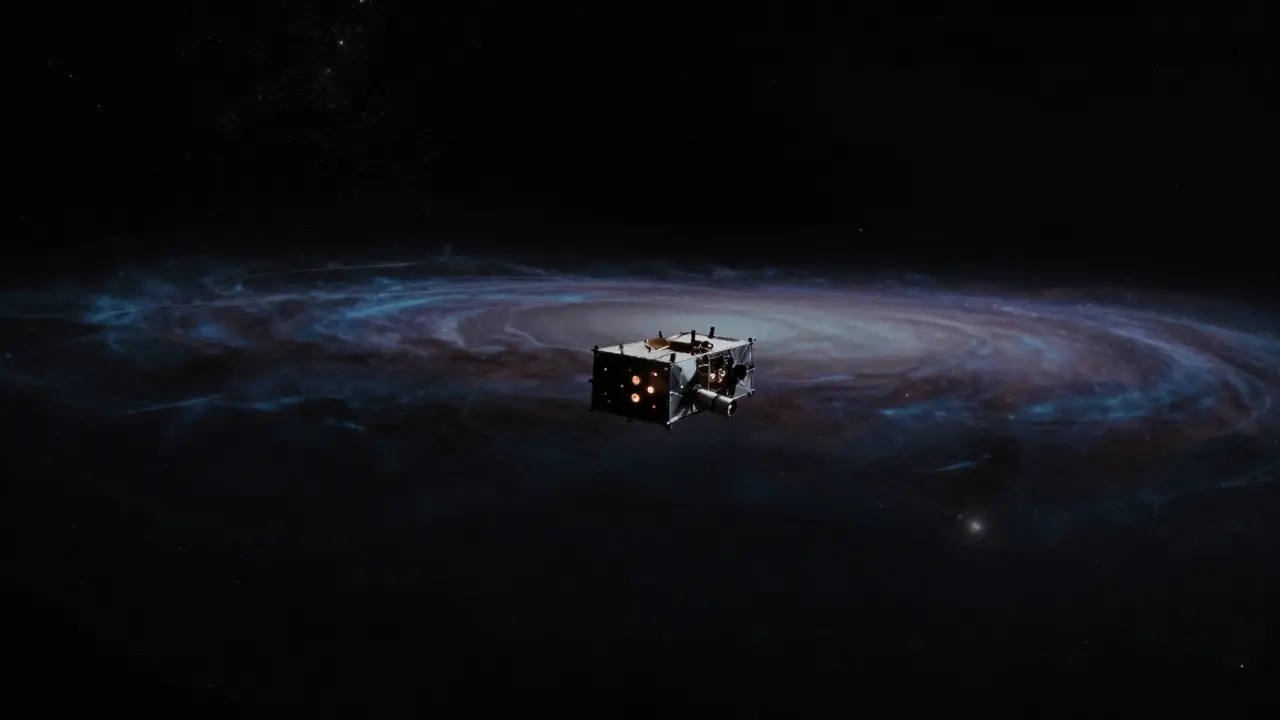
Imagine sending a message in a bottle into the ocean, but instead of water, it’s the vacuum of space, and instead of drifting to the next beach, it’s heading for another star system. That is exactly what humanity did with the Voyager missions, which are two robotic spacecraft launched by NASA in 1977 that have traveled farther from Earth than any other human-made objects. As of June 2026, these twin probes are not just exploring our solar system; they are swimming in the dark, cold waters between stars. They are the only functioning machines we have ever built that exist outside the Sun’s protective bubble.
It is easy to think of space exploration as something happening right now, with shiny new rockets launching every week. But the true pioneers of deep space are old. Really old. They were designed before the internet existed, before mobile phones, and when computing power was measured in kilobytes, not gigabytes. Yet, here we are, nearly fifty years later, still talking to them. Why do we care about two metal boxes floating billions of kilometers away? Because they are rewriting our understanding of where our solar system ends and the galaxy begins.
The Grand Tour: A Once-in-a-Lifetime Alignment
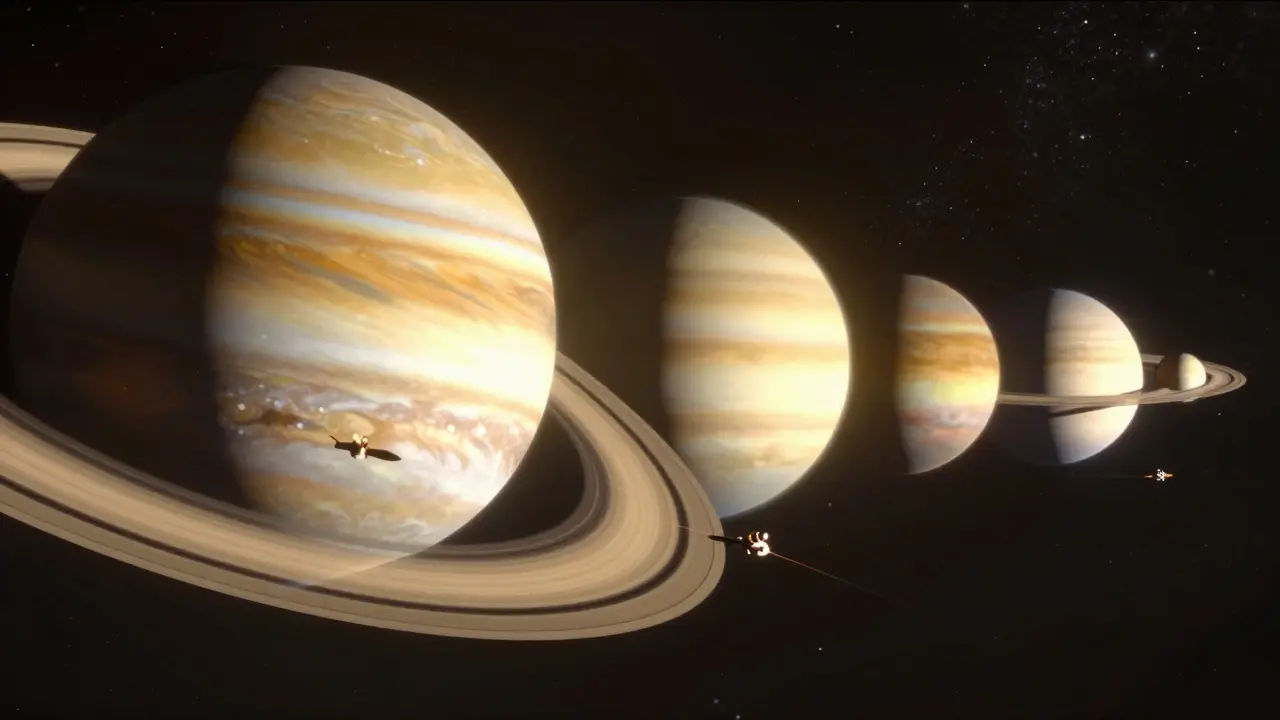
To understand how far the Voyagers have gone, you first need to appreciate how they got there. The mission didn’t start with an eye on interstellar space. It started with a planetary alignment that happens once every 176 years. In the mid-1970s, astronomers realized that Jupiter, Saturn, Uranus, and Neptune would line up in a way that allowed a single spacecraft to use gravity assists-slingshotting off one planet to gain speed toward the next-to visit all four giants.
This concept was called the "Grand Tour." Originally, NASA planned to send three probes. Budget cuts reduced this to two: Voyager 1 and Voyager 2. Confusingly, Voyager 2 was launched first, on August 20, 1977. Voyager 1 followed on September 5, 1977, but took a faster, shorter route to reach Jupiter and Saturn sooner. This decision meant Voyager 1 missed out on visiting Uranus and Neptune, while Voyager 2 became the sole explorer of those ice giants.
| Feature | Voyager 1 | Voyager 2 |
|---|---|---|
| Launch Date | September 5, 1977 | August 20, 1977 |
| Planets Visited | Jupiter, Saturn | Jupiter, Saturn, Uranus, Neptune |
| Interstellar Crossing | August 25, 2012 | November 5, 2018 |
| Current Status (2026) | Operational in Interstellar Space | Operational in Interstellar Space |
The engineering behind these launches was audacious. Both probes rode Titan IIIE-Centaur rockets from Cape Canaveral. They weighed 722 kilograms each at launch. Today, they are lighter, having shed fuel and some instruments, but their momentum carries them forward at roughly 17 kilometers per second relative to the Sun. That is about 38,000 miles per hour. To put that in perspective, if you could fly a commercial jet at that speed, you would circle the Earth in less than an hour. The Voyagers have been doing it for decades.
Discoveries That Changed Astronomy
Before the Voyagers arrived, the outer planets were just blurry disks in telescopes. We knew little about their moons, rings, or atmospheres. The data returned by these probes revolutionized astronomy almost overnight.
At Jupiter, Voyager 1 and 2 revealed the complexity of the Great Red Spot, a storm larger than Earth that has raged for centuries. More shockingly, they discovered active volcanism on Io, Jupiter’s moon. Scientists had never seen volcanoes erupting in real-time on another world. Io’s surface was constantly reshaped by sulfur plumes shooting hundreds of kilometers into space. At Saturn, the probes mapped the intricate structure of its rings, showing gaps and wave patterns caused by the gravitational pull of embedded moons. They also gave us our first close-up look at Titan, revealing a thick, orange haze that hinted at complex chemistry beneath.
Voyager 2’s journey continued alone to Uranus and Neptune. These ice giants were completely unknown territory. Uranus surprised everyone with its extreme tilt; it essentially rolls around the Sun on its side. Its magnetosphere is crooked and offset from the planet’s center, creating a chaotic magnetic environment. Neptune, the windiest planet in the solar system, showed supersonic winds and a "Great Dark Spot" similar to Jupiter’s red spot. Its moon Triton was found to be geologically active, with nitrogen geysers erupting from its surface. These discoveries proved that the outer solar system was not a dead, frozen wasteland, but a dynamic place full of energy and change.
Crossing the Heliopause: Entering the Unknown
After completing their planetary tours, the primary mission ended. Most people assumed the Voyagers were done. But NASA approved an extended mission. The goal? To find out where the Sun’s influence stops and interstellar space begins.
The Sun emits a constant stream of charged particles known as the solar wind. This wind creates a giant bubble around the solar system called the heliosphere, which is a protective region dominated by the Sun's magnetic field and solar wind. Inside this bubble, the solar wind pushes outward. Outside, the pressure of the interstellar medium-the gas and dust between stars-pushes inward. The boundary where these forces meet is the heliopause.
For years, scientists debated what this boundary looked like. Was it a sharp wall? A gradual transition? A messy, turbulent zone? The Voyagers provided the answers. On December 16, 2004, Voyager 1 crossed the termination shock, where the solar wind slows down from supersonic speeds. It entered the heliosheath, a turbulent region between the shock and the heliopause.
Then, on August 25, 2012, something changed. The number of energetic particles coming from the Sun dropped sharply. At the same time, galactic cosmic rays-high-energy particles from outside the solar system-surged. NASA confirmed in September 2013 that Voyager 1 had crossed the heliopause. It was the first human-made object to enter interstellar space. Voyager 2 followed suit on November 5, 2018, confirming that the boundary was consistent across different directions.
This crossing was not just a milestone; it was a scientific breakthrough. Data from the probes showed that the interstellar plasma density was higher than models predicted. This means the Milky Way exerts more pressure on our solar system than we thought. The heliosphere is not a perfect sphere; it is distorted, shaped by the interstellar magnetic field and the Sun’s movement through the galaxy. Understanding this shape is crucial for knowing how well the Sun protects Earth from harmful cosmic radiation.
The Power Struggle: Keeping Them Alive
You might wonder why we haven’t sent newer, better probes to follow them. The truth is, we can’t easily replicate their success. The Voyagers are powered by radioisotope thermoelectric generators (RTGs). These devices use the heat from decaying plutonium-238 to generate electricity. There is no refueling option. No solar panels work out there because sunlight is too weak.
At launch, each RTG produced about 470 watts of electrical power. By the 2020s, that number had dropped to under 250 watts. Every year, the power output decreases by about 4 watts due to radioactive decay. Mission controllers at NASA’s Jet Propulsion Laboratory (JPL) in Pasadena, California, face a tough choice: turn off instruments to save power for heaters and communications, or keep everything running and risk losing the spacecraft entirely.
Over the decades, non-essential systems have been shut down. The imaging cameras were turned off after the planetary encounters. Many science instruments have been disabled. Today, the core team focuses on keeping the attitude control system and telecommunications alive. The Deep Space Network (DSN), a global array of massive radio antennas, picks up their faint signals. The data rate is incredibly slow-just tens to hundreds of bits per second. Sending a simple command takes hours to arrive, and the response takes even longer. A round-trip communication delay is over 40 hours.
Despite these challenges, the Voyagers remain operational. Engineers tweak software, optimize power usage, and monitor hardware health remotely. It is a delicate dance with entropy. NASA expects the probes to remain functional until the early-to-mid 2030s. When the power finally drops below the threshold needed to operate even the most basic systems, the mission will end. But until then, they continue to send back valuable data about the interstellar medium.
The Golden Record: A Message to the Stars
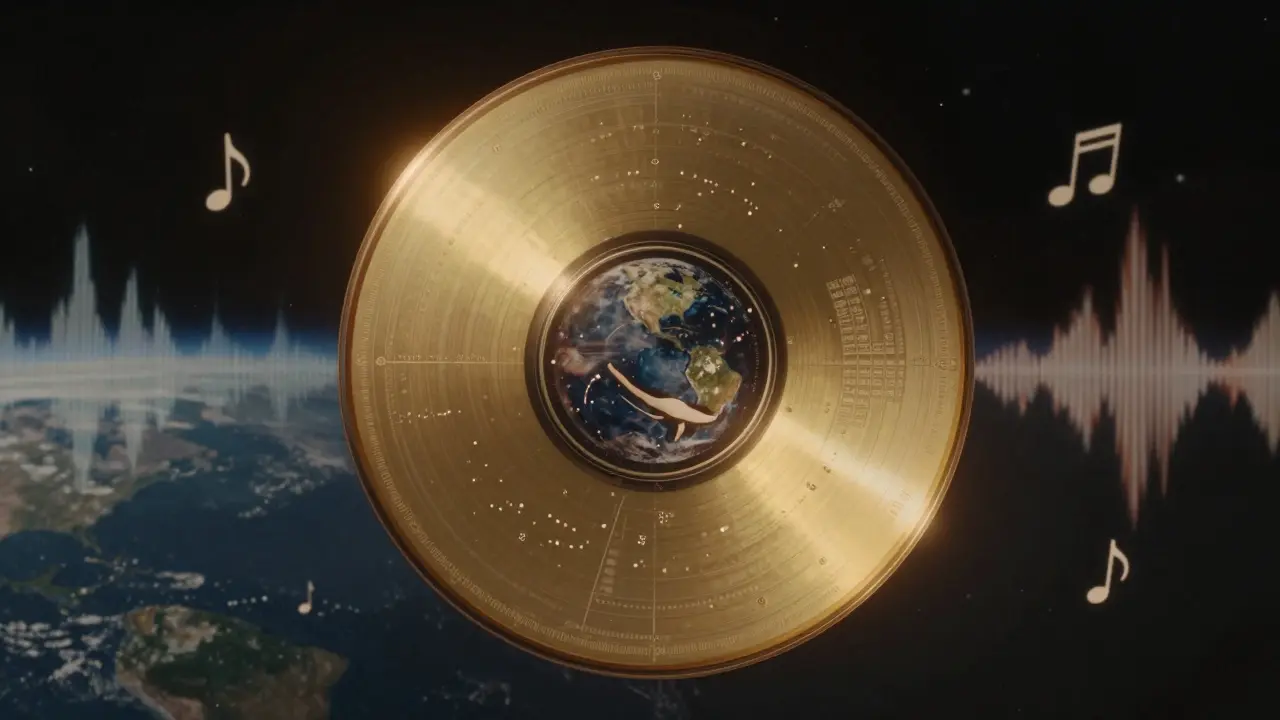
Beyond the science, the Voyagers carry something deeply human. Each probe holds a gold-plated copper phonograph record, known as the Voyager Golden Record, which is a time capsule containing sounds, images, and music from Earth intended for extraterrestrial civilizations.. Developed by a committee chaired by astronomer Carl Sagan, the record is a greeting card to the universe.
It contains 115 images encoded in analog form, depicting humans, landscapes, animals, and mathematical concepts. It includes natural sounds like thunder, whales singing, and laughter. It features 90 minutes of music ranging from Bach and Beethoven to Chuck Berry and traditional music from around the world. Greetings in 55 languages are recorded, including Ancient Greek and Navajo. Diagrams on the cover explain how to play the record and locate the Sun using pulsar maps.
This record transforms the Voyagers from mere scientific tools into cultural artifacts. They are likely to outlast many human structures. Long after cities crumble and nations fade, these probes will drift through the Milky Way for billions of years. If an advanced civilization finds them, they will know we were here. They will hear our music, see our faces, and understand our curiosity. It is a testament to hope, creativity, and the desire to connect.
What Comes Next?
The Voyagers are not the end of interstellar exploration; they are the beginning. Their data is guiding future mission concepts. NASA and other agencies are studying ideas for dedicated interstellar probes. These future missions might travel faster, reaching 400 to 1,000 astronomical units (AU) within decades rather than centuries. One AU is the distance from Earth to the Sun, about 150 million kilometers. Voyager 1 is currently over 164 AU away.
Future probes could carry more powerful instruments, higher data rates, and perhaps even laser communication systems. They might aim to study the Oort Cloud, a theoretical shell of icy bodies surrounding the solar system, or sample interstellar dust directly. The Voyagers have proven that long-duration, deep-space missions are possible. They have shown us that the edge of the solar system is not a void, but a complex, dynamic interface between our Sun and the galaxy.
As we look to the stars, we remember the path cleared by these two humble probes. They remind us that exploration is not just about technology; it is about persistence. It is about asking questions and following the answers, no matter how far they lead. The Voyagers are still talking to us, whispering secrets from the dark. And as long as they can, we will listen.
How far away are the Voyager probes from Earth in 2026?
As of mid-2026, Voyager 1 is approximately 24.5 billion kilometers (about 164 astronomical units) from the Sun, making it the farthest human-made object. Voyager 2 is slightly closer, at around 20.5 billion kilometers (approximately 138 AU). Both are traveling outward at speeds exceeding 38,000 mph relative to the Sun.
Are the Voyager probes still communicating with Earth?
Yes, both Voyager 1 and Voyager 2 are still operational and transmitting data. However, the signal strength is extremely weak, and data transmission rates are very low, often just a few hundred bits per second. NASA uses the Deep Space Network to receive these faint signals.
When will the Voyager missions end?
NASA estimates that the Voyagers will remain capable of returning scientific data until the early-to-mid 2030s. This depends on the remaining power from their radioisotope thermoelectric generators (RTGs). Once power levels drop too low to operate essential systems like heaters and transmitters, the mission will effectively end.
What is the difference between the heliosphere and interstellar space?
The heliosphere is a bubble-like region surrounding the Sun, created by the solar wind-a stream of charged particles emitted by the Sun. Inside this bubble, the Sun’s magnetic field and solar wind dominate. Interstellar space is the region beyond the heliosphere, where the material and magnetic fields of the galaxy take over. The boundary between them is called the heliopause.
Why didn't Voyager 1 visit Uranus and Neptune?
Voyager 1 was given priority to reach Jupiter and Saturn quickly to capture high-resolution images before entering hibernation mode during Saturn’s night side. This trajectory required a slingshot maneuver around Saturn’s moon Titan, which tilted Voyager 1’s path out of the ecliptic plane. This new direction prevented it from reaching Uranus and Neptune. Voyager 2, launched earlier but on a slower path, stayed in the ecliptic plane and visited all four giant planets.