

| Feature | UTXO (Bitcoin) | Account (Ethereum) |
|---|---|---|
| Analogy | Physical Cash/Coins | Bank Account/Debit Card |
| Balance Tracking | Sum of unspent outputs | Single global state balance |
| Privacy | Higher (Address per txn) | Lower (Single address) |
| Programmability | Limited Scripting | Turing-complete (Smart Contracts) |
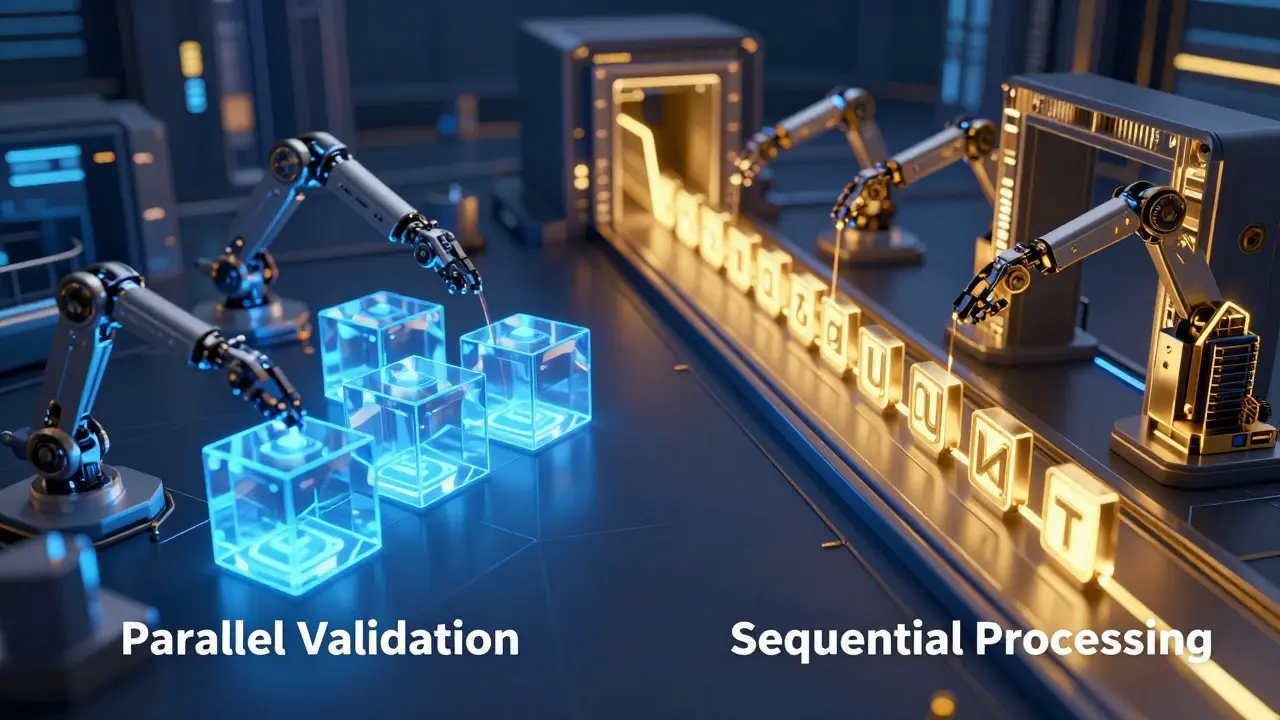
| Validation | Parallel (Independent) | Sequential (Nonce-based) |
Understanding the UTXO Model: Digital Cash
The UTXO model is an accounting system where the blockchain tracks "Unspent Transaction Outputs" rather than individual user balances. This is the core of how Bitcoin has functioned since 2009. In this system, there is no such thing as a "wallet balance" stored on the blockchain. Instead, your wallet simply scans the entire network for UTXOs that belong to your private keys and adds them up.
Think of a UTXO like a physical banknote. If you have a £10 bill and want to buy a £3 coffee, you can't just tear off £3 from the bill. You hand over the whole £10 note. The shopkeeper takes £3 and gives you £7 back as change. In Bitcoin, it works the same way. If you have one UTXO worth 1.5 BTC but only want to send 1 BTC, you must spend the entire 1.5 BTC. The transaction will create two new outputs: 1 BTC for the recipient and 0.5 BTC sent back to a "change address" that you control.
This means every transaction consumes old outputs and creates new ones. Because each output can only be spent once, the network can easily prevent double-spending. If you try to spend the same "banknote" twice, the nodes will see that the UTXO has already been marked as spent and reject the second attempt instantly.
The Account Model: The Digital Ledger
Ethereum took a different path in 2015. It uses the account-based model, which is much more like a traditional bank. Instead of tracking individual pieces of coin, the network maintains a global state database that maps an address to a specific balance.
When you send 1 ETH to a friend, the network doesn't look for specific outputs to combine. It simply checks if your account balance is ≥ 1 ETH. If it is, the system subtracts 1 from your total and adds 1 to your friend's total. There is no "change" involved because the system is just updating numbers in a ledger.
Ethereum breaks these accounts into two types. First, there are Externally Owned Accounts (EOAs), which are the ones you control with a private key. Then, there are Contract Accounts. These are essentially smart contracts-pieces of code that live on the blockchain. These contract accounts can hold their own balances and execute complex logic, which is why Ethereum is often called a "world computer" rather than just a digital currency.
Transaction Speed and Parallel Validation
One of the most interesting technical trade-offs is how these models handle validation. The UTXO model is naturally built for parallelism. Since each UTXO is independent, a computer can validate ten different transactions at once as long as they aren't trying to spend the same output. There's no need for a central coordinator to say "Wait, let's finish transaction A before we do transaction B."
The account model struggles more with this. Because accounts have a sequential order-tracked by a nonce (a number used once to prevent replay attacks)-transactions from the same account must be processed in a specific order. If you send three transactions from one account, the second one can't be finalized until the first one is. This creates a bottleneck that makes scaling more challenging but is the price paid for the flexibility of complex state management.
Privacy and the "Dust" Problem
If you care about privacy, UTXO has a clear edge. Because the model encourages using a new address for every single transaction (including the change address), it's harder for an outsider to see your entire financial history just by looking at one address. They would need to use complex heuristics to guess which addresses belong to the same person.
In the account model, you typically use one address for everything. This means anyone with a block explorer can see exactly how much is in your account and every single transaction you've ever made. While you can create new accounts, the ergonomics of the system push users toward a single-address identity.
However, UTXO has a quirk called "dust." Since every output is a separate entity, you might end up with hundreds of tiny fractions of Bitcoin (dust) spread across different UTXOs. If the network fees spike, it might actually cost more in fees to spend a small UTXO than the value of the Bitcoin inside it. In an account model, this isn't an issue because your balance is just one number; there's no such thing as a "too small" piece of your balance to spend.
Programmability and Smart Contracts
The biggest win for the account model is the ability to build complex apps. Because Ethereum maintains a persistent state, developers can create Smart Contracts that remember things. A DeFi protocol can track who owes what, manage a liquidity pool, or handle a complex loan with interest rates that change over time.
Doing this in a UTXO model is incredibly difficult. Since UTXOs are consumed and destroyed after use, there is no "permanent memory" for a contract to reference. Bitcoin does have a scripting language, but it's intentionally limited to keep the network secure and simple. While you can do some advanced things with things like Taproot, it's not comparable to the Turing-complete environment of the Ethereum Virtual Machine (EVM).

Fee Economics: Storage vs. Computation
The way you pay for transactions also differs. In Bitcoin's UTXO model, fees are mostly based on the size of the transaction data. If you have 50 small inputs (UTXOs) to send a single payment, your transaction will be physically larger and therefore cost more in fees. You're paying for the space you take up in a block.
Ethereum uses Gas. Instead of just looking at the size of the transaction, the network charges based on the computational effort required to update the state. A simple transfer is cheap, but a complex smart contract execution that requires thousands of calculations will cost more gas. This reflects the difference between a system designed for simple payments and one designed for running software.
Which model is more secure against double-spending?
Both are highly secure, but they use different methods. UTXO prevents double-spending by marking specific outputs as "spent." Once a UTXO is used, it's gone. Account models prevent it by checking the global balance and using a nonce to ensure the same transaction isn't processed twice.
Why doesn't Bitcoin use the account model?
Bitcoin prioritizes simplicity, auditability, and decentralized security. The UTXO model allows for easier parallel validation and better privacy. Adding a global state would make the network more complex and harder to verify for lightweight nodes.
What is 'dust' in a UTXO system?
Dust refers to very small amounts of cryptocurrency that are stored in their own UTXOs. Because transaction fees are based on the size of the transaction, these small amounts can become "uneconomical" to spend if the fee is higher than the value of the dust itself.
Can you have smart contracts on a UTXO blockchain?
Yes, but they are much more limited. Bitcoin uses a constrained scripting language. While you can create multi-sig wallets or time-locks, you cannot create the complex, state-dependent applications (like Uniswap or Aave) that are possible on Ethereum's account-based model.
Does the account model make Ethereum slower?
In terms of validation, yes. The need for sequential processing (via nonces) and managing a global state creates more bottlenecks than the independent nature of UTXOs. This is one reason why Layer 2 solutions and sharding are so critical for Ethereum's scalability.
What's Next?
If you're a developer, you might want to explore how Layer 2 solutions like the Lightning Network use UTXOs to create instant payments off-chain. If you're more interested in the "world computer" side, look into Account Abstraction on Ethereum, which is trying to bring some of the flexibility of smart contracts to the way we manage our personal accounts.
13 Responses
This is a super chill way to break down a complex topic. Really helps the newcomers get their head around the basics without feeling overwhelmed.
It is quite fascinating how some people still struggle with the basic concept of a ledger, though I must point out that your use of the pound symbol when referring to Bitcoin is a bit inconsistent with the general theme of the post. I'm just trying to help you keep things tidy for the sake of the readers!
The comparison between the UTXO model's parallel validation and the sequential nature of the account model is particularly striking from a systems design perspective. It essentially highlights the fundamental trade-off between state flexibility and raw throughput efficiency.
One finds the analogy of the banknote to be an elementary simplification that borders on the reductive. While it suffices for the layman, it fails to address the ontological shift in how we perceive ownership when transitioning from a physical asset to a cryptographic proof. The inherent tension between privacy and utility is not merely a technical hurdle but a philosophical conundrum regarding the nature of transparency in a decentralized society. We are essentially debating whether the ghost of the ledger is more important than the reality of the coin. It is quite trivial to see that the account model is simply a digital reflection of the very banking systems Bitcoin sought to dismantle. Thus, the irony remains that the pursuit of complexity in Ethereum has led us back to a structure that mimics the centralized entities of old. One might argue that the 'world computer' is just a more efficient way to organize a digital bureaucracy. In the end, the UTXO model represents a purity of form that the account model sacrifices for the sake of convenience. This is the tragedy of modern blockchain evolution. We trade the robustness of the original vision for the versatility of a programmable state. It is a common trajectory in technological advancement where the ideal is slowly eroded by the practical. Truly, the 'dust' problem is a metaphor for the fragmentation of the original cypherpunk dream. We are left with remnants of a vision that was too pure for the greed of the DeFi era. The sequential processing of nonces is just a fancy way of saying we've reintroduced the queue.
Love the banknote example! Makes it so much easier to visualize :) :)
I really like how this explains the difference in privacy! It's so important to know how our data is seen on the chain 🌟. I wonder if there are ways for regular people to use UTXO for daily stuff without worrying about the dust part?
Omg, I literally can't even deal with the idea of 'dust' just sitting there and being unspendable because fees are too high, like that is actually a nightmare scenario for anyone just trying to save a bit of money 😭!!! I mean, imagine having like 50 cents in a different account and just NOT being able to touch it because the system is basically telling you it's not worth the effort, I would actually scream!! 😱
It is a fair point that the account model provides more flexibility for those building the next generation of apps, even if the privacy isn't as strong as the UTXO side.
Basically, we're just choosing between a digital wallet of coins or a digital bank statement. Same thing, different vibe.
Too long, but the table helped.
Wow... such a a a 'deep' analysis... I'm sure the people who don't know what a blockchain is are totally enlightened now!!!!
It is imperative to note that while the UTXO model offers superior privacy, this is often a veil for those attempting to obscure transactions from the inevitable regulatory gaze of the globalist regime. One must consider if the 'parallel validation' is truly a feature or simply a way to make the network more susceptible to certain types of sophisticated attacks that only the inner circle understands. I find it highly suspicious that the industry pushes the 'world computer' narrative to distract us from the fact that global state management is a perfect tool for centralized surveillance. We are being herded into accounts for a reason, friends.
The explanation of nonces is totally correct, but you're being way too soft on the Account model's scaling failures! It's a disaster compared to UTXO's efficiency!