
The Legal Landscape of Space Innovation
If you launch an experiment to the International Space Station and develop a breakthrough there, who actually owns the patent? It might seem obvious to assume your home country applies, but space law doesn't work quite like terrestrial law. For decades, researchers and commercial partners have relied on a specific set of rules to protect their ideas while orbiting Earth. Today, those rules remain anchored in a document signed nearly thirty years ago.
The foundation for this protection is the Intergovernmental Agreement The formal title is the Agreement Among the Government of Canada, Governments of Member States of the European Space Agency, the Government of Japan, the Government of the Russian Federation, and the Government of the United States of America Concerning Cooperation on the Civil International Space Station, often referred to simply as the IGA. Signed on January 29, 1998, this treaty established the comprehensive legal framework governing intellectual property rights for everything happening aboard the station. Unlike earlier space treaties which focused on general principles of exploration, the 1998 IGA was the first international space agreement to explicitly specify protections for patents, trade secrets, and marking procedures as covered activities.
This creates a unique environment. While a company in Texas is subject to Texas laws for ground-based R&D, research conducted in zero gravity falls into a category called "quasi-territorial jurisdiction." This means the station acts as an extension of national territory. If your experiment takes place inside a specific module owned by a specific partner, the laws of that partner generally apply to your invention. This distinction is crucial for startups and academic institutions looking to commercialize microgravity science.
| ISS Module | Governing Partner | Jurisdiction Applied | Example Law Type |
|---|---|---|---|
| US Orbital Segment (USOS) | NASA National Aeronautics and Space Administration | United States | Patent Act, Copyright Act |
| Kibo (JEM) | Japan Aerospace Exploration Agency (JAXA) | Japan | Japanese Patent Office Rules |
| Columbus | European Space Agency ESA | France (Registry) | Euro-Patent Convention |
| Zarya/Zvezda | Roscosmos | Russia | Russian Civil Code |
How Quasi-Territoriality Shapes Ownership
The concept of quasi-territoriality is the engine driving IP enforcement on the station. Article 21 of the IGA clarifies that for inventions occurring on the ISS, jurisdiction is determined by the location of the activity pertaining to the IP. In simple terms, the country of inventorship is determined by the ownership and registry of the ISS element where an invention occurs.
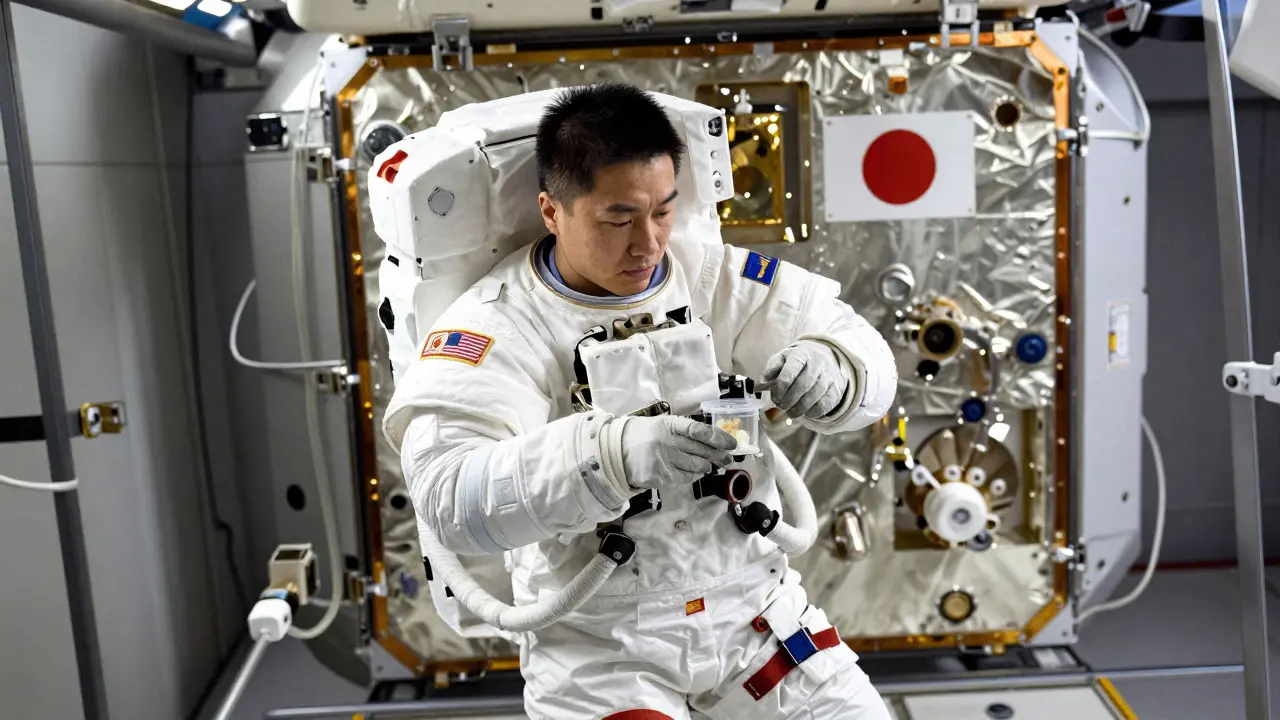
This might sound technical, but the impact is direct. Imagine a biotechnology firm runs a protein crystallography experiment inside the Japanese Experiment Module, known as Kibo. Even if the team consists entirely of American researchers flying on a US rocket, the physical occurrence of the invention is legally tied to the Japanese module. Consequently, an invention made in Kibo is deemed to have occurred in Japan. This creates legal certainty for researchers because they know exactly which patent office to file with before leaving the ground.
However, this system isn't perfect. As Professor Susan Harris of McGill University's Institute of Air and Space Law has critiqued, the element-based jurisdiction approach creates complexity for multinational research teams. It requires careful contractual planning before experiments begin. If you are a European company working with a US contractor on a Russian hardware component, you cannot just assume one legal framework covers everyone. You must understand that the hardware itself carries its nation's jurisdiction with it into orbit.
Protecting Your Innovations: Patents, Secrets, and Liabilities
Beyond determining jurisdiction, the IGA establishes mechanisms to protect actual assets. The agreement treats registered space objects as extensions of national jurisdiction, creating a stable environment for business. But protecting IP also involves managing risk, particularly regarding damage caused during operations.
Enter Article 16 of the IGA, which provides for a cross-waiver of liability. This provision allows ISS Partners to waive claims against each other for damage sustained as a result of ISS activities. For commercial partners, this reduces legal uncertainty significantly. Without this waiver, a research project could stall over fears that a minor mishap during a material processing run could lead to massive cross-border litigation. This clause was developed to avoid infringement of rights owned by ISS Partners and their entities, including contractors and subcontractors.
In terms of actual IP types, traditional protections apply. Patents, trade secrets, and copyright are specified under Article 21. However, enforcement can differ based on how you handle the data. Article 19 of the IGA requires ISS Partners to exchange specific technical data and goods when necessary for safe operation of the ISS while maintaining proprietary protections. This balance ensures safety isn't compromised by secrecy.
The World Intellectual Property Organization (WIPO) notes that while patent protection is traditionally territorial, international space law creates a 'quasi-territory' framework specifically for these purposes. Yet, questions remain about whether these protections conflict with the 1967 Outer Space Treaty's principle regarding the freedom of exploration. The International Trademark Association (INTA) reported in December 2022 that while the IGA represents the most developed framework, it remains limited to the ISS context and doesn't fully solve trademark issues outside that specific zone.
Commercial Access and the ISS National Lab
For private companies, navigating these laws usually involves an intermediary rather than dealing directly with the treaty text. In the United States, the primary channel is the ISS National Lab. Managed by the Center for the Advancement of Science in Space (CASIS), this organization operates under a cooperative agreement with NASA.
NASA entered into a $136 million cooperative agreement with CASIS in August 2011, extended in July 2017 to September 2024 with total cost increasing to $196 million. The mandate guarantees access to a minimum of 50% of U.S. research capacity and crew time. This setup was driven by the 2010 NASA Authorization Act, pushing for more commercialization.
Companies must be aware of the contract terms. Users who submit content to the ISS National Lab website grant the organization broad rights to use that content worldwide. This includes royalty-free, perpetual rights to use, license, reproduce, and even derive revenue from derivative works. Understanding this transfer of rights is vital for startups hoping to monetize their findings later.
The economic reality supports the push for IP clarity. As of 2023, the ISS National Lab had facilitated research from over 300 commercial entities and academic institutions. Biotechnology, materials science, and Earth observation represent the largest research categories. A Space Safety Magazine analysis noted a 37% increase in commercial research proposals involving proprietary IP considerations from 2018-2022, indicating growing confidence in the framework. However, the European Space Policy Institute reported in 2023 that only 28% of surveyed European companies were aware of the specific IP provisions under the IGA, highlighting a significant knowledge gap in some markets.
The Future: Beyond the Current Framework
While the IGA governs the present station, the landscape is shifting. Current operations are planned through 2030, with potential extension to 2031. As the ISS approaches this timeline, questions arise about IP continuity for successors.
There is a regulatory gap emerging for future lunar and deep space activities. The 2020 NASA Artemis Accords set out general principles for space exploration but do not address IP specifics like the ISS IGA does. The OECD Space Forum discussion paper from January 2024 recommended harmonizing the ISS IGA's IP approach with the Artemis program framework to create consistent rules across low-Earth orbit and lunar activities. No formal agreements have been established yet, but the industry is watching closely.
Proposed enhancements include expanding the Madrid System for international registration of trademarks in space. The INTA report proposed this for the 2030 timeframe, aiming to fully develop the acquisition of rights and enforcement mechanisms. Another idea floated involves creating 'Outer Space IP Registries and Enforcement' with local registries specific to space regions, though this would require immense international coordination.
Until then, the logic of the ISS remains the gold standard. It proves that complex multinational cooperation can function under strict property rules. The success relies on the understanding that the state where a space object is registered retains jurisdiction over it. This stability encourages the billions of dollars currently flowing into the sector, as innovators know where they stand.
Which country's patent law applies to an invention made on the International Space Station?
Jurisdiction depends on the specific module where the invention occurred. If the research took place in a module owned by the United States, U.S. patent law applies. If it happened in the Japanese Kibo module, Japanese law applies. This is known as quasi-territoriality.
Does the IGA protect trademarks in space?
Yes, Article 21 specifies protection for trademarks along with patents and trade secrets. However, current enforcement relies on national laws based on the host module's registry. There is no single global space trademark database yet.
What is the Cross-Waiver of Liability?
Under Article 16 of the IGA, partners agree not to sue each other for damages resulting from ISS activities. This protects commercial partners from lawsuits if equipment failure occurs during an experiment, encouraging investment and participation.
Can private companies conduct research on the ISS?
Absolutely. Organizations like CASIS manage the ISS National Lab to facilitate commercial research. Companies pay for flight time and must agree to specific IP terms regarding the use and distribution of their data.
Will these IP rules apply to missions to the Moon?
Not automatically. The Artemis Accords do not detail IP provisions like the ISS IGA does. Future lunar bases may require new treaties or frameworks, though efforts are underway to harmonize the systems to avoid legal gaps.
15 Responses
The concept of quasi-territorial jurisdiction fundamentally alters how we approach patent prosecution strategy for orbital assets. Under Article 21 of the IGA the legal status of an invention is tied directly to the registered element of the station where the claim originates. This creates a complex matrix for multinational contractors who must file applications in multiple national jurisdictions simultaneously to avoid gaps in coverage. We need to understand that the hardware module essentially acts as an extension of sovereign territory for the purpose of intellectual property enforcement. Most engineers overlook the implication that a software algorithm developed in the USOS but deployed via Russian systems may trigger dual litigation risks. Commercial entities should consult with specialized space law firms before submitting proposals to the ISS National Lab. The cost of non-compliance far outweighs the initial investment in legal preparation for the flight manifest.
Navigating these regulations requires a deep dive into the specific annexes of the 1998 agreement. It is clear that relying on standard terrestrial contracts is insufficient for high altitude R&D initiatives. Proper documentation of the exact coordinates and module registry numbers during the operational window is essential for future validity.
It really makes you wonder if we are setting ourselves up for disaster with how we handle intellectual property rights up in the low earth orbit zone right now 🌍. The way the intergovernmental agreement assigns legal boundaries based on specific hardware modules feels incredibly outdated considering the velocity of modern technology development cycles. We see companies investing millions into protein crystallography yet they have to navigate a fragmented patchwork of national patent offices instead of a unified space court system. This lack of centralization creates massive inefficiencies for startups trying to pivot their business models around microgravity data analysis results. Ethically speaking it raises serious concerns about whether public funds subsidize private monopolies through these liability waivers without enough public oversight mechanisms in place. The cross waiver clause sounds protective but effectively shields corporate actors from accountability if negligence occurs during high risk material processing experiments. Imagine a scenario where a proprietary experiment damages a shared utility grid and no one can actually sue the responsible party because everyone mutually waived their rights beforehand. It seems like a loophole designed specifically to protect the wealthy consortium partners rather than the broader scientific community interested in open discovery. We need to ask ourselves if this framework truly promotes exploration or just incentivizes siloed research agendas driven by profit motives alone. Furthermore the reliance on quasi territorial jurisdiction ignores the reality of global supply chains used to construct those very modules being cited as legal anchors. As we move toward the Artemis accords there is a distinct possibility that these old rules will cause friction with new lunar governance structures. Transparency regarding data ownership is critical for maintaining trust between nations collaborating on what should be humanity’s collective endeavor in deep space exploration environments. We cannot afford to let terrestrial commercial conflicts bleed over into orbital operations where failure rates could mean loss of life or equipment worth billions of dollars. Every delay caused by legal uncertainty is a lost opportunity for medical breakthroughs that rely on zero gravity conditions. Hopefully legislators realize the urgency of updating these provisions before the next major launch window opens for the next generation space stations. It is time we prioritize human advancement over protecting trade secrets in a vacuum environment where resources are already so scarce 🚀.
they dont tell you about the secret deals made behind closed doors regarding who really owns the moon dust samples collected during maintenance shifts. i think the whole thing is rigged to benefit the big boys while we get stuck cleaning up the debris nobody wants. why do they keep hiding the real financial ledgers from the public eye
Understanding the distinction between jurisdiction and module ownership is crucial for anyone entering this field. The ISS operates under a specific regime where each nation retains sovereign authority over its respective elements. If you conduct research in the Columbus module French law generally dictates the outcome despite who built the sample tray. It is important to recognize that this system was designed to provide legal certainty for long term international partnerships. Misinterpreting the scope of these rights can lead to significant losses for commercial partners expecting different protections. Educated planning ensures that your IP portfolio aligns with the physical location of your experimental hardware. Collaboration between legal teams and flight operations staff is mandatory for success here. We must respect the historical context that made this framework possible in the first place. Future generations depend on us getting these foundational legal principles right now.
so does that mean if i invent something on a SpaceX vehicle docked there it changes the rules completely? i feel like people forget that private vehicles might bring their own jurisdiction baggage with them. it would be interesting to see how they handle the handoff zone legally. probably someone else has thought of this before though. i am just curious about the grey areas between government and commercial segments. maybe the lawyers are sleeping on this one
oh great another layer of bureaucracy just to protect your little toy rocket 🚀 honestly the amount of paperwork required to file a patent for something floating in zero G is absurd. surely we can streamline this process for the sake of innovation speed? the joke is always on the small guys trying to compete with the giants who have the best law firms waiting. i bet half the researchers just ignore the cross waiver terms until something actually goes wrong :)
Property is a social construct invented to divide resources among competing egos. Applying terrestrial notions of ownership to the cosmos is inherently contradictory. Why should one nation claim exclusive rights to knowledge gained in a void that belongs to all of humanity? The entire framework assumes scarcity where abundance is the reality of the vacuum state. We are projecting earthly greed onto infinite expanses that do not care for our legal filings. True wisdom lies in abandoning the concept of possession entirely. But they will never admit that. They cling to the paper like a child to a teddy bear 🤔.
You are missing the bigger picture completely. Without clear property rights no one puts money into the station. Your philosophy doesn’t pay for the launch. Money builds the hardware not abstract ideals. Wake up and realize capitalism drives survival here. Stop dreaming about sharing everything that requires billions to build. The system works because it rewards investment. You cant argue logic with a blank check book.
teh quasi territoriality doctrine is fundamentally flawed due to teh inherent limitations of sovereignty in extra atmospheric jurisdictions. scholars of the 20th century failed to anticipate the rise of non state actors in the orbital domain. thier assumptions regarding state registries do not hold up against private enterprise growth rates. we are seeing a shift towards de facto zoning laws created by market forces rather than treaties. teh legal vacuum is widening faster than legislative bodies can draft amendments. this creates a dangerous precedent for future lunar mining rights. one must consider the implications of data theft via quantum encryption vulnerabilities. the current framework is tehe obsolete remnant of cold war thinking. we need a total overhaul of the artemis accord stipulations. until then expect chaos and unregulated competition in the geosynchronous belt.
I worry that focusing too much on patents might hurt the safety culture. Astronauts just want to do good science not fight lawsuits. Protecting people is more important than protecting ideas. The waiver helps everyone sleep better at night knowing they wont be sued forever. We should help each other succeed together in space. Safety comes first always. Everyone benefits when things run smoothly up there.
The cooperative agreement with CASIS ensures regulatory compliance. It streamlines the access protocol for commercial payloads. Adherence to these standards is mandatory.
The distinction between the Japanese module and the American segment often gets overlooked in general discussions regarding jurisdiction. When researchers physically enter the Kibo laboratory they are technically stepping into a zone where Tokyo retains sovereign authority over inventions produced within its walls. This applies regardless of the nationality of the crew members operating the specialized equipment mounted on the internal racks. A European team flying on a Soyuz capsule might find their work falls under Russian law depending on which docking port was utilized for the transfer phase. These nuances demand precise contractual alignment before any payload leaves the ground transportation facility for final integration. Failure to secure proper legal standing prior to launch can invalidate potential patent claims months after return to Earth. Many academic institutions underestimate the administrative burden required to maintain compliance across multiple national legal frameworks simultaneously. The ISS National Lab provides guidance but ultimately the responsibility rests heavily on the shoulders of the primary investigator managing the grant funding. Companies must decide early whether they want protection in the United States Patent and Trademark office or the Japan Patent Office for the same invention process. Dual filing strategies increase costs significantly and reduce the overall profitability margin for smaller biotechnology ventures seeking rapid monetization. Additionally the requirement to share technical data for safety purposes under article nineteen creates tension with confidentiality agreements signed with shareholders. Safety protocols dictate that operational parameters remain visible to mission control while proprietary algorithms used to interpret sensor data should theoretically remain shielded from competitors. Balancing these competing interests requires a sophisticated understanding of both engineering constraints and international treaty obligations written decades ago. As we approach the planned retirement timeline of twenty thirty the question of legacy data ownership becomes increasingly urgent for historical records kept off planet. Partnerships established today will determine the precedents set for lunar habitats emerging from the current Artemis program roadmap discussions. We must ensure stability remains intact even as the physical infrastructure ages beyond its original design life specifications.
This whole discussion misses the point that Canada barely gets any credit for our module contributions. We push forward while others take the glory. Its frustrating to watch the negotiations stall because of US dominance in the process. We need equal footing for all partner nations involved in the logistics chain. Stop ignoring the northern hemisphere contributions entirely. It takes effort to keep things running up there.
Just wait until they try to patent oxygen.
This international cooperation stands as a testament to what humanity can achieve together. Despite political differences nations have found common ground to foster peace through science. We should celebrate these achievements rather than critique the minor details of legal paperwork. The spirit of collaboration is what matters most for future expansion. Let us remain positive about the progress made thus far.