
Imagine a dollar that doesn't rely on a bank, a government, or a CEO. Most people think of stablecoins as digital versions of cash, but if you look closer at tokens like USDT or USDC, they're basically just digital receipts for money held in a private company's vault. If that company freezes your account or goes bust, your money vanishes. This is where DAI is a decentralized, crypto-collateralized stablecoin that maintains a 1:1 peg with the US dollar using smart contracts instead of a central bank. It's designed to give you the stability of the dollar without forcing you to trust a single human being or corporation.
The Magic of Overcollateralization
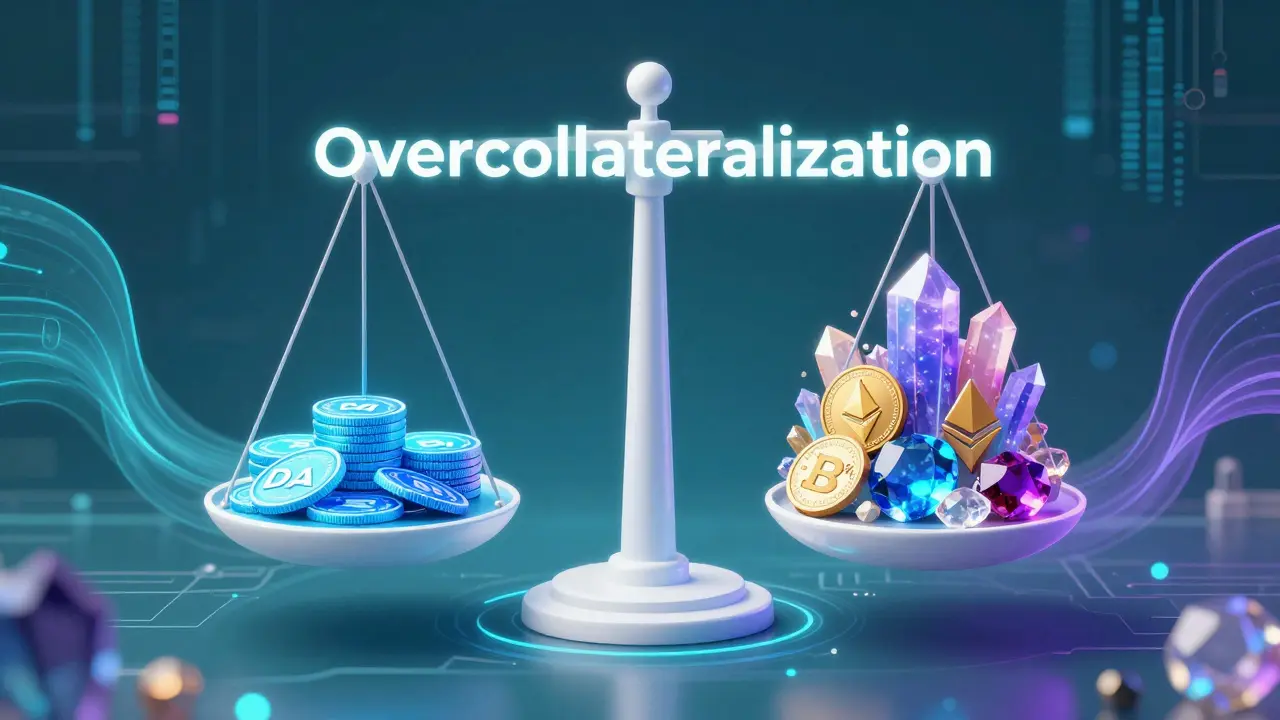
You can't just print money out of thin air; it needs backing. Since DAI doesn't have a bank account full of cash, it uses a system called overcollateralization. Think of it like a pawn shop. If you want to borrow $100 from a pawn shop, they won't just take your word for it; they'll ask for a piece of jewelry worth $150. If you don't pay the money back, they sell the jewelry to cover the debt.
In the DAI ecosystem, MakerDAO manages this process through automated vaults. To get DAI, you lock up cryptocurrency-like Ethereum-in a smart contract. Because crypto prices swing wildly, the system requires you to put up more than you borrow. If you want 100 DAI, you might need to lock up $150 worth of ETH (a 150% collateralization ratio). This buffer ensures that even if the price of ETH drops, there is still enough value to cover the DAI in circulation.
How the Peg Stays at One Dollar
Maintaining a steady price without a central office is a balancing act. DAI uses a combination of incentives and automated liquidations to keep the price stable. If the price of DAI dips below $1.00, the market is essentially saying DAI is undervalued. This encourages people to buy it or use it to pay off their debts in the vaults, which burns the tokens and reduces supply, pushing the price back up.
On the flip side, if DAI climbs above $1.00, users are incentivized to mint new DAI and sell it for a profit, increasing the supply and bringing the price down. To protect the system from a total crash, decentralized oracles-which are essentially data feeds-constantly watch the value of the collateral. If your collateral value drops too close to the amount you borrowed, the system automatically triggers a liquidation. Your collateral is sold on a decentralized exchange to ensure the DAI you minted remains fully backed.
| Feature | DAI (Decentralized) | USDT/USDC (Centralized) |
|---|---|---|
| Backing | Crypto Assets (Overcollateralized) | Fiat Reserves (Cash/Treasuries) |
| Control | Community Vote (DAO) | Corporate Management |
| Transparency | On-chain (Publicly Verifiable) | Attestations/Audits (Private) |
| Censorship Risk | Very Low (Permissionless) | High (Accounts can be frozen) |
From One Asset to Many: The Evolution of Collateral
When DAI first launched in 2017, it only accepted Ethereum as collateral. This was known as Single Collateral DAI (SCD). While it worked, it was risky; if Ethereum's price tanked, the entire system felt the pressure. To fix this, the protocol evolved into Multi-Collateral DAI (MCD) in 2019. This allowed the community to vote on adding other assets, such as WBTC (wrapped Bitcoin).
By diversifying the "basket" of assets backing the coin, MakerDAO reduced systemic risk. Now, the protocol can tailor risk parameters for different assets. For example, a very volatile coin might require a higher collateralization ratio than a more stable one. This flexibility makes the entire financial structure more resilient to market shocks.
Who is Really in Charge? The Role of the DAO
One of the biggest claims about DAI is that it has no centralized control. But someone still has to decide which assets are allowed as collateral or how much the "stability fee" (essentially the interest rate) should be. This is handled by MakerDAO, a decentralized autonomous organization.
If you hold the governance token, originally MKR (now transitioning to SKY), you have a vote. You can propose changes to the protocol and vote on them. This means the rules aren't set by a board of directors in a skyscraper, but by a global community of token holders. This democratic approach prevents any single person from unilaterally freezing funds or changing the rules to benefit themselves.
The Trade-offs: Is DAI Right for You?
DAI is a powerhouse for financial sovereignty, but it isn't a perfect tool for every single person. The biggest hurdle is the capital requirement. If you want to borrow $1,000 in DAI, you can't just sign a credit agreement; you need to already own roughly $1,500 to $2,000 in crypto to lock away. This makes it an expensive way to get a loan if you're starting from scratch.
However, for those who already hold crypto, it's a game-changer. Instead of selling your Bitcoin or Ethereum to get cash-which would trigger a taxable event and lose you your upside if the price goes up-you can simply use those assets as collateral to mint DAI. You get the spending power of dollars while keeping your long-term investment intact.
A Foundation for the New Financial System
DAI did more than just create a stable coin; it proved that the Ethereum blockchain could handle complex financial logic without a middleman. By solving the problem of price volatility, DAI became the "base layer" for most of decentralized finance (DeFi). It allowed other apps to create lending markets, yield farms, and automated trading strategies without the constant fear that their currency would crash 20% overnight.
What happens if my collateral price drops too much?
If the value of your locked assets falls below the minimum collateralization ratio, the system automatically sells (liquidates) a portion of your collateral to pay back the DAI you borrowed. This ensures the system remains solvent and the DAI peg stays stable.
Is DAI safer than USDT or USDC?
"Safe" depends on what you fear. USDT and USDC are safe if you trust the company managing the reserves. DAI is safer if you distrust corporations and prefer a transparent, on-chain system where no one can freeze your funds.
Can anyone mint DAI?
Yes. The process is permissionless. As long as you have a compatible crypto wallet and sufficient collateral to lock into a MakerDAO vault, you can mint DAI without needing an application or approval process.
What is the stability fee?
The stability fee is essentially an interest rate you pay to the protocol for borrowing DAI. The rate is decided by MKR/SKY token holders via governance votes to help manage the overall supply and demand of DAI.
What is the difference between SCD and MCD?
SCD (Single Collateral DAI) only allowed Ethereum to back the coin. MCD (Multi-Collateral DAI) allows a variety of approved assets, like wrapped Bitcoin and other stablecoins, to be used as collateral, reducing the risk of relying on a single asset.
13 Responses
makes sense
You people really believe this is decentralized? Just because there is a DAO doesn't mean the big whales aren't pulling the strings from the shadows. It is all a big game to move the money around while we think we are free. The whole thing is just another layer of control by the elite to keep us trapped in a digital loop. Wake up, the a-la-carte collateral is just a way to make the crash even bigger when the house of cards finally falls down. They want us to lock our ETH so we can't sell when the real panic starts. It is a trap disguised as a tool for sovereignty.
Oh, please!!! As if this is some revolutionary breakthrough!!!! The overcollateralization model is fundamentally inefficient and just a fancy way to say you are wasting capital!!!! Why would anyone lock up $150 to get $100 when the risk of a flash crash is always there!!!! It is just a playground for people who like to pretend they are hedge fund managers from their bedrooms!!!! Absolutely laughable that anyone calls this a stable solution when it relies on the volatility of the very assets it tries to hedge against!!!! Completely absurd!!!!
The explanation of the liquidation process is helpful. For anyone looking to start, it is crucial to monitor your health factor daily. If the market dips suddenly, the smart contract will not wait for you to log in to sell your assets. It is a cold, hard mathematical execution to protect the peg.
This is absolutely electric! The way DeFi is evolving to replace old-school banking is just mind-blowing. We are literally watching the birth of a new financial era right now. Keep pushing the boundaries!
I can see where some people get worried about the whales, but maybe we can just find a middle ground and trust the transparency of the chain over the secrets of a bank vault.
Actually, the inefficiency is the point. Purely algorithmic stability is a myth; collateral is the only real anchor. Most people just don't get that.
The table is a bit basic but okay. Honestly, I don't even want to read the whole thing, but it seems like a lot of work just to have a dollar. Do we really need this much complexity for a stablecoin? Seems kinda overkill if you ask me, but whatever.
I noticed a few phrasing choices in the text that could be tightened up, but the concept of the stability fee is explained really well here!
Very intrestng read. I think this is a great step for the globel economy, even if the tech is still a bit new for some of us. Respect to the devs.
Love seeing more people understand the difference between centralized and decentralized coins! 🚀✨ It really is all about who you trust with your hard-earned money! 💎🙌
It sounds a bit scary that the system can just sell your stuff automatically if the price drops. I can imagine how stressful that would be for someone who doesn't check their phone for a day.
Absolute rocket fuel for the future of money! 🚀 The idea of a bank-less world is just super spicy and exciting. Let's get this momentum going and disrupt the whole system with some serious DeFi energy! Who's with me on this wild ride to financial freedom?!