
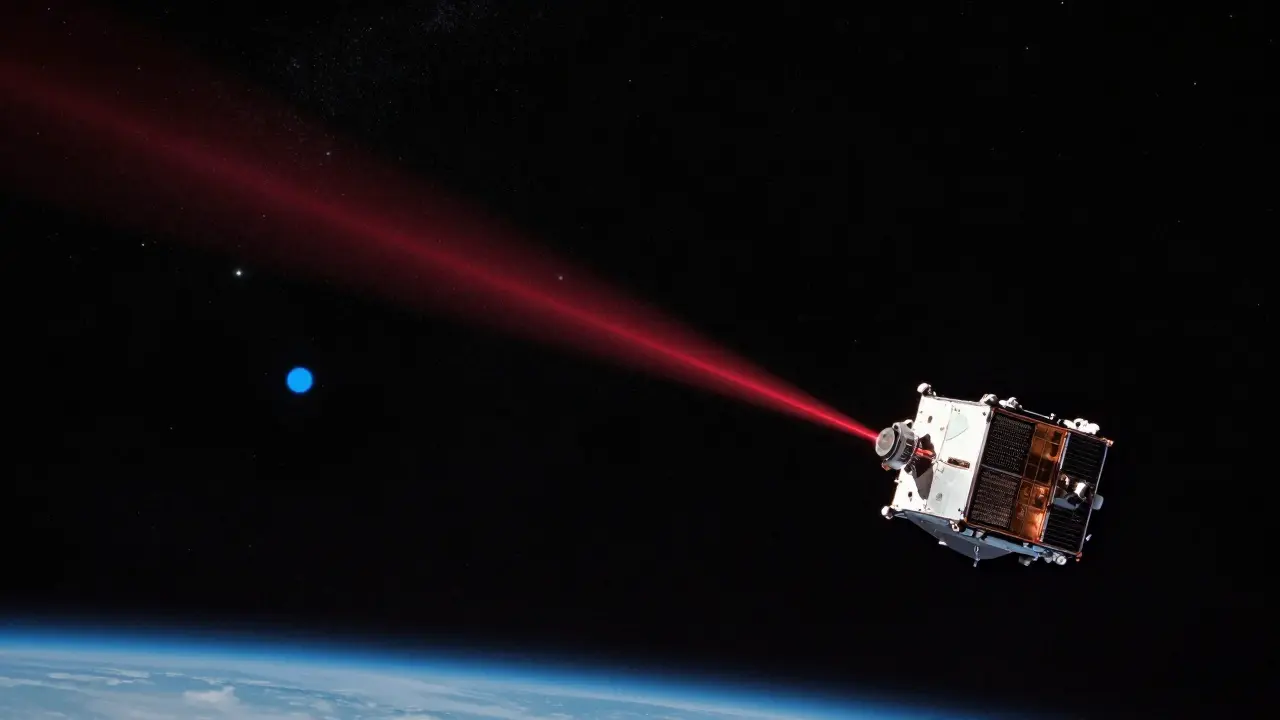
For decades, deep space missions have relied on radio waves to send data back to Earth. But as we send more complex missions to Mars and beyond, radio is hitting its limits. The data rates are slow, the signals are weak, and the bandwidth can’t keep up with high-res images, video, or real-time science. Enter optical communications - laser-based links that are changing everything. NASA’s DSOC mission didn’t just test a new tech. It proved that we can now send data from deep space faster than your home internet.
Why Lasers Beat Radio in Deep Space
Radio signals spread out as they travel. By the time they reach Mars, a typical signal is spread over an area larger than Earth. That means most of the power is wasted. Lasers, on the other hand, stay tightly focused. Think of it like comparing a flashlight to a laser pointer. The laser doesn’t lose as much energy over distance, so you can send more data with less power. NASA’s Deep Space Optical Communications (DSOC) system took this idea and ran with it. On December 11, 2023, the Psyche spacecraft, 19 million miles from Earth, sent back the first ultra-high-definition video from deep space. Not just a still image. A full video. And it did it at 267 megabits per second - faster than many home broadband connections. Four months later, it hit 25 Mbps from 140 million miles away. That’s over 1.5 times the distance from Earth to the Sun. And in September 2025, it closed its final link from over 200 million miles out. No other system has ever done that. The secret? Precision. Optical beams are narrow. So narrow, in fact, that if you miss the target by a fraction of a degree, the signal is gone. That’s why DSOC’s Photon-Counting Camera (PCC) is so critical. Built by MIT Lincoln Laboratory, it doesn’t just receive light. It finds it. It tracks the faint signal through background starlight, compensates for the fact that Earth has moved 20 minutes since the signal left Psyche, and predicts where Earth will be when the light arrives. It’s like aiming a laser at a moving coin from across the country while blindfolded - and doing it in real time.How DSOC Works: The Ground-to-Space Link
DSOC isn’t just a laser on a spacecraft. It’s a two-way system. The spacecraft has a laser transceiver - a device that both sends and receives light. But to get that signal from Mars back to Earth, it needs a guide. That’s where the ground station comes in. On Earth, a powerful laser beacon shoots light toward Psyche. Even though it’s thousands of watts, by the time it reaches the spacecraft, it’s weaker than a single photon from a distant star. Psyche’s system detects this faint beacon, uses it to lock onto Earth’s location, and then sends its own signal back. The whole process relies on timing, precision, and a lot of math. Here’s the wild part: light takes 20 minutes to travel from Psyche to Earth. So when the spacecraft sees Earth’s beacon, it’s seeing where Earth was 20 minutes ago. But the signal Psyche sends back will take another 20 minutes to arrive. That means the ground station has to predict where Earth will be 40 minutes from now. DSOC does this with millisecond accuracy - using star catalogs, orbital mechanics, and real-time tracking. No human could do this. Only machines can.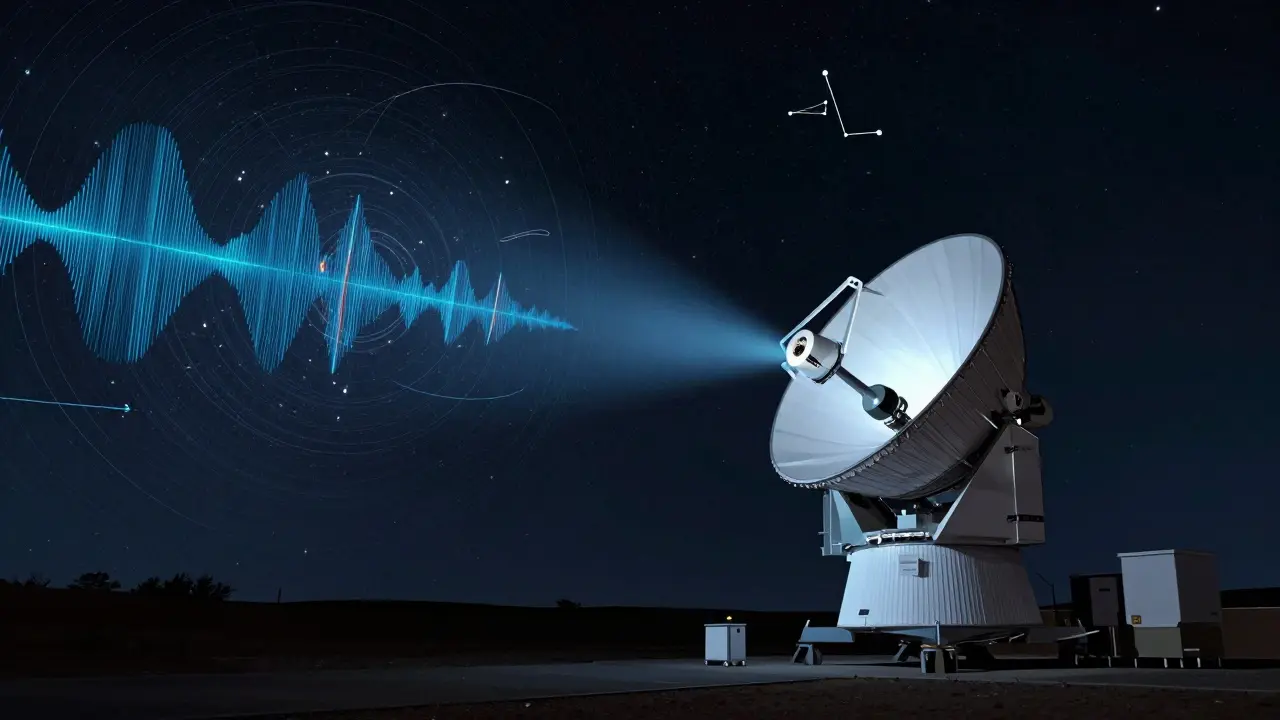
The Quantum Leap: Optical VLBI and Beyond
DSOC is just the start. The real future lies in optical Very Long Baseline Interferometry - or optical VLBI. This isn’t about sending data. It’s about seeing things we’ve never seen before. Radio VLBI has been around for decades. It links radio telescopes across continents to create a virtual telescope the size of Earth. The Event Horizon Telescope used it to take the first picture of a black hole. But radio waves are long - around 3 millimeters. That limits resolution. Optical light? Wavelengths are 500 to 1500 nanometers. That’s thousands of times shorter. So to get the same resolution as the EHT, you’d need a baseline of just 6 kilometers - not 12,000. Now imagine that baseline isn’t on Earth. Imagine it’s between two telescopes on the Moon. Or between a satellite in lunar orbit and one on Mars. No atmosphere. No distortion. Just vacuum. That’s where the next leap happens. Researchers in Australia, led by teams from the International Centre for Radio Astronomy Research, have already stabilized laser phase across 170 kilometers of fiber with incredible precision. They reduced noise by 10,000 times. That’s not just better data. It’s a new level of clarity. With a 400-kilometer baseline, they believe they could resolve features on exoplanets - not just spots of light, but weather patterns, cloud structures, maybe even signs of chemistry in atmospheres. And then there’s quantum. Entangled photons. Quantum memory. These aren’t sci-fi anymore. Experiments have shown that entangled photon pairs can be stored, manipulated, and measured across long distances. In a quantum-enabled VLBI system, you wouldn’t need to send the actual starlight from one telescope to another. You’d send entangled pairs - one to each telescope. Then, by comparing measurements locally, you’d reconstruct the image without ever moving the fragile signal across space. It’s like having two cameras that are magically linked, even if they’re on opposite sides of the solar system.Why This Matters for Future Missions
A Mars rover today sends maybe 2 kilobits per second. That’s a few blurry photos a day. With optical links, we could send full-color 3D panoramas, live video from the surface, real-time sensor data, and even streaming science reports. Imagine a future where astronauts on Mars can video-call Earth with zero lag - not because of magic, but because their laser modem works better than your Wi-Fi. This isn’t just about convenience. It’s about science. High-resolution data from distant moons, asteroids, and Kuiper Belt objects means we can study their composition, geology, and potential for life without ever landing. A single high-speed optical link could replace dozens of radio transmitters on a spacecraft, saving weight, power, and cost. And for Earth? We’re building the infrastructure. Ground stations in California, Spain, and Australia are being upgraded. Future lunar bases will have optical terminals. Satellites in Earth orbit are already testing laser links between themselves. This isn’t a one-mission wonder. It’s the foundation of a new communications layer for the solar system.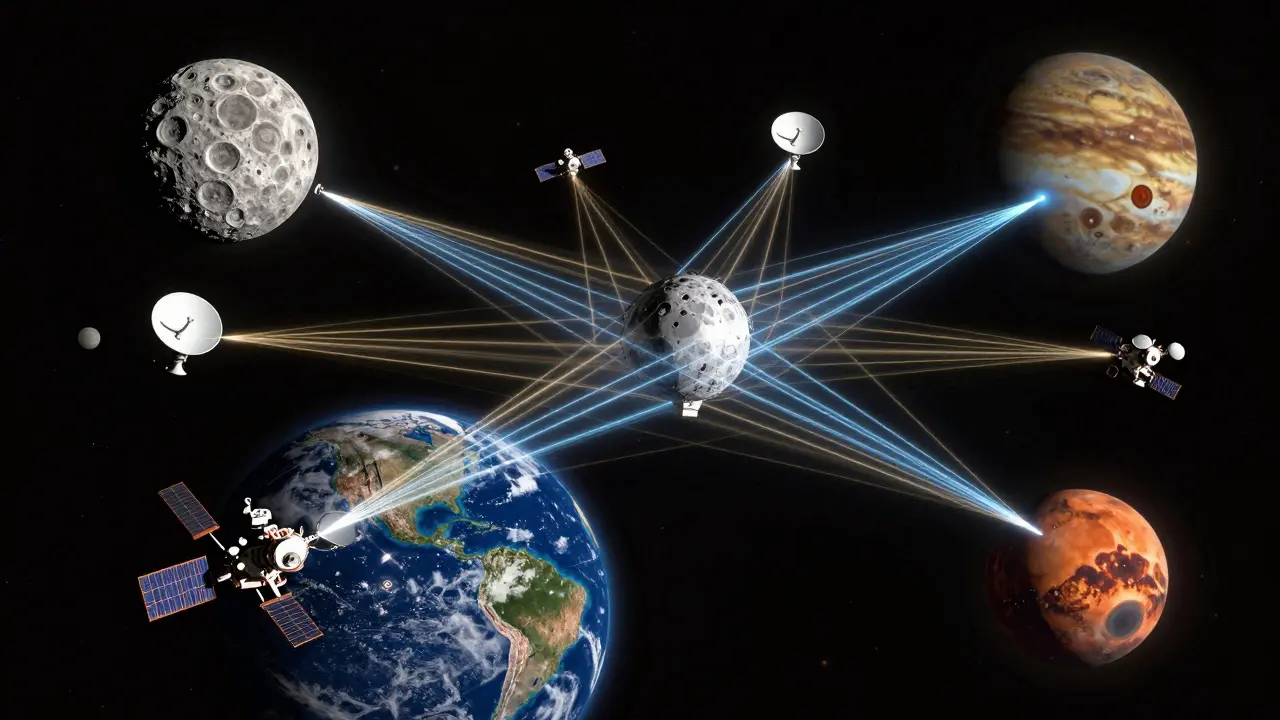
15 Responses
This is wild. Lasers in space? I thought we were still stuck with satellite dishes from the 90s. Now we’re sending HD video from Mars like it’s Netflix. The future is here and it’s got a laser pointer attached to it.
Yeah right. Like this isn’t just a PR stunt. They’re gonna tell us this works when the sun flares or a dust storm hits Mars. It’s all smoke and mirrors.
This is incredible 😍 I love how they’re not just pushing tech but building a whole new way to connect with space. We’re not just sending data-we’re streaming it. 🚀🔥
It is truly remarkable, and I must express my profound admiration for the engineering precision involved in this endeavor. The mathematical computations required to predict Earth’s position forty minutes into the future are nothing short of awe-inspiring. This is a monumental achievement for humanity.
so like… lasers in space? lol. they probly just used a fancy flashlight. also why do they keep saying 'optical' like its a new word. its just light dumbasses.
The article is technically accurate but dangerously oversimplified. It fails to address the fundamental thermodynamic inefficiencies of laser transmission through interplanetary dust. The 267 Mbps claim is misleading without context-signal-to-noise ratio, atmospheric attenuation at ground stations, and quantum efficiency of the photon-counting array are not mentioned. This reads like a press release, not peer-reviewed science.
I’ve been watching this for years. This is a cover. Lasers in space? They’re using this to mask quantum surveillance. The 'beacon' isn’t for alignment-it’s a tracking pulse for satellites. You think they’d risk billions on a camera? It’s a spy network. Mark my words.
The precision required for this system is staggering but it is not without its fundamental flaws. The assumption that interplanetary vacuum is stable is flawed. Solar wind fluctuations, micrometeoroid impacts, and thermal gradients on the spacecraft body introduce unacceptable error margins. This is not reliable for mission-critical data transmission. It is a proof of concept at best.
So we’re basically upgrading from dial-up to 5G… but in space? 😏 I mean, I’m not crying, you’re crying. Who knew we’d be streaming Mars sunsets like it’s a TikTok trend? The fact that we’re doing this at 200 million miles? That’s not science. That’s magic with a PhD.
this is so cool. i just wish we could do this for every probe. imagine if every rover had this. no more waiting months for a picture. just boom. instant panorama. we’re living in the future and we dont even know it.
The photon-counting camera’s adaptive tracking algorithm is a masterpiece of real-time orbital mechanics. Coupled with quantum-limited detection, it achieves sub-microradian pointing stability-something that was theoretically possible but never practically demonstrated until now. This isn’t just an upgrade. It’s a paradigm shift in deep-space telemetry architecture.
They say 'streaming' like it's cool. But let's be real-this is just a glorified laser pointer. And don't even get me started on 'quantum entanglement' for imaging. That's not science. That's wishful thinking wrapped in a lab coat. Also, 'VLBI'? You mean Very Long Baseline Interferometry? You know, the thing that's been around since the 70s? We're not inventing anything. We're just polishing old toys.
This whole thing is a trap. They're not trying to send data. They're trying to map the gravitational anomalies of Earth’s orbit. That’s why they need such precision. That’s why they’re so secretive. You think they’d let the public know they’re using space lasers to track our movements? Please.
I have been following this development for over a decade and I must say that the progression from the initial concept of deep-space optical communication to the successful demonstration of DSOC is one of the most significant milestones in the history of human technological advancement. The fact that we can now transmit high-definition video across distances greater than the orbit of Neptune, with a signal that is weaker than the light from a single star, is not merely impressive-it is transcendent. The engineering, the mathematics, the sheer audacity of this project speaks to the indomitable spirit of human curiosity. I am humbled and inspired.
Imagine this: a telescope on the Moon, laser-linked to Mars, bouncing signals off a satellite orbiting Europa, all while humming a tune to itself. That’s not a network. That’s a symphony. And we’re the orchestra. This isn’t just data-it’s poetry written in photons. I can’t sleep thinking about it. The stars are talking. And now, we’re finally learning how to listen.