

Imagine watching your portfolio drop by 50% in minutes. Not because of a slow market trend, but because a single entity with billions in assets decided to exit, or a smart contract glitch triggered a chain reaction of liquidations. This isn’t just bad luck; it’s a structural flaw in how many digital assets are designed. When we talk about tokenomics, we often focus on supply schedules and rewards. But the real danger lies in the security risks embedded in those designs: whale control, flash crashes, and liquidity attacks.
As of May 2026, the cryptocurrency landscape is still grappling with the aftermath of systemic failures that proved traditional financial safeguards don’t automatically apply here. The October 2025 market crisis wasn’t an anomaly; it was a stress test that exposed how fragile decentralized finance (DeFi) can be when concentrated power meets unregulated leverage. If you’re holding tokens, building protocols, or investing in this space, understanding these three specific threat vectors is no longer optional-it’s survival.
The Whale Problem: Concentration as a Weapon
In traditional stock markets, regulations prevent any single investor from controlling too much of a company’s voting shares. In crypto, there are no such rules for token distribution. A "whale" is typically defined as an address holding 5% to 10% or more of a project’s circulating supply. While large holders aren’t inherently evil, their sheer size creates asymmetric risk. They can move prices simply by selling, triggering panic among smaller investors.
The October 2025 flash crash provided a chilling example of this dynamic. A single actor, known as "Bitcoin OG," had been accumulating positions for 14 years. Just before a major macroeconomic announcement regarding tariffs, this whale opened massive leveraged short positions on Bitcoin and Ethereum via the Hyperliquid exchange. They borrowed against $752 million in Bitcoin and $353 million in Ethereum. When the news hit, prices plummeted. The whale didn’t just profit; they weaponized the market’s fragility. By closing 90% of their Bitcoin shorts and 100% of their Ethereum shorts within 24 hours, they netted approximately $190-200 million.
This event highlights a critical flaw in tokenomics design: poor distribution. When small numbers of wallets hold disproportionate shares, they create a single point of failure. Chainscorelabs analysis shows that projects with highly concentrated top-holder distributions are significantly more vulnerable to price manipulation. For developers, this means auditing wallet distributions early. For investors, it means checking who holds the majority of the supply before buying in.
| Feature | Traditional Equity Markets | Cryptocurrency/DeFi Markets (May 2026) |
|---|---|---|
| Circuit Breakers | Mandatory (SEC-style halts) | None (Trading continues during crashes) |
| Leverage Caps | Strict limits on margin trading | No industry-wide caps (Up to 100x+ available) |
| Ownership Limits | Regulatory restrictions on concentration | No limits on whale accumulation |
| Error Correction | "Clearly erroneous" trades canceled | Transactions are immutable once confirmed |
Flash Crashes: The Cascade Effect
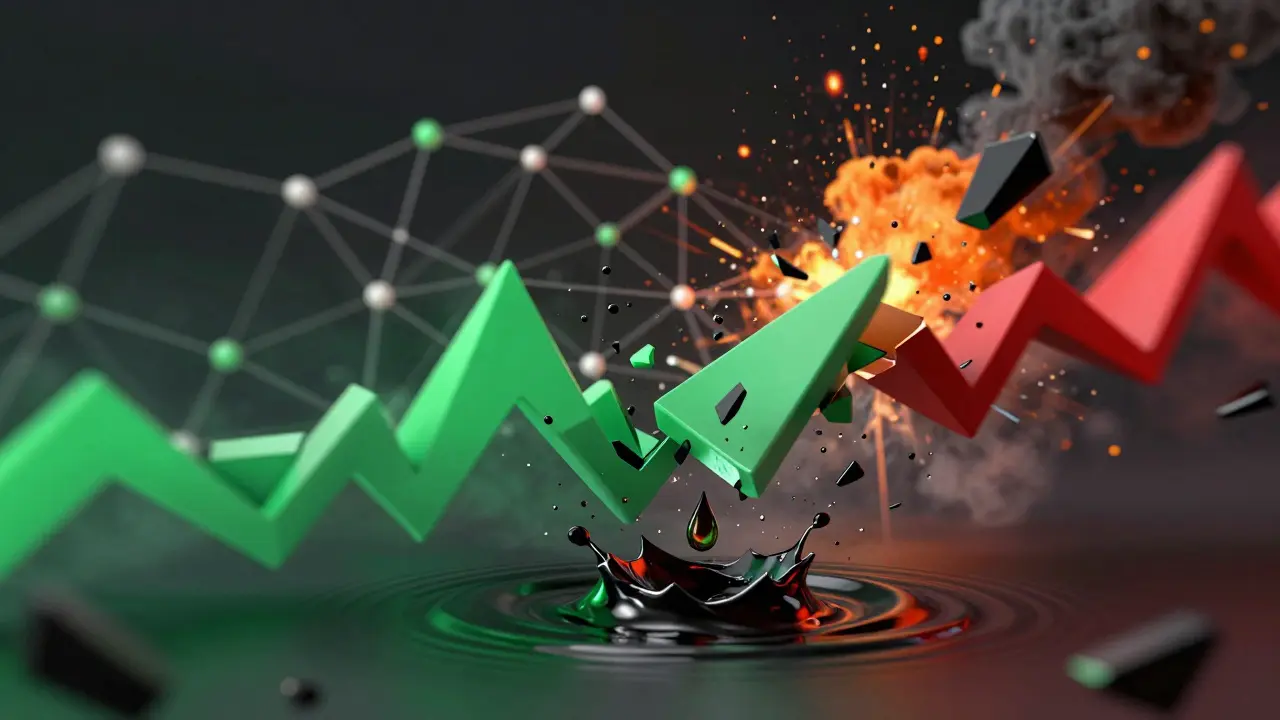
A flash crash is a sudden, sharp drop in asset prices followed by a rapid recovery. In crypto, these aren’t just glitches; they are often engineered by the architecture of lending platforms. The October 2025 event saw $19 billion in leveraged positions liquidated within 24 hours. Of that, $6.93 billion vanished in just 40 minutes.
What caused this? It wasn’t just the whale’s shorts. It was the cross-asset margin systems used by exchanges like Binance and Hyperliquid. In these systems, if one part of your portfolio loses value, the platform doesn’t just sell that asset. It may liquidate your entire account to cover losses. As Bitcoin and Ethereum dropped, Auto-Deleveraging (ADL) mechanisms kicked in. These systems forcibly closed profitable positions to maintain solvency, creating a domino effect. Traders who were actually winning money got swept up in the chaos because their collateral values were marked down simultaneously.
The situation worsened when the USDe stablecoin de-pegged, dropping from $1.00 to $0.65. Since many traders used stablecoins as collateral, their loan-to-value ratios spiked instantly. Sentora Research noted that while some protocols like Aave remained resilient due to prudent liquidation thresholds, the broader ecosystem suffered from fragmented liquidity. There was simply not enough buy-side depth to absorb the synchronized sell orders. Unlike the 2010 stock market flash crash, which led to SEC reforms including circuit breakers and trade transparency mandates, crypto has implemented no comparable system-wide protections as of May 2026.
Liquidity Attacks and Flash Loans
If whales use capital to manipulate markets, attackers use code. Flash loans represent a unique vulnerability in DeFi. They allow anyone to borrow millions of dollars without collateral, provided they repay the loan within the same blockchain transaction block. If the attack fails, the transaction reverts, and the attacker only loses a small amount in gas fees. This creates a low-risk, high-reward environment for malicious actors.
The most common vector is oracle manipulation. Protocols rely on "oracles" to determine the price of assets. Attackers use flash loans to buy up all available liquidity of a low-volume token on a decentralized exchange. This artificially inflates the price. The oracle sees this fake price and tells the lending protocol, "Your collateral is now worth twice as much." The attacker then borrows significant amounts of other assets using this inflated collateral, withdraws them, and lets the original flash loan revert. The protocol is left with worthless collateral and missing funds.
Chainalysis reported that in 2022 alone, DeFi protocols lost $386.2 million across 41 separate oracle manipulation attacks. Another method involves reentrancy attacks, where malicious code exploits design flaws to repeatedly enter and exit smart contract functions, draining funds before the balance updates. Defending against this requires Time-Weighted Average Price (TWAP) oracles, which average prices over time rather than taking a snapshot, making single-block manipulation ineffective. However, implementing TWAP adds complexity and latency, which can deter legitimate users.
New Threats: AI Agents and Volatility
As we move further into 2026, a new layer of risk has emerged: Artificial Intelligence agents. Unlike static algorithms that follow set rules, AI agents have persistence and goal-directed loops. Research from Aicerts.ai suggests that agentic AI systems can amplify volatility beyond momentary glitches. If multiple AI agents are deployed with similar logic, they might react identically to a signal, pulling bids instantaneously and causing liquidity to vanish faster than human traders can respond.
Worse, adversaries can potentially rewrite agent memories in Web3 protocols. A malicious prompt could broadcast across many deployed copies, causing each copy to unload positions simultaneously. This reverses historical safeguards where trading desks diversified algorithms to avoid feedback loops. Now, the concentration of decision logic in foundation models creates a new type of systemic risk. Microstructure experts recommend agent diversity, shadow simulations, and kill-switches as mitigation strategies, but widespread adoption is still lagging.
Building Resilient Tokenomics
So, how do we fix this? The Stoic AI framework identifies security as crypto’s "most unforgiving enemy." Mitigation requires a defense-in-depth approach. For protocol designers, this means moving beyond basic audits. You need to simulate extreme scenarios. Can your protocol survive a 50% drop in collateral value? Does your oracle resist flash loan manipulation?
For investors, the lesson from October 2025 is clear: excessive leverage erases gains in hours. The whale’s success was non-replicable because it relied on timing a black swan event while exploiting a market already in freefall. Prioritizing capital preservation over aggressive yield farming is the evidence-based strategy. Avoid protocols that offer unrealistic returns driven by complex, opaque leverage structures.
At a regulatory level, the International Monetary Fund (IMF) has warned that automated trading in tokenized markets increases flash crash likelihood. Yet, implementation remains incomplete. Industry advocates argue for mandatory circuit breakers, leverage caps, and stablecoin reserve requirements. Until these are standardized, participants must assume the market is structurally vulnerable. Diversification isn’t just about different coins; it’s about different risk profiles. Don’t put all your eggs in baskets that share the same underlying liquidity pools or oracle sources.
What is a whale in tokenomics?
A whale is a single wallet or entity that holds a disproportionately large amount of a token's supply, typically defined as 5% to 10% or more. Whales have the power to influence price movements through large buys or sells, creating significant risk for smaller investors.
How did the October 2025 flash crash happen?
The crash was triggered by a combination of a large whale executing massive leveraged short positions and systemic failures in cross-margin lending platforms. As prices dropped, auto-deleveraging mechanisms liquidated thousands of positions simultaneously, exacerbated by a stablecoin de-pegging event.
What is a flash loan attack?
A flash loan attack uses uncollateralized loans taken out and repaid within a single blockchain transaction to manipulate asset prices. Attackers often inflate the price of a token to borrow more assets from lending protocols, leaving the protocol with worthless collateral.
Why are crypto markets more prone to flash crashes than stocks?
Unlike traditional equity markets, crypto lacks circuit breakers, leverage caps, and error-correction mechanisms. Trading continues uninterrupted during extreme volatility, and transactions cannot be canceled if they are deemed "clearly erroneous," allowing cascading liquidations to accelerate unchecked.
How can I protect my portfolio from whale manipulation?
Check token distribution data before investing to ensure no single wallet holds a dominant share. Avoid high-leverage positions that can be wiped out by minor price swings. Diversify across different protocols and liquidity pools to reduce exposure to correlated risks.