

Imagine floating in the vacuum of space, where the temperature can swing from scorching heat to freezing cold in seconds. Now, imagine a tiny piece of rock or a paint chip from an old satellite screaming toward you at 17,500 miles per hour. In this environment, a simple fabric jumpsuit won't cut it. This is where the Thermal Micrometeoroid Garment is the critical outermost layer of a spacesuit designed to shield astronauts from extreme thermal radiation and high-velocity impacts. Often referred to as the TMG, this isn't just a "coat"-it is a complex piece of engineering that keeps an astronaut alive during extravehicular activity (EVA).
The Three-Layer Defense System
To understand why the outer layer is so special, you have to look at the whole suit. A professional EVA suit is essentially a wearable spacecraft. It consists of three integrated parts: the innermost liquid-cooling and ventilation garment (LCVG) to stop the astronaut from overheating, a middle pressure-restraint garment to keep oxygen in, and finally, the TMG on the outside. While the inner layers handle biology and pressure, the TMG handles the environment.
The TMG has two massive jobs. First, it provides thermal insulation. Space is a paradox; you can be baked by the sun (exceeding 100°C) or frozen in the shade. Second, it acts as armor against MMOD (Micrometeoroid and Orbital Debris). These are the microscopic "bullets" of space that can puncture a suit and cause a catastrophic loss of pressure.
The Science of Stopping Space Debris
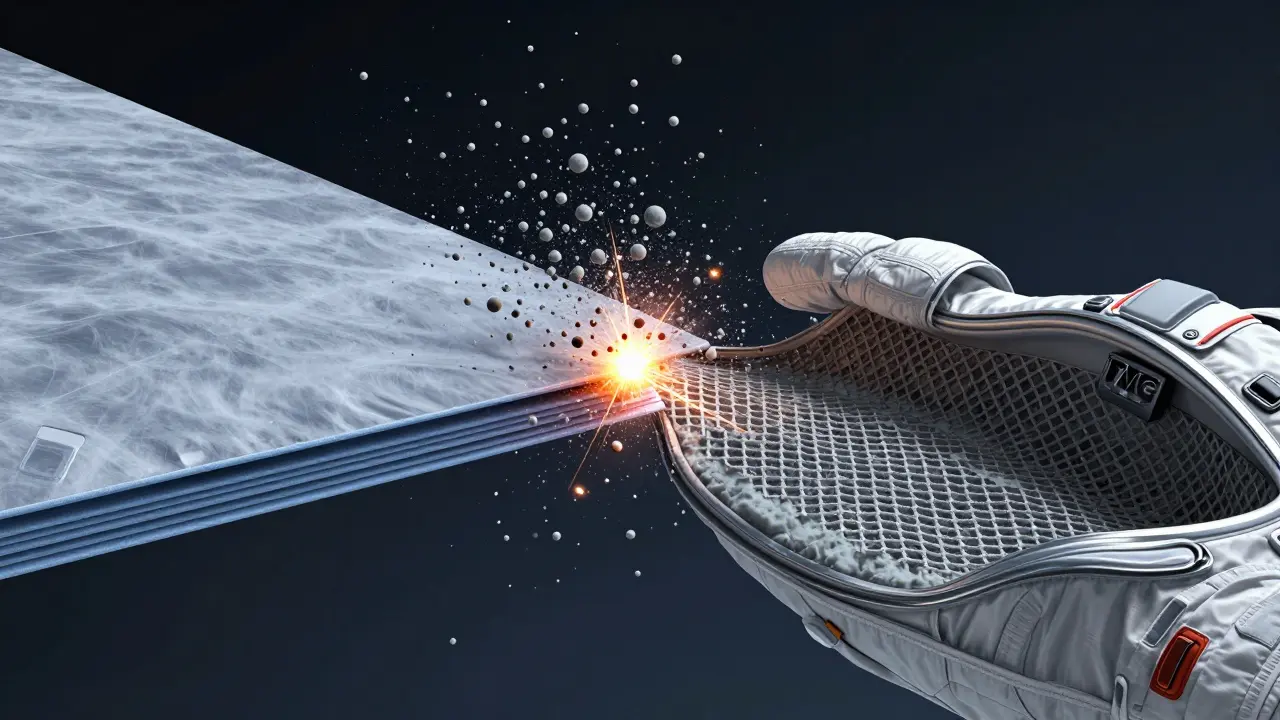
How do you stop a particle moving at hypervelocity? You don't just use one thick piece of metal; that would be too heavy to move in. Instead, engineers use the Whipple Shield principle. Think of it like a "bumper" system. When a micrometeoroid hits the first outer layer (the bumper), it doesn't just poke through-it shatters. This creates a cloud of smaller, less dangerous fragments. By the time these fragments reach the inner layers, they've lost most of their energy.
To make this work, TMGs use a specific structural layup: a bumper layer, a standoff space (which provides the distance for the debris cloud to spread), and a rear wall. Some advanced systems even add metal mesh layers. This mesh causes the debris to spread even further, ensuring that the impact is distributed rather than concentrated on one tiny point.
| Material | Key Attribute | Primary Function |
|---|---|---|
| Kevlar | Aramid Fiber | Highest hypervelocity impact protection |
| Nextel | Ceramic Fiber | High-heat and MMOD shielding |
| Aerogel | Low Density/Porous | Extreme thermal insulation and spacer loft |
| Silver-plated Nylon | Reflective Coating | Radiative heat reflection |
Advanced Materials: From Bulletproof Vests to Ceramic Fibers
Picking the right fabric is a balancing act between weight and safety. If it's too heavy, the astronaut can't move; if it's too light, they're at risk. Many of the materials used in TMGs come from the defense industry. For example, Kevlar, specifically KM2 fabrics, is used because it handles hypervelocity impacts better than almost anything else. Then there is Nextel, a ceramic fabric made of alumina-boria-silica fibers. It's incredibly tough and can withstand the heat and friction of a collision.
Other high-strength-to-weight options include Spectra and Vectran. In fact, JAXA (the Japan Aerospace Exploration Agency) often tests materials originally meant for satellites and bulletproof vests to see if they can be adapted for suits. This cross-pollination ensures that the "skin" of the suit is as tough as the hull of a spacecraft.
Solving the Thermal Challenge
Heat doesn't just come from the sun; it also leaks through the suit. The TMG uses Multi-Layer Insulation (MLI) thermal blankets to block radiative heat. In newer prototypes, like NASA's Exploration TMG (ETMG), they use silver-plated ripstop nylon for the outer shell. The silver reflects the sun's rays away from the body, preventing the astronaut from cooking in the direct sunlight.
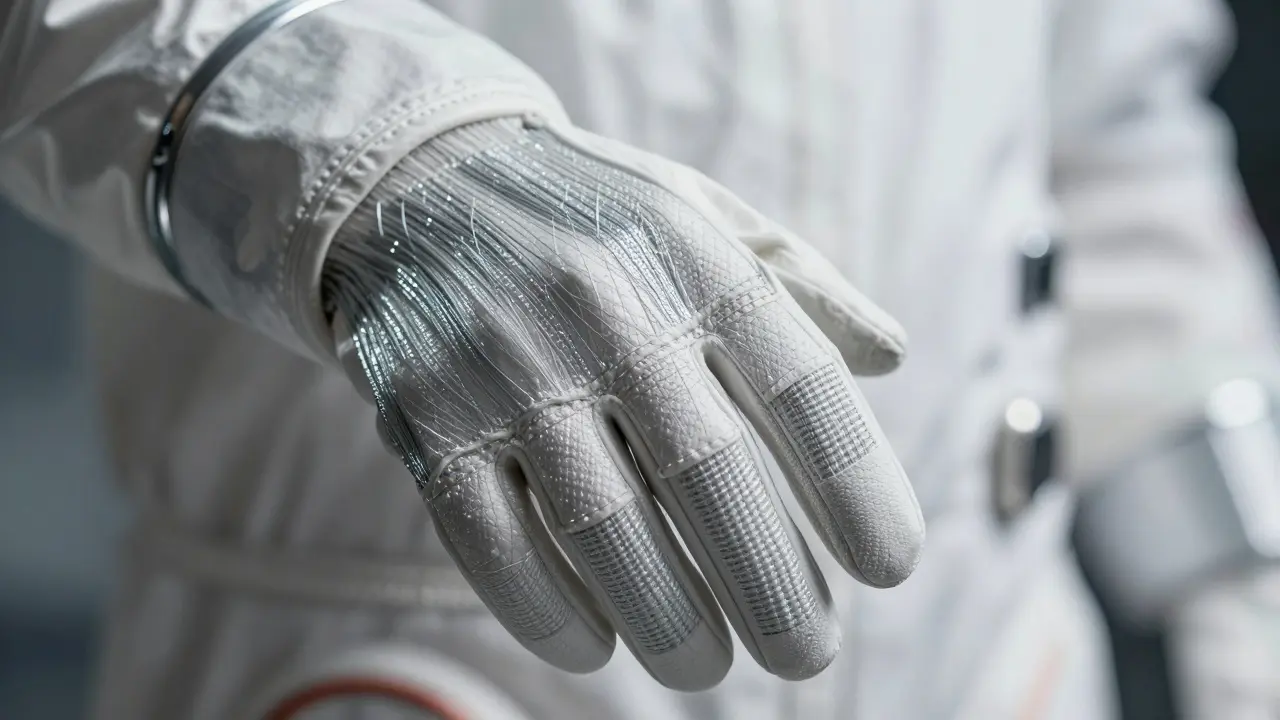
The real struggle is often at the seams and joints. Think about your gloves-the fingers need to move, but seams are where heat leaks out. To fix this, engineers use two layers of urethane-coated nylon in finger mobility areas. Additionally, Aerogel is being integrated into exploratory glove designs. Because aerogel is one of the best insulators known to man, it stops conductive heat transfer while simultaneously acting as a spacer for MMOD protection.
Scaling Protection to the Spacecraft
The strategies used for TMGs aren't just for people; they're used for the ships too. The same "bumper and wall" logic is applied to the Soyuz modules and Functional Cargo Blocks (FGB). For instance, the FGB uses multi-shock ceramic fabric layers that can stop aluminum projectiles up to 1.5 centimeters in diameter.
We see these TMG principles applied to critical spacecraft parts as well: adding protective sleeves to radiator interconnect lines or putting thermal protection on wing leading edge fittings. Whether it's a glove or a radiator, the goal is the same: create a barrier that breaks the threat before it reaches the vital interior.
What is the main purpose of a Thermal Micrometeoroid Garment?
The TMG serves as the outer layer of a spacesuit, providing two primary functions: thermal insulation to protect astronauts from extreme space temperatures and a physical shield against micrometeoroids and orbital debris (MMOD) that could puncture the suit.
How does the Whipple Shield effect work in a spacesuit?
A Whipple Shield uses a "bumper" (outer layer) to break up an incoming projectile into a cloud of smaller fragments. A standoff space allows this cloud to expand, so that by the time it hits the inner wall of the suit, the impact energy is dispersed and less likely to cause a puncture.
Which materials are most effective for MMOD protection?
Kevlar (especially KM2 fabrics) and Nextel (a ceramic fiber fabric) are among the most effective. Other high-performance materials include Spectra, Vectran, and carbon-composites due to their high strength-to-weight ratios.
Why is silver-plated nylon used in TMG shells?
Silver-plated ripstop nylon is used because it is highly reflective. This helps protect the astronaut from radiative heat transfer by reflecting solar radiation away from the suit, keeping the internal temperature manageable.
What role does aerogel play in modern space suit design?
Aerogel is used primarily in gloves and complex components to minimize conductive heat transfer. Because of its unique structure, it also serves as a lightweight "loft" material that contributes to the spacer layer needed for MMOD protection.
Next Steps for EVA Gear
If you're interested in how we're moving forward, keep an eye on Phase VII EVA Glove development. The goal is to move away from bulky, stiff protection toward "smart" materials that offer the same safety with much better dexterity. We're also seeing a shift toward simulation testing where JAXA and NASA use hypervelocity collision scenarios to predict exactly how a new fabric will behave before a human ever wears it. The next leap will likely involve integrated sensors in the TMG that can alert an astronaut if the outer layer has been compromised, even if the pressure hasn't dropped yet.
14 Responses
Pretty cool how they use simple bumpers to stop space rocks.
This is absolutely mind-blowing stuff! The way they engineer these garments to fight off those zooming space pebbles is just pure wizardry. It is totally exhilarating to think about the sheer grit and brilliance going into these suits to keep our brave explorers safe in that cosmic void!
Sure, they tell us about ceramic fibers and bumpers. But why are we really going back? It is all a giant game to keep us distracted from what is actually happening on earth. These suits are probably just movie props anyway because if a real rock hit them at that speed, they would just pop like a balloon. Everything is fake.
Kevlar is a bit cliché for high-end protection, don't you think?
It is really interesting to see how different agencies like JAXA and NASA collaborate on this. The cross-pollination of tech from bulletproof vests is a great example of how we can use existing earth-tech to conquer the stars. Everyone should take a look at how the Whipple shield works, it is a basic but genius concept.
The explanation of the Whipple Shield principle is very clear. For those interested in the physics, it is essentially about momentum transfer and fragmentation. When the projectile hits the first layer, the shock wave causes it to shatter, which spreads the force over a larger area of the rear wall. This prevents a single point of failure in the pressure garment. It is a standard approach in aerospace engineering, but seeing it applied to a flexible suit is quite an achievement.
I love how this explains the different layers! It is so fascinating to see the breakdown of materials like Nextel and Aerogel. I bet the feel of these suits is totally different from what we imagine. The science behind the thermal radiation is just wild!
The part about the gloves is so impressive 🚀✨. Imagine having to move your fingers while wearing all that ceramic and aerogel 🧤. Truly amazing work by the engineers 🌟!
The author has failed to adhere to basic punctuation standards in the table headers. Furthermore, the lack of a formal bibliography for the mentioned JAXA tests is utterly unacceptable. One does not simply cite 'cross-pollination' without providing a peer-reviewed source to substantiate such claims. This is an affront to technical writing.
Tbh the table is a bit messy. Why bother with all these details if the formatting is this lazy?
Keep pushing the boundaries of science! This is a fantastic breakdown. The future of smart materials is going to be a total game changer for EVA activities!
Very intresting read. i think the use of silvr plated nylon is quite lapped with traditionnal methods but it works well for thremal control.
this is a great start for anyone wanting to learn about space gear just keep reading and exploring the tech its all so cool when you think about it
It sounds so scary to have tiny rocks flying at you like that. I am glad they have these suits to keep them safe.