
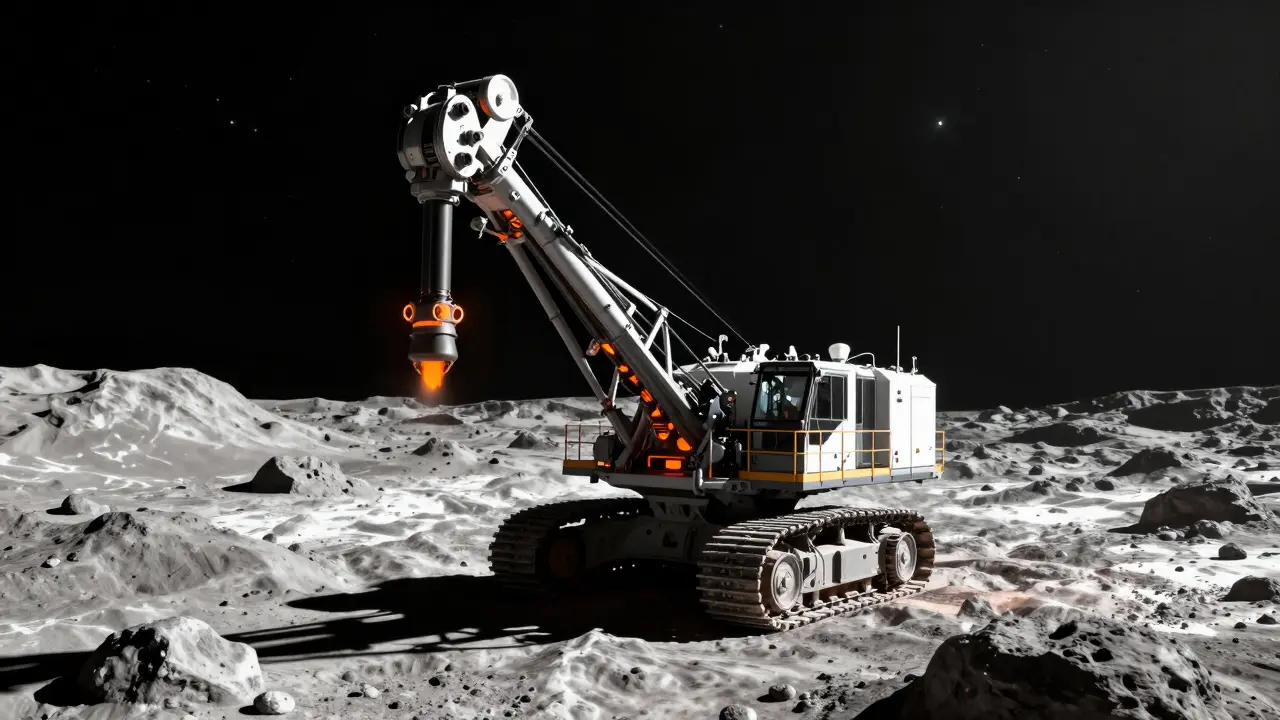
Imagine drilling into a moon or an asteroid. Your equipment is generating massive amounts of heat from motors and hydraulics. Outside, the temperature swings between blistering sun and freezing shadow. If you don’t manage that heat, your machinery melts or freezes solid within hours. This isn’t just a sci-fi problem; it’s the biggest engineering hurdle for space mining, which requires robust industrial extraction operations in extraterrestrial environments.
On Earth, we rely on air to cool things down. In space, there is no air. Heat can only escape by radiation-glowing away energy like a hot stove element. For mining gear, this means designing systems that reject waste heat efficiently while keeping vital components warm enough to function. It’s a balancing act involving advanced radiators, clever insulation, and dust-proofing.
The Physics of Heat in a Vacuum
First, let’s clear up a common misconception. Space isn’t "cold" in the way you think. It’s a vacuum, so it doesn’t suck heat out of your equipment. Instead, your equipment loses heat by emitting infrared radiation. The colder the surrounding environment, the better this works. Deep space hovers around 2.7 Kelvin (absolute zero), making it a perfect heat sink if you can point your radiator at it.
However, mining equipment generates significant internal heat. Drills, crushers, and processing units turn mechanical energy into waste heat. If this heat builds up, electronics fail. The challenge? You need to keep the inside of your machine above the temperature of your external radiator to force heat outward. But if the outside gets too hot from solar radiation, the radiator stops working. This creates a tight thermal window.
- Radiative Transfer: The only way to lose heat in a vacuum.
- Temperature Gradient: Internal components must be hotter than the radiator surface.
- Solar Load: Direct sunlight adds unwanted heat, reducing radiator efficiency.
To maximize efficiency, engineers aim radiators at "free space"-away from the sun, the planet, or other heat sources. Shielding is critical. A radiator facing the sun absorbs more energy than it can emit, causing overheating.
Advanced Radiator Technologies
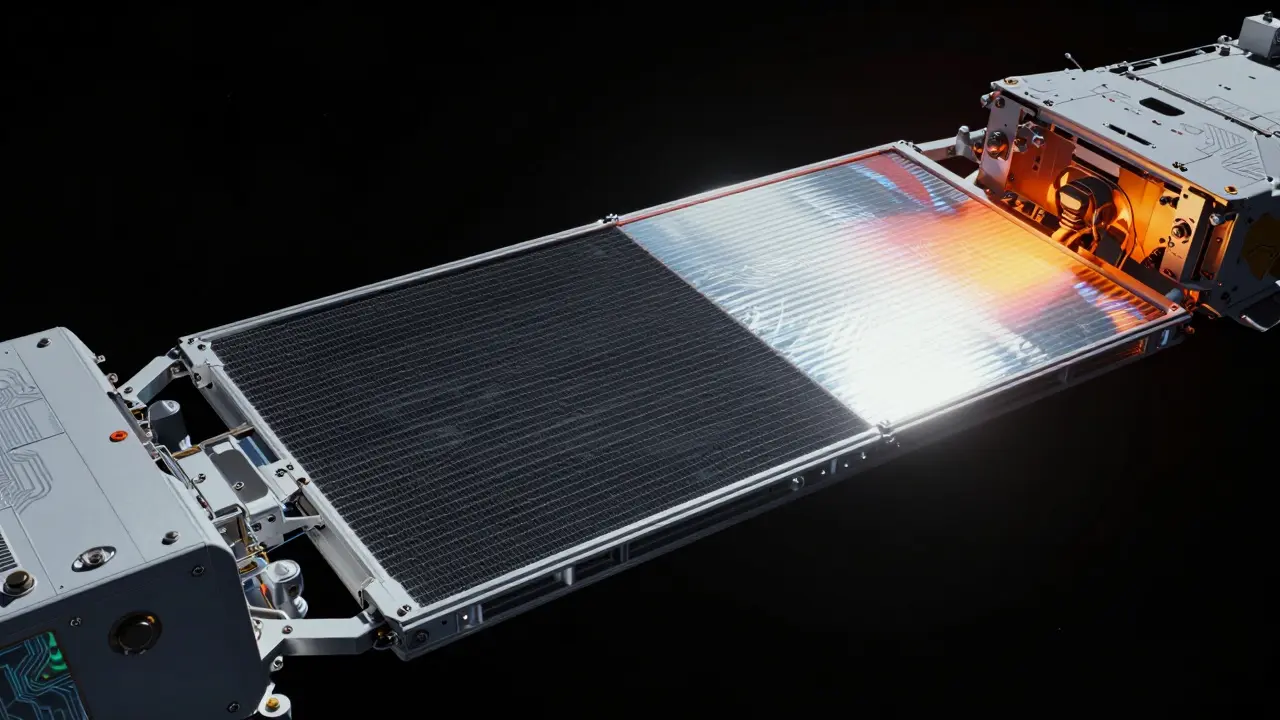
Traditional spacecraft use fixed aluminum panels painted black to radiate heat. These work, but they’re heavy and inefficient for high-power mining tasks. Newer technologies are changing the game.
| Technology | Emittance Range | Key Advantage | Best Use Case |
|---|---|---|---|
| Fixed-Plate Aluminum | 0.8 - 0.9 (Static) | Proven reliability, low cost | Low-power sensors |
| Variable Emittance | 0.1 - 0.9 (Adaptive) | Passive adjustment, no power needed | Cycling loads (drill vs. idle) |
| Electrochromic Coatings | 0.1 - 0.9 (Active) | Precise control via voltage | High-variable operational phases |
| Deployable Panels | High Emissivity Backsides | Large surface area, dual-use with solar | High-power extraction units |
Variable emittance radiators are a breakthrough. They change their infrared emissivity based on temperature without using electricity. When the mine is running hot, the surface becomes highly emissive (0.9) to dump heat quickly. When idle, it becomes reflective (0.1) to stay warm. This passive adaptation is crucial for autonomous mines where power budgets are tight.
For even more control, electrochromic coatings allow active modulation. By applying a small voltage, you can switch the radiator’s state instantly. This is useful when switching between high-load excavation and low-load data processing. Meanwhile, deployable radiator systems solve the size constraint. Mining rigs can’t carry massive flat plates folded inside their chassis. Deployable panels extend outward during operation, offering huge surface areas directed at deep space. Some designs even use the backside of solar arrays for cooling, combining power generation and heat rejection.
Moving Heat: Pipes and Interfaces
Having a great radiator is useless if you can’t get the heat to it. Inside the mining equipment, heat is generated in compact zones-like drill heads or processors. You need to transport that heat to the external panels efficiently.
Heat pipes are the workhorses here. Traditional aluminum-ammonia heat pipes work well for temperatures between 0°C and 40°C. But mining involves extremes. Modern loop heat pipes offer thermal conductivities up to 10,000 W/mK. That’s incredibly efficient. They pump heat from the hot core to the cold radiator without moving parts, relying on phase change (liquid to vapor and back).
The connection points matter too. Thermal interface materials (TIMs) fill the microscopic gaps between components and heat pipes. Recent advances include carbon nanotube-enhanced phase change materials with thermal conductivities of 50 W/mK. These materials maintain low thermal resistance (0.05 cm²·K/W) even after thousands of thermal cycles. This durability is essential because lunar days and nights cause repeated expansion and contraction of materials.
Don’t forget thermal doublers. These spread concentrated heat over a larger area before it hits the radiator, preventing hot spots that could damage the panel.
Insulation Strategies Beyond Foam
On Earth, foam insulation stops heat from escaping by trapping air. In space, there’s no air to trap. So, traditional foam does nothing. Instead, miners use Multi-Layer Insulation (MLI). MLI consists of dozens of thin, reflective layers separated by spacers. Each layer reflects radiant heat back inward, creating a barrier against both incoming solar radiation and outgoing internal heat.
But insulation isn’t just about wrapping the whole box. You need thermal breaks. Imagine a drill head getting hot from friction. You don’t want that heat traveling into the main chassis where sensitive computers live. Thermal breaks-often made of low-conductivity materials like titanium or specialized composites-act as insulating washers between hot and cold sections. They isolate specific components, allowing different parts of the machine to operate at different optimal temperatures.
Additionally, Optical Solar Reflectors (OSRs) help manage solar load. These mirrors reflect most sunlight while still allowing the underlying surface to radiate heat. Placing OSRs near radiators prevents them from absorbing solar energy, keeping the radiator cool and efficient.
Environmental Challenges: Dust and Cycling
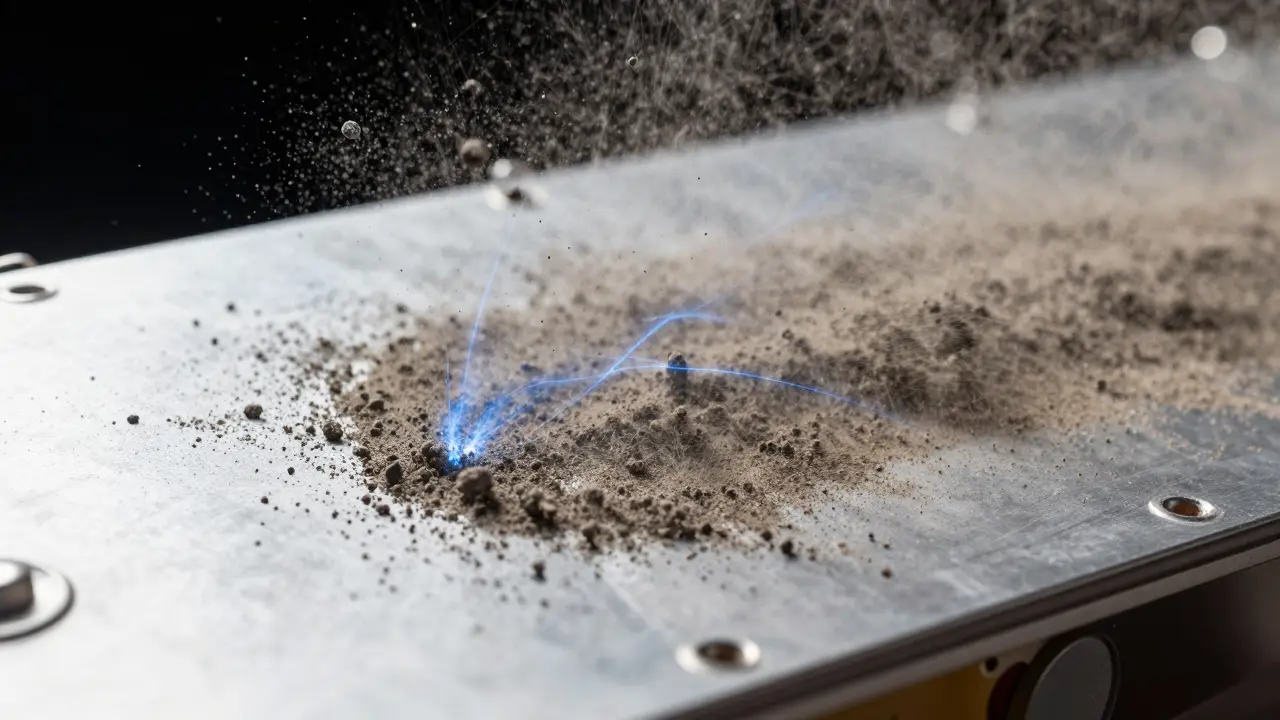
The environment itself fights your thermal design. On the Moon or asteroids, regolith dust is everywhere. These particles are tiny (less than 100 micrometers) and electrostatically charged. They stick to everything.
If dust coats your radiator, it acts like a blanket. It blocks infrared emission and traps heat. A dusty radiator might lose 50% of its cooling capacity. To combat this, engineers are testing electrodynamic dust mitigation. By applying an electric field to the radiator surface, you can repel charged dust particles before they settle. It’s an active system, but it preserves radiator performance over long missions.
Then there’s thermal cycling. On the Moon, day lasts 14 Earth days, followed by 14 days of night. Temperatures swing by over 300°C. Materials expand and contract repeatedly. Adhesives, seals, and radiator mounts must withstand this stress without cracking. Lunar mining equipment needs components rated for these extreme cycles, unlike satellites in stable orbits.
Mars presents a different puzzle. Its thin atmosphere offers minimal convective cooling, but global dust storms can coat surfaces and alter solar absorptance. Plus, polar regions drop to -143°C. Here, standard ammonia heat pipes might freeze. Miners may need cryogenic heat pipes using nitrogen or methanol to handle the deep freeze.
Integration with Power and Propellant
Thermal control doesn’t exist in a vacuum-it ties directly into power and fuel. Solar panels generate electricity but also absorb heat. Smart designs use the chassis as a primary radiator while deploying solar arrays separately. The back of the solar array can be coated with high-emissivity material to reject heat, while the front generates power.
For advanced missions involving water ice extraction, cryogenic propellant management becomes relevant. Processing ice into hydrogen and oxygen fuel requires keeping tanks extremely cold. Interestingly, you can use the boil-off heat from these cryogenic tanks as a heat source for other systems, or conversely, use the cold tanks as a heat sink for the mining equipment. This coupling reduces the need for separate radiators, saving mass and complexity.
Summary of Key Takeaways
- Radiation is King: In space, heat only escapes via radiation. Point radiators at deep space, not the sun.
- Adaptive Surfaces: Variable emittance and electrochromic radiators adjust cooling power passively or actively, ideal for fluctuating mining loads.
- Efficient Transport: Loop heat pipes and carbon nanotube TIMs move heat from hot cores to cold radiators with minimal loss.
- Smart Insulation: Multi-Layer Insulation (MLI) and thermal breaks isolate components, protecting sensitive electronics from heat and cold.
- Dust Mitigation: Electrodynamic fields prevent regolith dust from blinding radiators, maintaining cooling efficiency.
- System Integration: Combining thermal control with solar power and cryogenic fuel processing saves mass and increases mission viability.
Why can't we use fans to cool mining equipment in space?
Fans rely on convection-moving air to carry heat away. Space is a vacuum, meaning there is no air. Therefore, fans are useless for cooling in space. Heat must be transferred via radiation (infrared light) or conduction through solid materials.
What happens if dust covers a space radiator?
Dust acts as an insulator. It blocks the radiator's ability to emit infrared heat and may absorb solar radiation instead. This causes the equipment to overheat. Electrodynamic dust mitigation systems use electric fields to repel charged dust particles, keeping the radiator clean.
How do variable emittance radiators work?
These radiators change their surface properties based on temperature. When hot, they become highly emissive (black-like) to release heat quickly. When cold, they become reflective (white-like) to retain heat. This happens passively without needing electrical power, making them reliable for autonomous mining.
Why are thermal breaks important in mining equipment?
Thermal breaks isolate hot components (like drill heads) from cold or sensitive ones (like computers). Without them, heat would conduct through the entire structure, potentially damaging electronics or wasting energy trying to cool the whole chassis.
Can solar panels help with cooling?
Yes. The backside of deployable solar arrays can be coated with high-emissivity material. While the front generates power, the back radiates waste heat into space. This dual-use design saves mass and volume compared to carrying separate radiator panels.