
Imagine waking up one morning to find that a financial system you trusted with your savings has vanished overnight. For thousands of investors in May 2022, this wasn't a nightmare-it was reality. The Terra-Luna collapse stands as one of the most dramatic failures in cryptocurrency history, wiping out nearly $45 billion in market value in less than a week. It wasn't just a bad trade or a hacked exchange; it was a fundamental breakdown of how money works when built on code instead of cash reserves.
If you’ve ever wondered why some digital currencies promise high returns while others stay steady at $1, the story of TerraUSD (UST) and LUNA is essential reading. It explains exactly what happens when confidence evaporates from an algorithmic stablecoina digital currency designed to maintain a fixed price through automated mechanisms rather than physical asset backing. Today, we break down the mechanics, the timeline, and the aftermath of this historic event.
How the System Was Supposed to Work
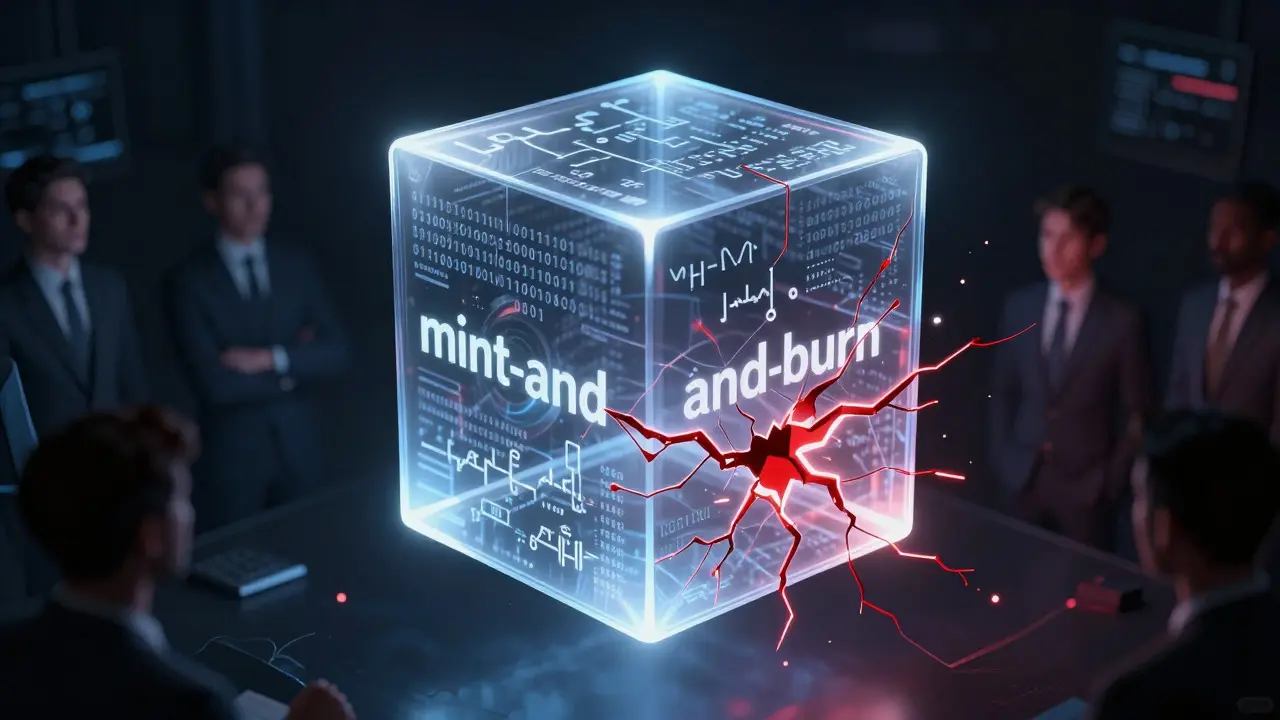
To understand the crash, you first need to grasp the design. Terraform Labs, led by Do Kwon, created an ecosystem centered on two tokens: TerraUSD (UST)an algorithmic stablecoin pegged to the US dollar and LUNAthe volatile governance token used to stabilize UST. Unlike traditional stablecoins like USDT or USDC, which are backed by actual dollars held in bank accounts, UST relied on a mathematical formula known as mint-and-burn arbitrage.
The theory was elegant. If UST traded above $1, users could burn LUNA to create new UST, increasing supply and driving the price down. If UST dropped below $1, users could burn UST to mint $1 worth of LUNA, reducing supply and pushing the price back up. This mechanism assumed that rational actors would always step in to profit from small deviations, keeping the peg intact.
But there was a catch. To make holding UST attractive, the ecosystem offered Anchor Protocol, a lending platform that promised an annual percentage yield (APY) of roughly 20%. This unsustainable return drew billions of dollars into the system. By early 2022, about 75% of all circulating UST was parked in Anchor. This concentration meant that if people lost faith in Anchor’s ability to pay those returns, they would pull their money out simultaneously, triggering a run on the bank-but without any actual deposits to cover it.
The Trigger: A Liquidity Shock
The collapse didn’t start with a bang, but with a whisper in the liquidity pools. On May 7, 2022, large holders-often called "whales"-began withdrawing hundreds of millions of UST from Anchor. They dumped these tokens into Curve Finance, a decentralized exchange platform, selling them for other stablecoins like USDC.
This action overwhelmed the available liquidity. With not enough buyers willing to accept UST at $1, the price dipped to around $0.985. In a healthy system, this minor deviation would have been corrected instantly by arbitrageurs. However, because so much UST was locked in Anchor, the market lacked the depth to absorb the shock. The dip signaled doubt, and in crypto, doubt spreads faster than light.
The Death Spiral: May 8-13, 2022
Once the peg broke, the algorithmic defense mechanism kicked into overdrive-and that’s where things went wrong. As UST fell below $1, holders burned UST to mint LUNA. Every time someone redeemed $1 worth of UST, the protocol printed $1 worth of LUNA. But since LUNA’s price was falling rapidly due to panic selling, the newly minted LUNA had little value. This caused hyperinflation of the LUNA supply.
| Date | Event | Impact |
|---|---|---|
| May 7 | Large withdrawals from Anchor | UST dips to $0.985 |
| May 8 | Luna Foundation Guard buys UST | Temporary stabilization |
| May 9 | Second depeg attempt fails | UST drops to $0.35 |
| May 10-11 | LFG exhausts Bitcoin reserves | LUNA supply explodes to trillions |
| May 12 | Terra blockchain halted | Trading suspended on major exchanges |
| May 13 | Market cap near zero | ~$45B wiped out |
On May 8, the Luna Foundation Guard (LFG), a nonprofit entity associated with Terra, tried to save the system by spending its massive Bitcoin reserves to buy UST. They bought billions of dollars worth of UST, temporarily stabilizing the price. But this was a band-aid on a bullet wound. By May 10, LFG had spent all its Bitcoin reserves, buying over 1.1 billion UST. It didn’t matter. Confidence was gone.
As more people redeemed UST, more LUNA was minted. The circulating supply of LUNA exploded from 350 million tokens to over 6.5 trillion in just 48 hours. With such a massive increase in supply and plummeting demand, LUNA’s price crashed from nearly $120 to fractions of a cent. UST followed suit, settling around $0.10-$0.20 before eventually becoming worthless. By May 13, the Terra blockchain was halted to prevent further damage, marking the end of the original network.
Why Algorithmic Stablecoins Are Risky
The Terra-Luna case highlights the core vulnerability of algorithmic stablecoins: they rely entirely on market psychology. Traditional stablecoins like USDCa fiat-collateralized stablecoin issued by Circle work because you can redeem them for real dollars. UST worked only as long as people believed others would keep buying it. When that belief shattered, the math couldn’t save it.
Experts point out three critical flaws:
- Concentration Risk: Too much UST was tied to Anchor Protocol. When Anchor faltered, the whole system shook.
- Reflexivity: Falling prices caused more selling, which caused more price drops-a feedback loop with no brake.
- Lack of Hard Collateral: Without physical assets backing the value, the system depended on continuous growth and optimism.

Legal Aftermath and Regulatory Impact
The human cost was staggering. Retail investors who were lured by the 20% APY lost life savings. Many treated UST as a safe savings account, unaware of the underlying risks. In April 2024, a U.S. jury found Terraform Labs and co-founder Do Kwon liable for securities fraud. Later that year, Terraform Labs agreed to a $4.47 billion settlement with the Securities and Exchange Commission (SEC).
This legal victory signaled a shift in how regulators view crypto projects. Authorities now scrutinize high-yield DeFi products closely, warning that promises of guaranteed returns often mask extreme risk. The collapse also fueled debates about central bank digital currencies (CBDCs), as governments seek to offer digital alternatives that don’t carry the volatility of private experiments.
Lessons for Future Investors
So, what should you take away from this disaster? First, question any investment that offers unusually high returns with low risk. If it sounds too good to be true, it probably is. Second, understand the difference between collateralized and algorithmic stablecoins. Just because something is called "stable" doesn’t mean it is.
Finally, diversify. The Terra-Luna collapse showed how interconnected crypto markets can be. When one giant falls, it takes many others down with it. Always do your own research, read the whitepapers, and never invest more than you can afford to lose.
What happened to LUNA after the collapse?
The original LUNA token became virtually worthless, trading at fractions of a cent. The Terra blockchain was split, leading to the creation of Terra 2.0, which uses a new version of LUNA (now called LUNC) that is separate from the failed UST ecosystem. Most holders of the original LUNA saw their investments drop by over 99%.
Is UST still usable today?
No, the original TerraUSD (UST) is considered defunct. It lost its peg permanently and trades at a tiny fraction of its former value. While some experimental forks exist, none have regained significant trust or utility compared to established stablecoins like USDC or USDT.
Who was responsible for the Terra-Luna collapse?
Terraform Labs and its co-founders, particularly Do Kwon, were held legally responsible. A U.S. court found them liable for securities fraud in 2024, citing misleading statements about the stability of UST and the sustainability of Anchor Protocol’s yields.
How did the Luna Foundation Guard try to save UST?
The Luna Foundation Guard (LFG) attempted to defend the peg by using its reserve of Bitcoin to buy UST on the open market. They spent approximately 33,000 BTC in a desperate bid to restore confidence, but once the reserves were exhausted, the collapse accelerated.
Are algorithmic stablecoins dead?
Not entirely, but they are viewed with extreme caution. The Terra-Luna collapse proved that pure algorithmic models are vulnerable to runs. Newer designs often incorporate hybrid approaches, mixing some hard collateral with algorithmic adjustments to reduce risk, though skepticism remains high among regulators and institutional investors.