
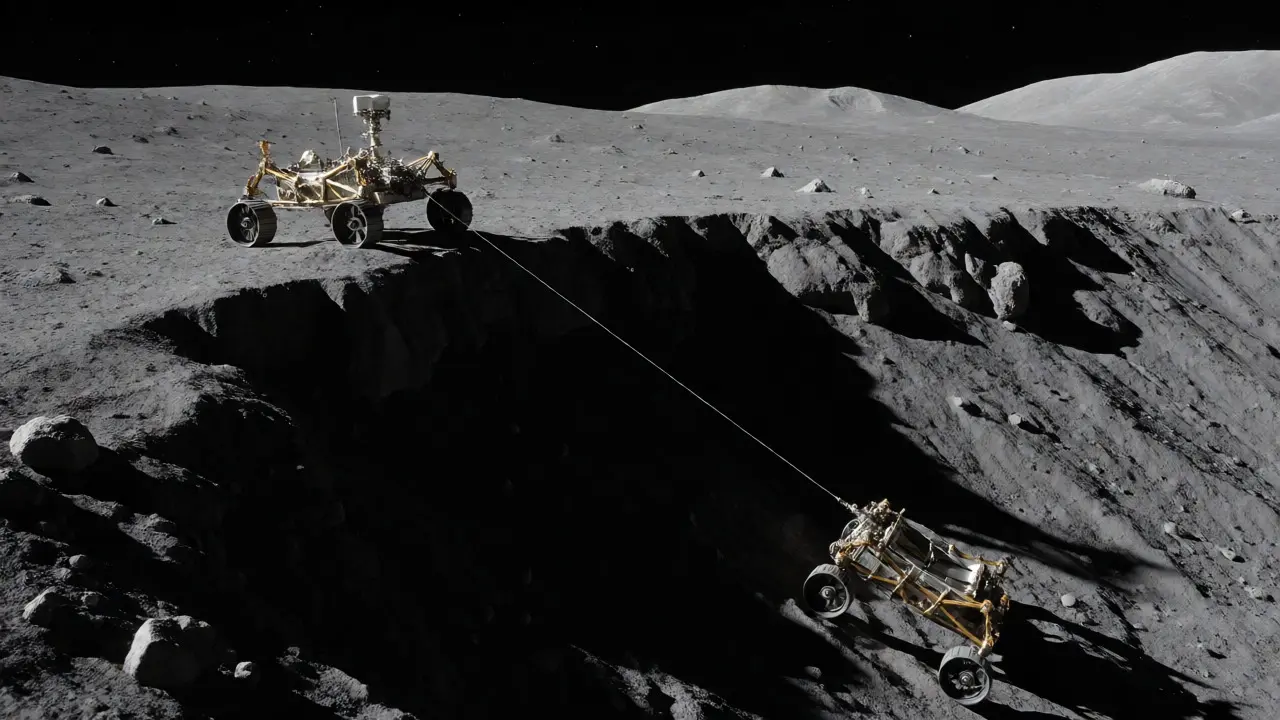
Imagine driving a rover on the Moon, only to hit a wall of solid rock. But wait-there’s a hole right in front of you, leading into a dark, unknown tunnel that could hold ice, shelter from radiation, or even signs of past life. How do you get down there without crashing? You don’t jump. You rappel.
This is the core problem facing tethered robots designed for planetary exploration. As we look toward establishing permanent bases on the Moon and Mars, surface conditions are brutal. Daytime temperatures can hit 127°C (260°F), while nights plunge to -173°C (-280°F). Cosmic rays and micrometeorites bombard everything exposed. But underground? It’s stable. NASA data suggests permanently shadowed regions inside lunar pits stay near a mild 17°C (63°F). These subsurface voids, known as lava tubes, are prime real estate for future habitats and scientific discovery.
The catch? We can’t just drop a robot in. Gravity on the Moon is one-sixth of Earth’s, but falling debris or a slip on a steep slope can still destroy expensive hardware. Plus, once a robot goes underground, it loses line-of-sight with Earth. No GPS, no direct radio link, no easy rescue. That’s why engineers at NASA, ESA, and universities are betting big on tethered systems. A cable isn’t just a safety rope; it’s a power cord, a data highway, and a navigation guide all rolled into one.
Why Tethers Are Non-Negotiable for Cave Access
You might ask, why not use drones or autonomous rovers that just drive down slowly? Drones struggle in low-pressure environments like Mars and fail completely in the vacuum of the Moon due to lack of aerodynamic lift. Autonomous wheeled rovers risk tipping over on uneven terrain and getting stranded. Once they’re out of sight, they’re effectively gone.
A tether solves three critical issues simultaneously:
- Safety: It physically prevents falls. If a robot slips, the anchor holds.
- Power: Batteries are heavy and limited. A tether allows a surface lander to supply continuous electricity, extending mission duration from hours to days or weeks.
- Communication: Radio waves have trouble penetrating thick rock. A physical wire guarantees a high-bandwidth data link back to the surface.
However, tethers introduce their own engineering nightmares. The cable must withstand abrasive regolith (moon dust) that acts like sandpaper. It has to survive extreme temperature swings and UV exposure. And if it snaps, the mission ends. This delicate balance drives the design of every major concept currently under development.
DuAxel: The Proven Rappelling Rover
If any system comes close to being "flight-ready," it’s DuAxel. Developed by NASA’s Jet Propulsion Laboratory (JPL), DuAxel is essentially two smaller rovers called Axels docked together. Think of it as a four-wheeled vehicle that can split in half.
Here’s how it works: DuAxel drives across flat terrain using standard Ackermann steering. When it reaches a steep cliff or pit edge, it anchors itself securely. Then, one Axel undocks and rappels down the slope on a tether, while the other remains at the top as an anchor and relay station. In October 2020, NASA released footage of a field test in the Mojave Desert where DuAxel successfully descended a 90-degree slope. Issa Nesnas, a JPL robotics technologist, noted that the system "performed extremely well," demonstrating autonomous maneuvering and instrument deployment without human intervention during the descent.
The tether used in tests was a 1/8-inch steel cable, strong enough to support hundreds of pounds. For actual missions, engineers are targeting lighter, stronger materials that can handle up to 300 meters of descent. DuAxel’s strength lies in its simplicity and proven mechanics. It doesn’t need to fly, and it doesn’t need complex legged locomotion. It just needs to hold on tight and lower itself carefully.
Moon Diver: Targeting Tranquillitatis Pit
Taking the Axel concept further, NASA proposed the Moon Diver mission. The target? Tranquillitatis Pit, a massive vertical shaft discovered by the Lunar Reconnaissance Orbiter. This isn’t just a small hole; it’s a gateway to potentially vast underground tunnels.
Moon Diver would consist of a lander equipped with a crane-like mechanism. An Axel rover, attached to a long tether, would be lowered into the pit. The tether would carry redundant electrical conductors, allowing the lander to power the rover continuously. The goal is to traverse up to 300 meters down the pit wall, mapping the interior and checking for structural stability. Unlike a simple drop, Moon Diver allows for controlled exploration. If the path looks clear, the rover descends. If obstacles appear, it can ascend back to safety.
As of late 2026, Moon Diver remains a concept in advanced study. While no launch date is set, it represents the most concrete plan for using tethered technology specifically for lunar pit exploration. It highlights the trade-off between reach and weight: longer tethers allow deeper access but add mass and complexity to the spool mechanism.
DAEDALUS: The Sphere for Deep Reconnaissance
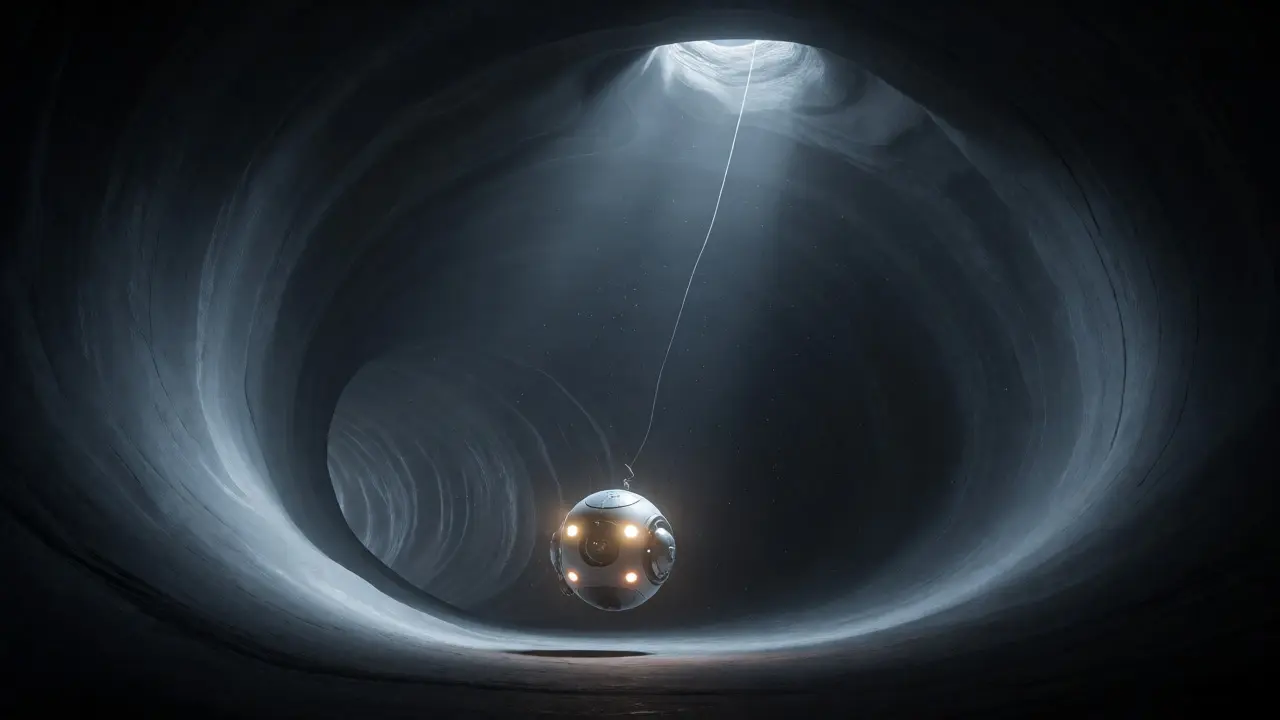
While DuAxel focuses on rappelling, another approach asks: what if the robot could roll freely once it hits the bottom? Enter DAEDALUS, short for Descent And Exploration in Deep Autonomy of Lava Underground Structures. Led by the University of Würzburg with support from ESA, this concept uses a spherical robot about 46 centimeters in diameter.
The strategy is different. A robotic crane lowers the sphere into a skylight (an opening in a lava tube roof). During descent, the tether provides power and data. Once the sphere reaches the floor, it disconnects. Now free, it rolls around using internal motors, mapping the cave with lidar and stereoscopic cameras. The key innovation here is the tether end: it stays suspended above, acting as a Wi-Fi access point. The rolling sphere sends data up to the hanging tether, which relays it to the surface. This avoids the need for the robot to climb back up, saving energy and reducing mechanical wear.
DAEDALUS is ideal for initial reconnaissance. Its compact size means it can fit through narrow openings that larger rovers miss. However, it relies heavily on the surface infrastructure. If the crane fails or the tether breaks during deployment, the sphere is stranded. It’s a high-risk, high-reward scout for the first look inside.
ReachBot: Bracing Against the Walls
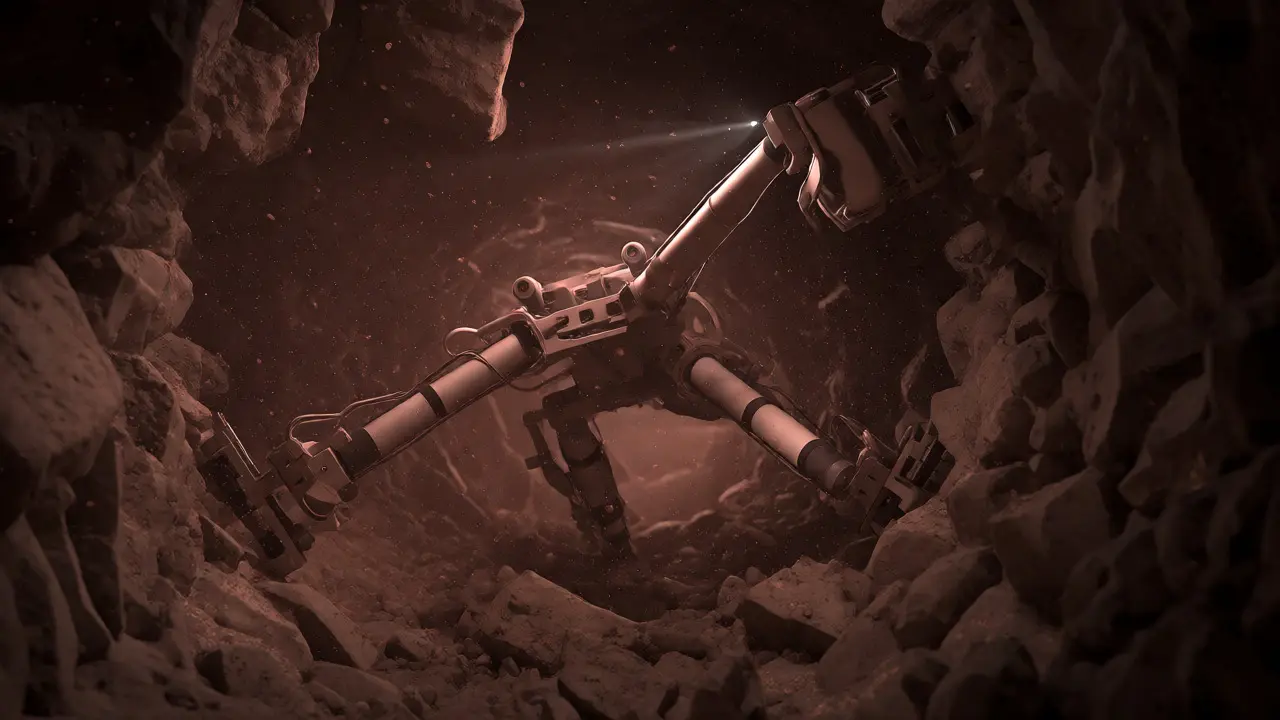
Lava tubes aren’t always smooth vertical shafts. Sometimes they’re irregular, jagged voids with rubble floors and uneven ceilings. Wheeled rovers struggle here. So does rappelling. This is where ReachBot shines. Designed primarily for Mars, ReachBot uses extendable booms to brace against opposing surfaces.
Imagine a spider that can stretch its legs to touch both sides of a chimney. By pushing against opposite walls, ReachBot creates friction and force closure, allowing it to move upward, downward, or sideways regardless of gravity direction. The proposed MELT (Martian Exploration of Lava Tubes) mission envisions a 10-kilogram ReachBot descending via tether from a mother rover. With booms extending up to 20 meters, it can navigate large open spaces where wheels would sink into dust or fall off edges.
ReachBot is mechanically more complex than DuAxel. More moving parts mean more potential failure points. Dust infiltration is a major concern, as Martian regolith is fine and electrostatic. But for traversing complex cave interiors, it offers mobility that simple wheels cannot match.
Comparing the Contenders
Each system targets a specific phase or type of exploration. Here’s how they stack up:
| System | Primary Strength | Best Use Case | Key Limitation | Status (Nov 2026) |
|---|---|---|---|---|
| DuAxel | Proven anchoring and rappelling | Steep slopes, crater rims, crevasses | Limited interior mobility once landed | Field-tested on Earth |
| Moon Diver | Lander-powered deep descent | Vertical lunar pits (e.g., Tranquillitatis) | Tether length and spool capacity | Concept study |
| DAEDALUS | Compact, free-roaming after release | Initial cave mapping, narrow entrances | Dependent on surface crane; hard to recover | Technology demonstration |
| ReachBot | Bracing against irregular walls | Complex Martian lava tube interiors | Mechanical complexity; dust sensitivity | Design study |
| Skylight | Persistent tether infrastructure | Long-term monitoring of lava tubes | Requires semi-autonomous micro-rover | ESA investigation |
The Engineering Hurdles Ahead
Building these robots is hard, but operating them is harder. The tether itself is a critical subsystem. NASA engineers have tested fibers capable of supporting 60 kilograms over 300 meters, but real-world conditions are unforgiving. Abrasion from sharp rocks can sever cables. Thermal cycling makes materials brittle. On Mars, the thin atmosphere doesn’t help cool electronics, while on the Moon, vacuum causes outgassing that can lubricate mechanisms unexpectedly.
Communication is another bottleneck. Even with a tether, bandwidth is limited. Sending high-resolution lidar maps takes time. If the tether breaks, the robot must switch to emergency autonomy. Systems like DAEDALUS are programmed to stop, save data locally, and attempt to re-establish contact. But if that fails, the robot becomes a silent monument to ambition.
Power management dictates mission length. Tethered robots can operate indefinitely if the surface lander has nuclear or solar power. Untethered phases rely on batteries. Reaching the bottom and then trying to climb back up drains energy quickly. This is why concepts like Skylight propose leaving the tether connected as a charging station, rather than releasing the robot entirely.
What’s Next for Lunar and Martian Caves?
We aren’t sending humans into caves yet. The immediate next step is robotic confirmation. NASA selected the GIMLI payload in 2026 to investigate the Marius Hills Pit, though it focuses on geophysical sensing rather than direct tethered entry. Meanwhile, ESA announced plans in November 2026 for a lunar-cave mission involving a tethered probe. These steps suggest a cautious approach: confirm the void exists, map the entrance, then send a robot.
The ultimate goal is sample return. Imagine a robot descending into a Martian lava tube, drilling into a wall, capturing a core sample, and sending it back up the tether. That sample could contain ancient water ice or biosignatures preserved from billions of years ago. Tethered robots make this possible because they provide the reliable link needed to retrieve samples safely.
For now, none of these systems are commercially available. They are research prototypes funded by government agencies. But the progress is rapid. From DuAxel’s desert tests to DAEDALUS’s sphere designs, the toolkit for exploring the hidden worlds beneath our feet is growing. The question isn’t if we’ll explore these caves, but which robot will be the first to turn on its lights in the dark.
Why can't regular rovers explore lunar caves?
Regular rovers rely on GPS and line-of-sight communication, both of which fail underground. Additionally, steep, unlit slopes pose a high risk of tipping over. Without a tether, a fallen rover cannot be recovered, resulting in total loss of investment.
How long can a tethered robot stay in a cave?
Duration depends on the power source. If connected to a surface lander via a powered tether, the robot can operate for weeks or months. If untethered and battery-dependent, operations typically last only a few hours to a few days before power depletion.
Is DuAxel ready for a moon mission today?
Not quite. While DuAxel has performed well in Earth-based field tests (like in the Mojave Desert), it requires flight-qualified components to withstand lunar vacuum, extreme temperatures, and radiation. It is considered a mature prototype, not a flight-proven system.
What happens if the tether breaks?
If the tether breaks, the robot loses power and communication. Most designs include emergency autonomy protocols: the robot stops, conserves battery, stores data locally, and attempts to transmit via backup radios. If recovery is impossible, the mission ends, but the collected data may still be retrievable if the robot can eventually surface or if a subsequent mission finds it.
Which planet is easier to explore with tethered robots, Moon or Mars?
The Moon is generally considered easier for tethered operations due to its lack of atmosphere (no wind loads on the tether) and simpler thermal environment compared to Mars's dust storms. However, Mars has thicker regolith and more complex geology, making the science more compelling despite the engineering challenges.