
When we talk about X-ray space telescopes, space-based observatories designed to detect high-energy X-rays from cosmic sources that can’t be seen from Earth. Also known as X-ray observatories, they’re the only way we can study the hottest, most violent places in the universe—like black holes swallowing stars, neutron stars spinning at light speed, and galaxy clusters glowing with superheated gas. Earth’s atmosphere blocks X-rays, so these telescopes have to orbit above us, flying in precise formations to catch signals that would otherwise vanish before they reach the ground.
These aren’t regular optical telescopes. They use special mirrors shaped like barrels to catch and focus X-rays at shallow angles—like skipping stones on water—because X-rays punch right through normal mirrors. The Chandra X-ray Observatory, NASA’s flagship X-ray telescope launched in 1999 and still operating today, has captured images of supernova remnants so detailed we can track how elements like iron and silicon explode outward. Meanwhile, X-ray astronomy, the field dedicated to studying cosmic X-ray sources relies on detectors cooled to near absolute zero, using the same cryostat and heat pipe tech you’ll find in the James Webb Space Telescope. Without these tools, we’d miss half the action in space: the collisions, the explosions, the invisible forces shaping galaxies.
What makes X-ray space telescopes so powerful is what they show us that other telescopes can’t. A glowing cloud in visible light might look peaceful. In X-rays, it’s a raging storm of particles accelerated to near-light speed. That’s how we found the first black holes, confirmed how dark matter pulls hot gas into galaxy clusters, and even spotted a star being torn apart by a supermassive black hole billions of light-years away. These aren’t just pretty pictures—they’re data that tell us how matter behaves under extreme gravity, how elements are forged in stellar explosions, and how the universe evolves over time.
The next generation of X-ray telescopes will be even sharper, with better resolution and wider fields of view. Some are already in development to pair with gravitational wave detectors, letting us see both the ripples in spacetime and the X-ray glow from the same event. That’s the future: seeing the universe in multiple wavelengths at once, stitching together a full picture of cosmic violence. What you’ll find in the articles below are real missions, real discoveries, and the engineering breakthroughs that made them possible—from cooling systems that keep detectors cold enough to see faint signals, to the precise orbits that keep telescopes locked on target for weeks at a time. This isn’t theory. It’s what’s happening right now, out there in the dark.
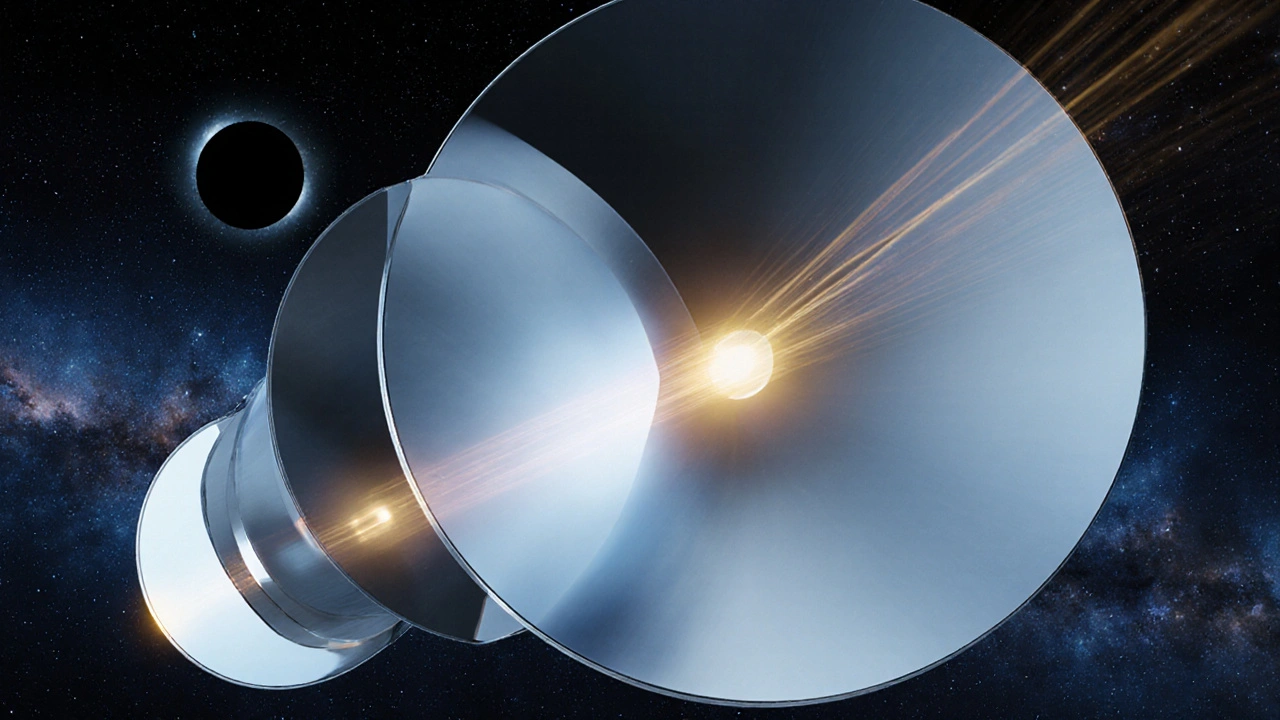
Grazing incidence optics enable X-ray space telescopes to focus high-energy radiation by reflecting it at shallow angles. This technology powers missions like Chandra and the upcoming ATHENA telescope, revealing black holes and galaxy clusters invisible to optical telescopes.
Learn More