
When we think of telescopes, we picture glass lenses pointing at stars. But the universe doesn’t show itself in visible light alone. The Wolter telescope, a specialized X-ray telescope design that uses nested, grazing-incidence mirrors to focus high-energy radiation. Also known as a Wolter-I optics system, it’s the only way we can see black holes, supernova remnants, and superheated gas clouds that glow in X-rays. Without it, we’d be blind to half the violent action in space.
Normal mirrors can’t reflect X-rays like they do visible light. X-rays punch right through glass or bounce off at wild angles unless they hit at a shallow, glancing angle—like a stone skipping across water. The Wolter telescope, a nested parabolic and hyperbolic mirror system designed to capture and focus X-rays through grazing incidence solves this by using curved, mirrored surfaces arranged in a precise cone shape. The first mirror catches the X-ray at a 1-degree angle and bounces it toward a second mirror, which directs it to a detector. This design, invented by Hans Wolter in 1952, became the backbone of every major space-based X-ray observatory since.
The Chandra X-ray Observatory, NASA’s flagship X-ray telescope launched in 1999, built on the Wolter design to achieve unprecedented resolution still holds the title for the sharpest X-ray vision in space. It’s seen gas swirling into black holes, mapped the shockwaves from exploded stars, and even spotted X-rays from planets in our own solar system. The NuSTAR, a more recent mission using Wolter optics to study high-energy X-rays from neutron stars and active galaxies pushes even further, seeing through dust clouds that block visible light. These aren’t just fancy cameras—they’re tools that turn invisible energy into images we can understand.
Building these telescopes isn’t easy. The mirrors have to be impossibly smooth—smoother than a mirror polished to atomic precision. They’re made of lightweight materials like glass or metal coated with iridium or gold to maximize X-ray reflection. And they have to survive launch vibrations, extreme cold, and years of radiation in space. That’s why every Wolter telescope is a marvel of engineering, not just optics.
Behind every stunning image of a black hole’s edge or a pulsar’s beam lies this quiet, clever design. It doesn’t get headlines like rockets or Mars rovers, but without the Wolter telescope, we’d have no idea how the universe’s most powerful objects behave. The posts below show how this technology connects to real missions, from how detectors cool down to catch faint X-rays, to how space weather can mess with their sensors, and how new materials are making future versions lighter and more precise. You’ll see how the same principles that guide Chandra are now being used to build the next generation of space eyes—ones that will look deeper into the X-ray sky than ever before.
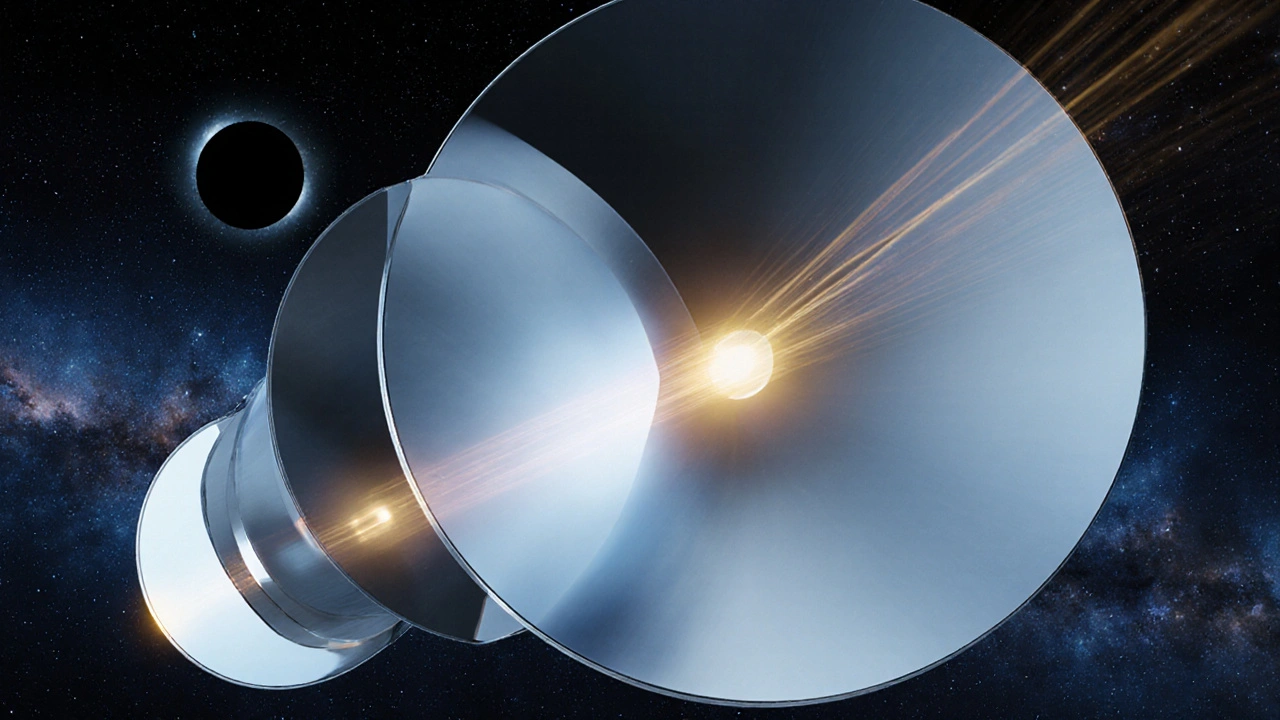
Grazing incidence optics enable X-ray space telescopes to focus high-energy radiation by reflecting it at shallow angles. This technology powers missions like Chandra and the upcoming ATHENA telescope, revealing black holes and galaxy clusters invisible to optical telescopes.
Learn More