
When you hear weightlessness, the condition where gravitational forces are not felt, often experienced in orbit or free fall. Also known as zero gravity, it’s not the absence of gravity—it’s the absence of resistance to it. You’re not floating because there’s no gravity up there. You’re floating because you’re falling—constantly—and so is everything around you. That’s microgravity, an environment where gravitational effects are greatly reduced but still present, like on the International Space Station. It’s why astronauts drift, why water forms floating balls, and why your coffee doesn’t pour the way it does on Earth.
What happens to your body in weightlessness? Your bones lose density. Your muscles shrink. Your inner ear gets confused—your brain stops trusting what your eyes tell you about up and down. NASA has spent decades studying this. Astronauts train underwater in the Neutral Buoyancy Laboratory, a massive pool where astronauts simulate spacewalks by matching buoyancy to microgravity conditions to get used to moving without weight. But even that’s not the same. On Earth, water pushes back. In orbit, there’s nothing. You push off a wall and keep going until you hit something. No friction. No stopping. That’s why even simple tasks—like opening a bag or turning a wrench—become full-body maneuvers.
It’s not just about movement. Your fluids shift. Blood pools in your upper body. Your face swells. Your nose gets stuffy. You lose your sense of taste. Some astronauts say food tastes bland up there. And sleep? You strap yourself in. Not because you’ll float away, but because your body doesn’t know where ‘down’ is anymore. Your brain still tries to make sense of it all, and that’s why motion sickness is common in the first few days. This isn’t sci-fi fantasy. It’s biology adapting to a place it wasn’t built for.
That’s why space physiology, the study of how the human body responds to space environments, especially prolonged exposure to microgravity is one of the biggest hurdles for Mars missions. We know how to get people to space. We don’t yet know how to keep them healthy for two years. Research on astronaut training, the physical and psychological preparation for spaceflight, including simulations of weightlessness and high-G environments keeps getting smarter. From specialized exercise gear to liquid-filled suits that mimic pressure, every trick is being tested. And it’s not just for astronauts. Scientists are using weightlessness to study everything from crystal growth to cancer cell behavior—because in microgravity, things behave differently.
What you’ll find here isn’t just theory. These articles show you how real missions deal with weightlessness—from the tech that keeps astronauts alive to the hidden costs of living without gravity. You’ll see how NASA trains for it, how private companies are testing it, and why even a short trip to space leaves lasting changes. This isn’t about wonder. It’s about survival. And the more we learn, the closer we get to living beyond Earth.
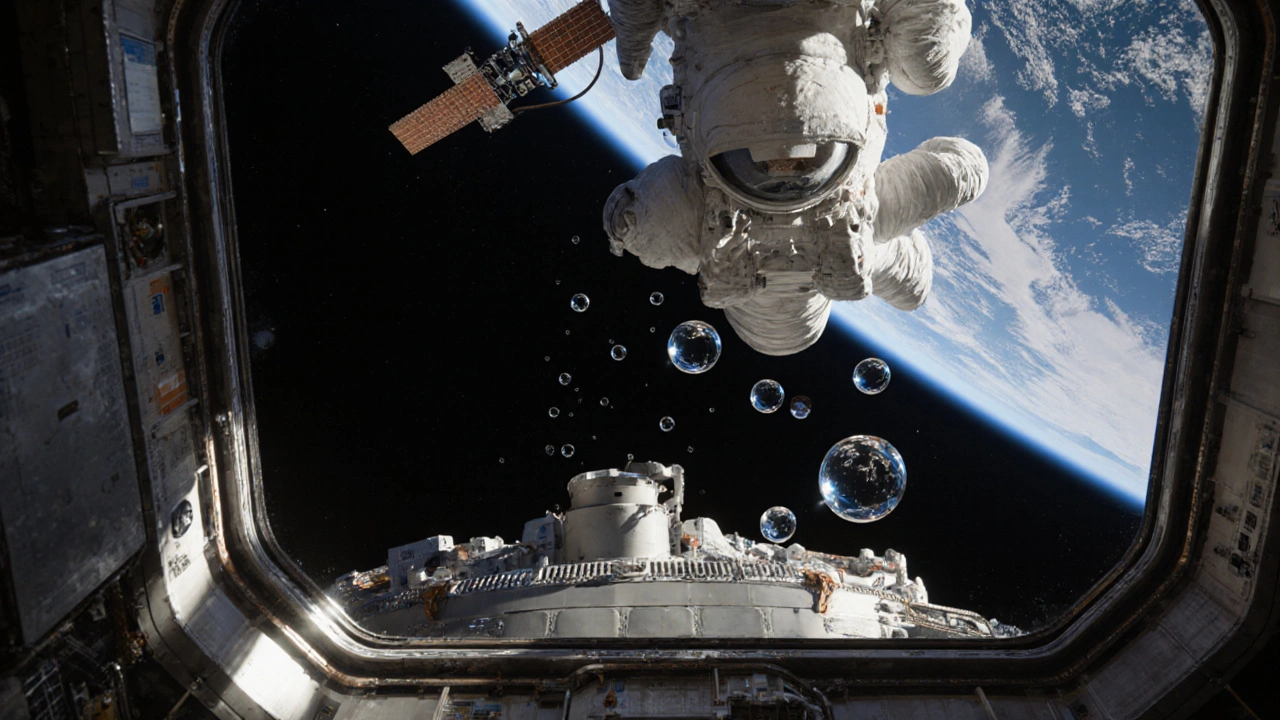
Microgravity isn't zero gravity-it's falling together. Learn how orbital motion creates weightlessness, why NASA rejects the term 'zero gravity,' and how this environment drives breakthroughs in medicine, materials, and science.
Learn More