
When the Sun flares up, it doesn’t just light up the sky—it can knock out your GPS, fry satellites, and blackout entire power grids. This is where space weather forecasting, the science of predicting solar activity and its effects on Earth’s magnetic field and upper atmosphere. It’s not about rain or snow—it’s about charged particles, radiation bursts, and magnetic storms racing through space at millions of miles per hour. Unlike regular weather, space weather moves fast and hits without warning. A single coronal mass ejection can reach Earth in less than 24 hours, and once it does, it can scramble communications, endanger astronauts, and overload transformers on the ground.
At the heart of this are two main players: coronal mass ejections, massive clouds of magnetized plasma ejected from the Sun’s atmosphere, and geomagnetic storms, disturbances in Earth’s magnetosphere caused by solar wind interacting with our magnetic field. These aren’t abstract concepts—they’re real, measurable events tracked by satellites like NOAA’s DSCOVR and NASA’s SOHO. When a CME hits, it compresses Earth’s magnetic field, sending currents through power lines and pipelines. That’s why utilities in Canada and the northern U.S. monitor space weather like a storm alert—because a strong geomagnetic storm in 1989 took out Quebec’s entire power grid in 90 seconds.
It’s not just about blackouts. Your phone’s GPS, your airline’s navigation, even the signals from Starlink satellites can get noisy or vanish during intense space weather. The same solar activity that creates beautiful auroras can also fry the electronics in low-orbit satellites. That’s why agencies like NASA and the Air Force have teams working 24/7 to track sunspots, measure solar wind speed, and predict when a flare might send a particle storm our way. They use data from space-based observatories, ground-based magnetometers, and computer models that simulate how solar material interacts with Earth’s magnetic shield.
And it’s getting more urgent. With more satellites in orbit, more power grids connected, and more people relying on space-based tech, the stakes are higher than ever. A major solar storm today could cost the global economy hundreds of billions—not because of the storm itself, but because of how long it takes to fix the damage. That’s why space weather forecasting isn’t just for scientists anymore. It’s for airlines rerouting flights, power companies prepping for outages, and satellite operators putting systems into safe mode before the storm hits.
Below, you’ll find real-world examples of how space weather impacts technology, how scientists are improving their predictions, and what’s being done to protect the systems we all depend on. From the ISS’s radiation shields to the new satellites watching the Sun from a million miles away, this is the science keeping our world running—even when the Sun is on the warpath.
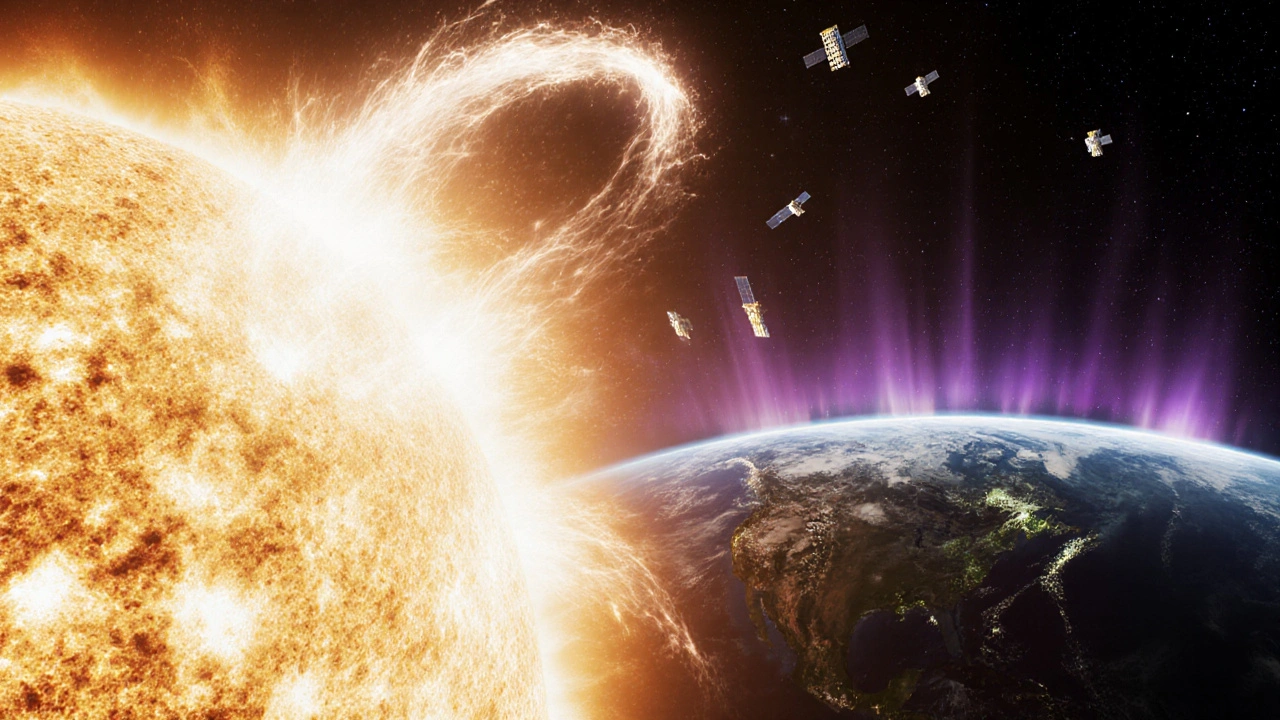
Learn how space systems are designed to survive solar storms, from radiation-hardened satellites to real-time forecasting systems. Understand the real risks to GPS, power grids, and communications-and how we're building resilience before the next major event.
Learn More