
When we talk about space mission technology, the hardware, software, and systems that enable spacecraft to launch, operate, and return safely from space. Also known as spaceflight systems, it includes everything from rocket engines to the software that keeps astronauts alive. This isn’t just about big rockets—it’s about the quiet, hidden innovations that make missions possible: heat pipes cooling JWST’s infrared sensors, 3D-printed rocket parts that survive 20+ launches, and lunar landing pads built from Moon dust.
Reusable rockets, systems like SpaceX’s Falcon 9 that return to Earth after launch to be flown again. Also known as flight-reusable launch vehicles, they’ve cut launch costs by over 90%. That’s not magic—it’s advanced alloys, grid fins, and precise engine control. Behind them is space law, a legal framework that limits liability between private companies and the U.S. government, capping risk at $2.7 billion per launch. Also known as commercial space indemnification, it’s why SpaceX and Rocket Lab can even exist. Without it, no private company would risk billions on a single launch.
Then there’s the gear that operates in extreme places. Space sensors, instruments like infrared detectors that need to be cooled to near absolute zero to see distant stars. Also known as cryogenic space instruments, they rely on cryostats and heat pipes—tech that keeps JWST’s eyes sharp while floating in the cold void. On the Moon, lunar landing pads, surfaces made by melting Moon soil with lasers or microwaves to prevent deadly dust from blowing everywhere during touchdown. Also known as in-situ resource utilization infrastructure, they’re designed to cut the weight of Earth-launched materials by 90%. That’s not science fiction—it’s NASA’s next step.
These aren’t random gadgets. They’re part of a connected system: better materials let rockets fly more often, which pushes the need for better insurance and legal rules; better sensors reveal new science, which demands better landing tech to get there. Every post in this collection ties into that chain—whether it’s how astronauts train underwater for spacewalks, how metamaterials shrink satellite antennas, or how GPS signals now match military precision without special hardware. You’ll find real tech, real data, and real missions—not theory, not hype. Just what’s working, what’s failing, and what’s coming next.
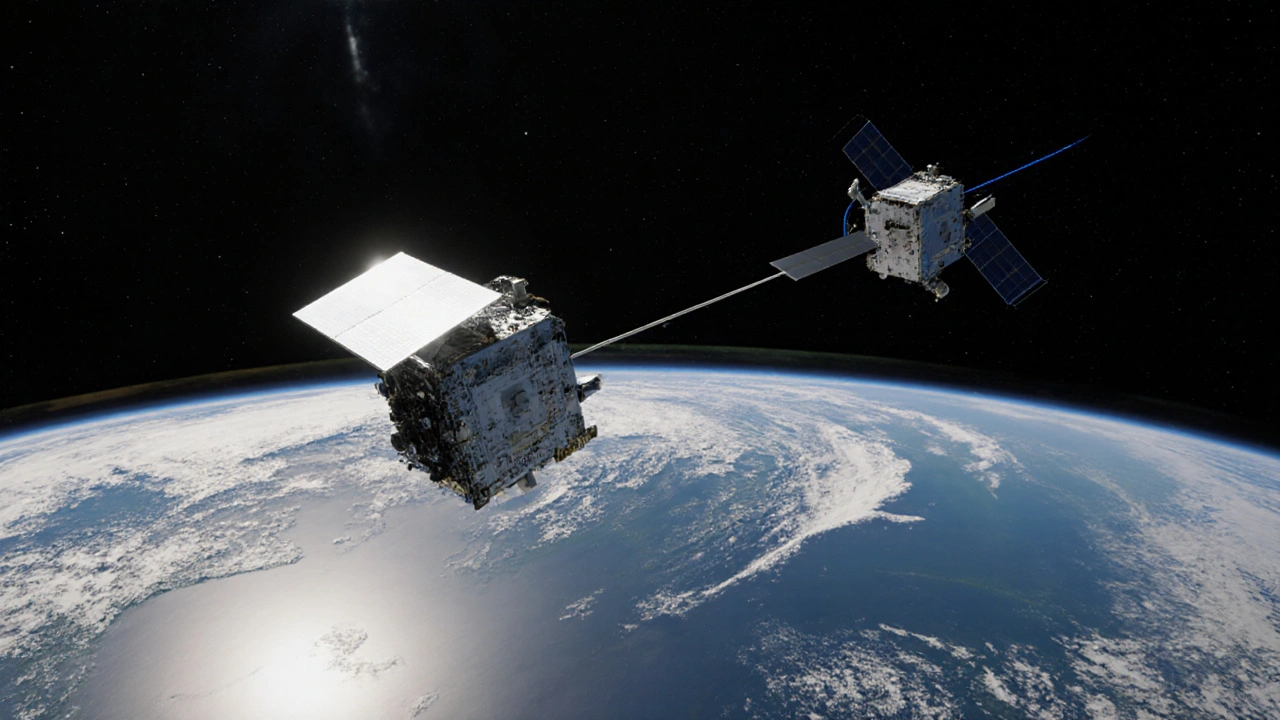
Formation flying satellites use precise relative navigation and control to act as a single instrument in space, enabling missions impossible for single spacecraft. Learn how they work, what goes wrong, and why they’re the future of space science.
Learn More