
When the sun lets out a massive burst of energy, it doesn’t just glow brighter—it sends a wave of charged particles racing toward Earth. This is a solar storm, a violent release of radiation and plasma from the sun’s atmosphere that can disrupt technology on Earth and in orbit. Also known as space weather, it’s not science fiction—it’s a daily risk we’re only beginning to understand. Solar storms aren’t rare. They happen every few years, sometimes multiple times a day during peak solar activity. And while we can’t stop them, we can prepare for them—if we know what to look for.
At the heart of every major solar storm are two things: solar flares, intense bursts of radiation that travel at the speed of light and hit Earth in minutes, and coronal mass ejections, giant clouds of magnetized plasma that take hours to days to reach us. Flares blind satellites and fry radio signals. CMEs are the real danger—they slam into Earth’s magnetic field, triggering geomagnetic storms, powerful disturbances that induce electric currents in power lines, pipelines, and even railway tracks. In 1989, one such storm knocked out power for six million people in Quebec. In 2003, it took out satellites, scrambled GPS, and forced airlines to reroute flights over the poles. These aren’t hypotheticals—they’ve already happened.
What’s new is how much we’re relying on systems that solar storms can break. Your phone’s location service? It uses satellites that can be knocked offline. Your power grid? It’s vulnerable to induced currents. Even the International Space Station, with its advanced shielding, has to reorient itself during strong events. NASA and NOAA now monitor the sun 24/7, using satellites like DSCOVR and Parker Solar Probe to give us early warnings. But we’re still playing catch-up. The next big one could come tomorrow—or in ten years. Either way, the damage won’t wait.
What you’ll find here are real stories, real science, and real solutions—from how astronauts protect themselves during solar events, to how engineers are building grids that can survive a direct hit. You’ll see how space weather affects everything from satellite internet to air travel, and why the next solar maximum isn’t just a headline—it’s a countdown.
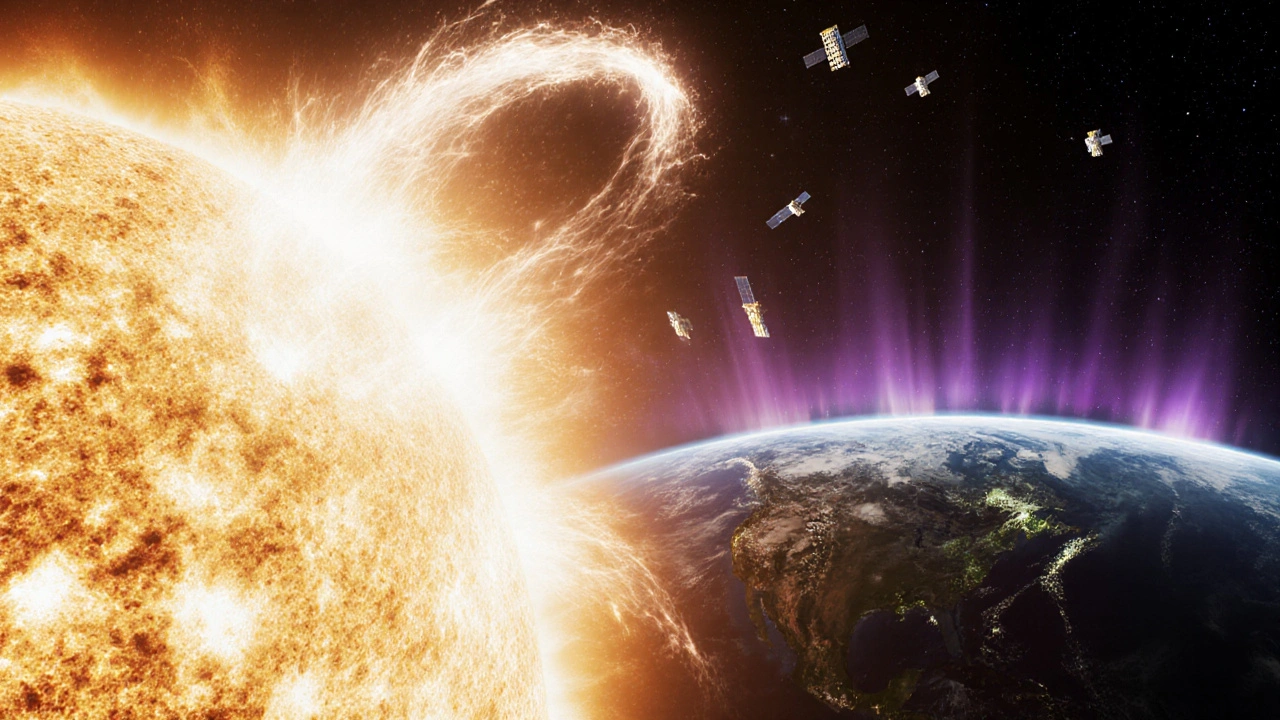
Learn how space systems are designed to survive solar storms, from radiation-hardened satellites to real-time forecasting systems. Understand the real risks to GPS, power grids, and communications-and how we're building resilience before the next major event.
Learn More