
When you think of satellites, you might picture them floating silently in space—but they’re anything but passive. Satellite control, the system of commands, sensors, and ground teams that keep satellites alive and on course. Also known as satellite operations, it’s what turns a launched rocket into a working tool—whether it’s sending your Netflix stream, tracking weather, or guiding your phone’s map app. Without constant monitoring and adjustments, satellites drift, lose power, or collide with space junk. This isn’t science fiction—it’s daily work done by teams at ground stations around the world.
Satellite control relies on three core pieces: ground stations, radio antennas on Earth that send commands and receive data from satellites, telemetry, the real-time stream of health data like battery levels, temperature, and orientation, and orbital mechanics, the math that predicts where a satellite will be hours or days ahead. These aren’t separate systems—they work together. Ground stations use telemetry to spot a drop in power, then calculate a new orbit using orbital mechanics, and send a command to fire thrusters. It’s like driving a car blindfolded, but with a GPS that tells you speed, fuel, and road conditions every second.
Modern satellite control doesn’t just keep things running—it prevents disasters. In 2022, a Starlink satellite nearly collided with a Chinese space station. That near-miss was avoided because ground teams spotted the drift early and adjusted the satellite’s path. The same systems track debris, manage fuel use, and even handle software updates over the air. Companies like SpaceX and Amazon now operate thousands of satellites at once, and their control centers use AI to handle routine tasks, freeing humans for complex decisions.
What you’ll find here are real stories from the people managing these systems. You’ll see how they track satellites using radio signals, why some need constant nudges while others stay stable for years, and how new tech is making satellite control faster and smarter. Whether it’s a tiny CubeSat or a giant telescope in space, someone is watching it, talking to it, and making sure it doesn’t go off course. This isn’t just about technology—it’s about keeping the invisible infrastructure of our daily lives working, one orbit at a time.
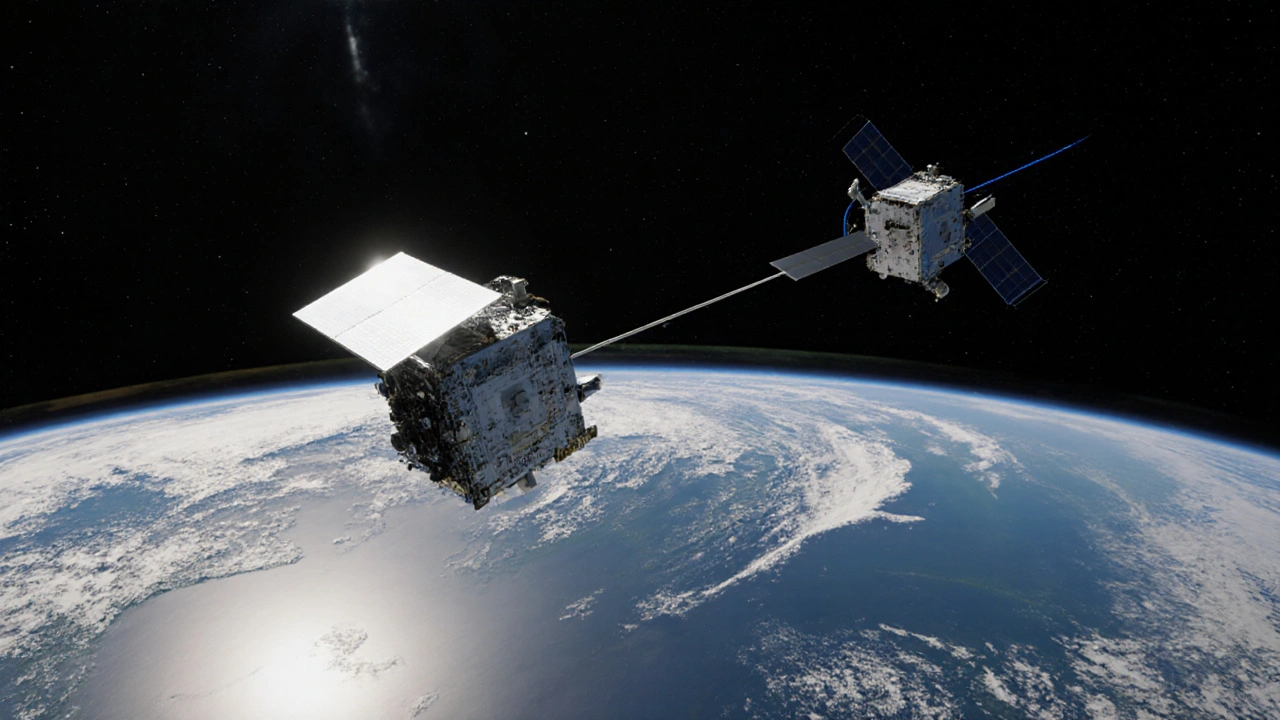
Formation flying satellites use precise relative navigation and control to act as a single instrument in space, enabling missions impossible for single spacecraft. Learn how they work, what goes wrong, and why they’re the future of space science.
Learn More