
When two spacecraft need to meet in space—whether it’s a cargo ship docking with the International Space Station or two satellites forming a telescope array—they can’t just use Earth-based GPS. That’s where relative navigation, the process of determining the position and motion of one object in relation to another in space. Also known as proximity operations, it’s the backbone of every successful rendezvous, docking, and formation flight. Unlike traditional navigation that points to Earth, relative navigation answers one simple question: Where are you, relative to me? It’s not about stars or ground stations—it’s about sensors, lasers, and math working together in real time.
This system relies on tools like Differential GPS, a method that uses ground-based corrections to boost positioning accuracy between nearby objects, laser rangefinders, and optical cameras. NASA and SpaceX use it daily: the Crew Dragon docks with the ISS using relative navigation, and future lunar landers will use it to find their landing pads on the Moon. Even the Space ROS, a modular software architecture designed for space robotics relies on precise relative navigation data to guide robotic arms and autonomous probes. Without it, missions like Mars sample return or satellite servicing would be impossible.
What makes relative navigation powerful isn’t just accuracy—it’s independence. It works even when Earth signals are blocked, during lunar missions, or in deep space. The same tech that helps two satellites avoid collision also lets rovers and orbiters coordinate science observations. And as private companies launch mega-constellations, the need for smart, self-guided navigation grows. You’ll find posts here that break down how this tech powers everything from lunar landing pads to Mars transportation systems. Some explain the sensors. Others show how software turns raw data into safe, real-time maneuvers. Whether you’re curious about how astronauts dock in orbit or how future Moon bases will coordinate multiple landers, this collection gives you the real-world details—not just theory.
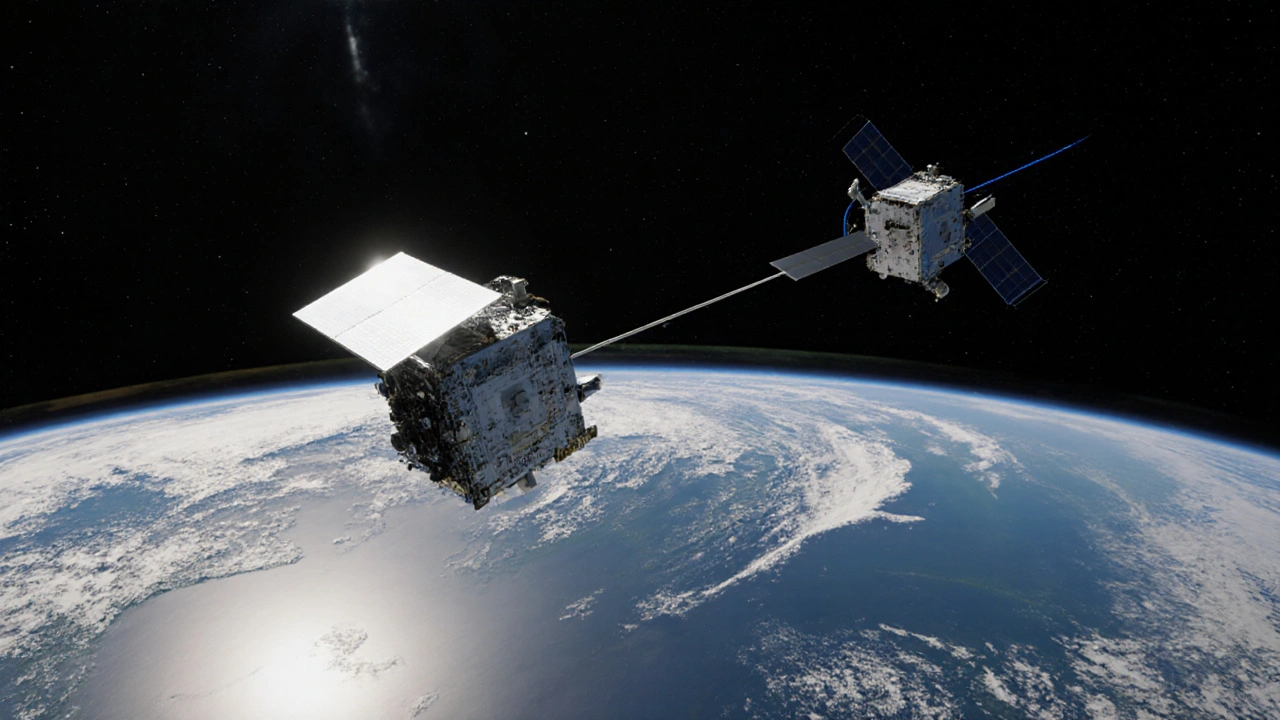
Formation flying satellites use precise relative navigation and control to act as a single instrument in space, enabling missions impossible for single spacecraft. Learn how they work, what goes wrong, and why they’re the future of space science.
Learn More