
When a planet orbits a star, it doesn’t just move around it—it tugs on the star too. This tiny pull creates a radial velocity method, a technique that detects exoplanets by measuring the back-and-forth motion of a star caused by gravitational tugs from orbiting planets. Also known as the Doppler method, it’s how we found the first confirmed exoplanet around a sun-like star in 1995, and it’s still the most successful way to find planets outside our solar system today. The star doesn’t move much—just a few meters per second—but modern instruments can detect that shift in light. As the star moves toward us, its light slightly blueshifts. When it moves away, it redshifts. By tracking these changes over time, astronomers can figure out if a planet is there, how big it is, and how close it orbits.
This method doesn’t just find planets—it tells us about their mass and orbit. Unlike other techniques that rely on a planet passing in front of its star, the radial velocity method works even when the planet’s orbit is tilted away from our view. That’s why it’s been used to discover massive gas giants like 51 Pegasi b, the first exoplanet detected using the radial velocity method, orbiting its star in just four days, and smaller rocky worlds too. It’s also paired with other methods, like transit photometry, to get a fuller picture. When you combine the planet’s size (from transits) with its mass (from radial velocity), you can calculate density—and that tells you if it’s rocky, gassy, or something stranger.
The Doppler shift, the change in wavelength of light due to motion toward or away from the observer, which is the core physical principle behind the radial velocity method is what makes this possible. But it’s not perfect. Big planets close to their stars are easiest to spot because they tug harder. Smaller, Earth-like planets in wider orbits? Much harder. That’s why this method found mostly hot Jupiters early on—and why newer instruments like ESPRESSO and HARPS-N are pushing the limits, hunting for signals smaller than a bicycle’s speed.
What’s fascinating is how this method shaped our understanding of planetary systems. Before its rise, we assumed all solar systems looked like ours. Then came the wobbles—planets orbiting way too close, in weirdly elliptical paths, even backwards. It forced us to rethink how planets form and move. Today, the radial velocity method is still the backbone of exoplanet surveys, even as space telescopes like TESS and JWST take over the spotlight for other types of detection.
What you’ll find in the posts below are real examples of how this method powers discoveries—from detecting planets in distant star systems to testing new tech that makes those tiny wobbles easier to spot. You’ll see how it connects to spacecraft design, instrument precision, and even how we plan future missions to study these worlds up close. This isn’t just theory. It’s how we found the neighbors next door in space—and how we’ll keep finding them.
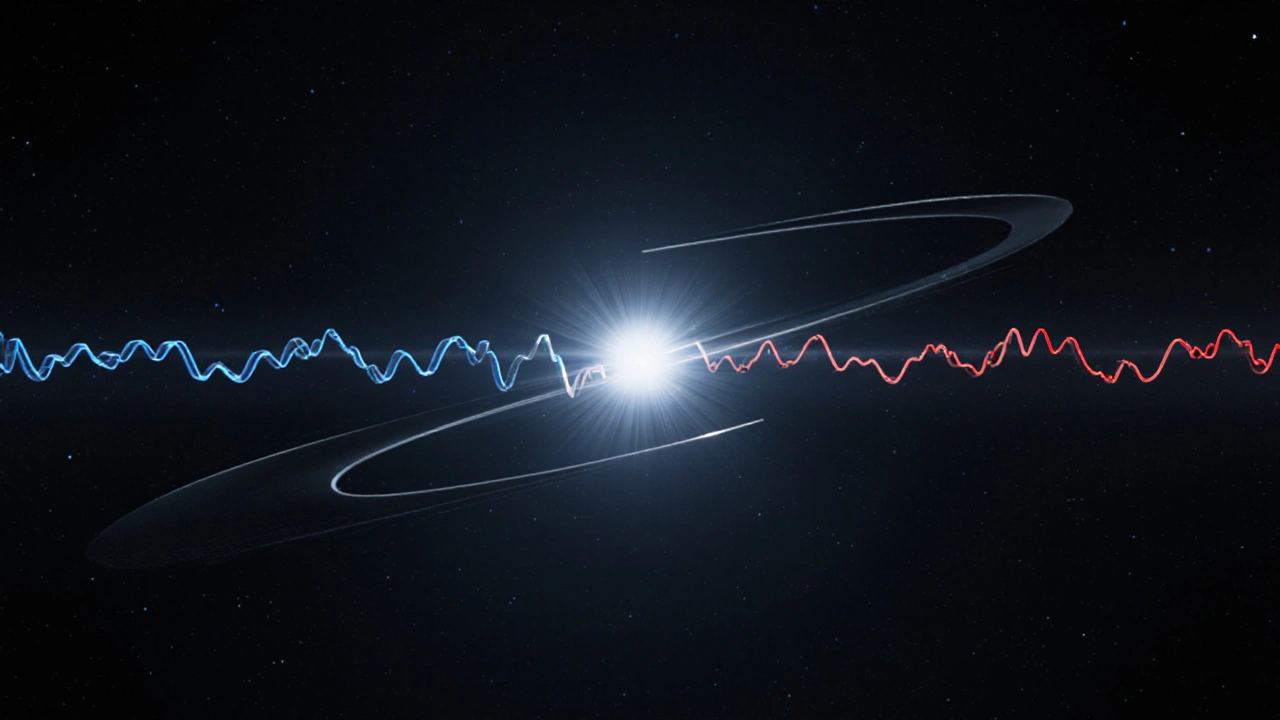
The radial velocity method detects exoplanets by measuring tiny wobbles in a star’s motion caused by orbiting planets. It’s how we found Proxima Centauri b and confirmed the TRAPPIST-1 system - and it’s still essential for measuring planetary mass.
Learn More