
When we talk about planetary wobble, the slight back-and-forth motion of a star caused by the gravitational pull of an orbiting planet. Also known as stellar wobble, it's not the planet that's shaking—it's the star, dancing in response to its unseen companion. This isn't science fiction. It's how we found most of the planets outside our solar system before telescopes could see them directly.
The radial velocity, a method that measures how a star moves toward or away from us by analyzing shifts in its light is the main tool that detects this wobble. When a planet pulls on its star, the star doesn’t just sit still—it moves in a tiny orbit. The bigger the planet, the stronger the tug. A Jupiter-sized world makes a star wobble noticeably. Even Earth-sized planets leave a trace, though we need super-sensitive instruments to catch it. This method doesn’t care if the planet is dark, dusty, or hidden behind glare—it only needs gravity to do its job.
It’s not just about finding planets. The orbital dynamics, how objects move under gravity’s influence in space of a wobbling star tell us how long a year lasts on that planet, how far it is from its star, and even if it might be in the habitable zone. You can’t see the planet? No problem. You can still know its mass, its orbit, and whether it’s likely to be a gas giant or a rocky world. That’s why this method still powers half of all confirmed exoplanet discoveries, even with fancy new telescopes like JWST around.
What’s surprising is how often this wobble leads to weird results. Planets orbiting backwards. Worlds spinning in circles around two stars. Planets so close to their star they’re scorched, yet still tugging hard enough to make the star move. These aren’t glitches—they’re clues. They tell us our solar system isn’t the norm. The universe is full of wild, unexpected arrangements, and planetary wobble is our best early warning system for them.
Behind every wobble is a story: a planet forming in a disk of dust, growing heavy enough to bend space-time around its star, and now pulling it like a magnet. That motion is recorded in light waves stretched and squeezed over years of observation. It’s quiet. It’s slow. But it’s unmistakable. And it’s how we learned that planets are everywhere.
Below, you’ll find real-world examples of how scientists use this technique to track exoplanets, how it connects to space mission design, and how even NASA’s most advanced instruments rely on the same basic principle: if something moves, something else is pulling it.
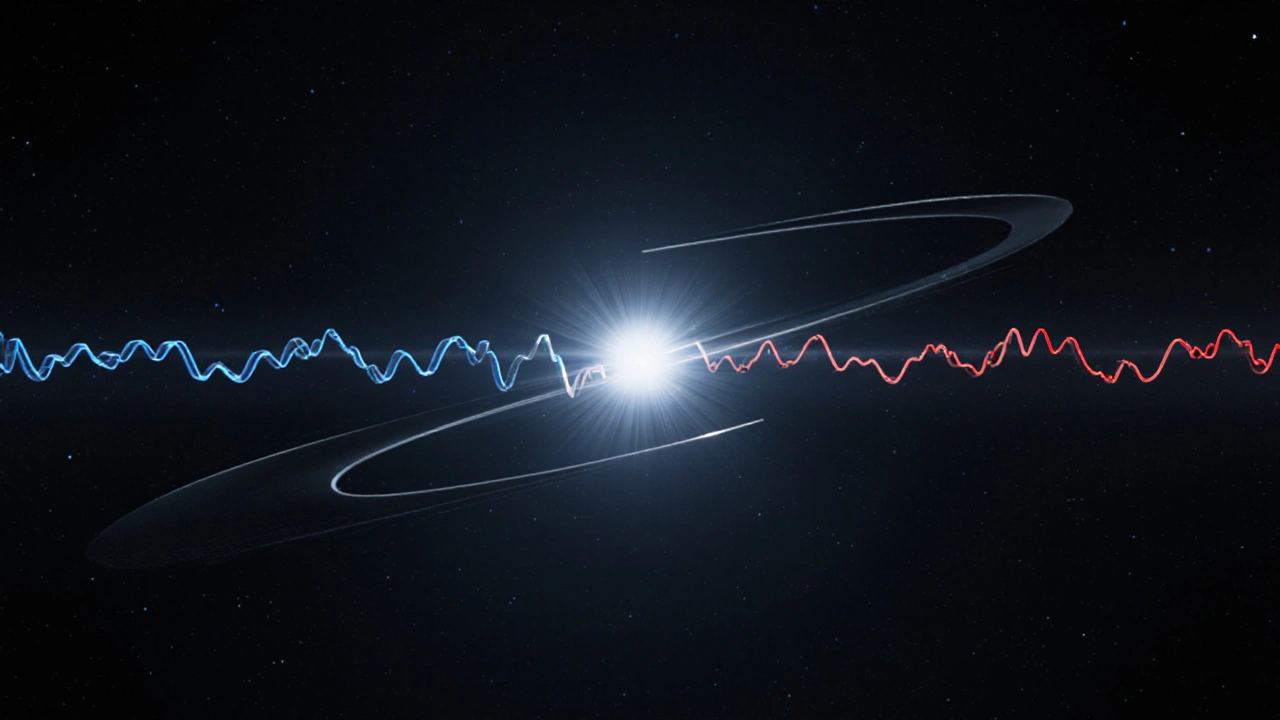
The radial velocity method detects exoplanets by measuring tiny wobbles in a star’s motion caused by orbiting planets. It’s how we found Proxima Centauri b and confirmed the TRAPPIST-1 system - and it’s still essential for measuring planetary mass.
Learn More