
When you think about space, you picture rockets blasting off—but what keeps them flying? That’s orbital motion, the balanced dance between gravity and forward velocity that lets objects circle planets without falling or flying away. Also known as celestial mechanics, it’s the reason the Moon doesn’t crash into Earth and why Starlink satellites stay in their lanes. Without it, no satellite, no space station, no lunar lander could function.
Orbital motion isn’t just about planets. It’s the backbone of formation flying satellites, precise clusters of spacecraft that move together like a single instrument to capture data no single satellite can. NASA and ESA use this for Earth observation and deep-space telescopes. It’s also how Differential GPS, a system that boosts navigation accuracy by comparing signals from ground stations and satellites works—each signal relies on knowing exactly where each satellite is, and how fast it’s moving along its orbital path. Even reusable rockets like Falcon 9 depend on orbital motion calculations to time their boosters’ return flights perfectly.
It’s not magic—it’s math. Every orbit is a balance: too slow, and you fall; too fast, and you escape. That’s why lunar landing pads need to be built with orbital motion in mind—rocket plumes kick up dust that can ruin instruments if the descent angle isn’t calculated down to the meter. The same math helps astronauts train underwater, simulating the weightless drift of orbital flight. And it’s why your phone’s GPS works: satellites aren’t just in space—they’re moving at 14,000 km/h, locked in orbits that repeat exactly every 12 hours.
What you’ll find below isn’t just a list of articles. It’s a map of how orbital motion connects everything—from the cooling systems on JWST that need to stay perfectly aligned with distant stars, to the blockchain-like structures that track satellite positions in real time, to the insurance policies that only cover space travelers if they’re in the right orbit at the right time. These posts don’t just describe space—they show you how the invisible rules of motion make it all possible.
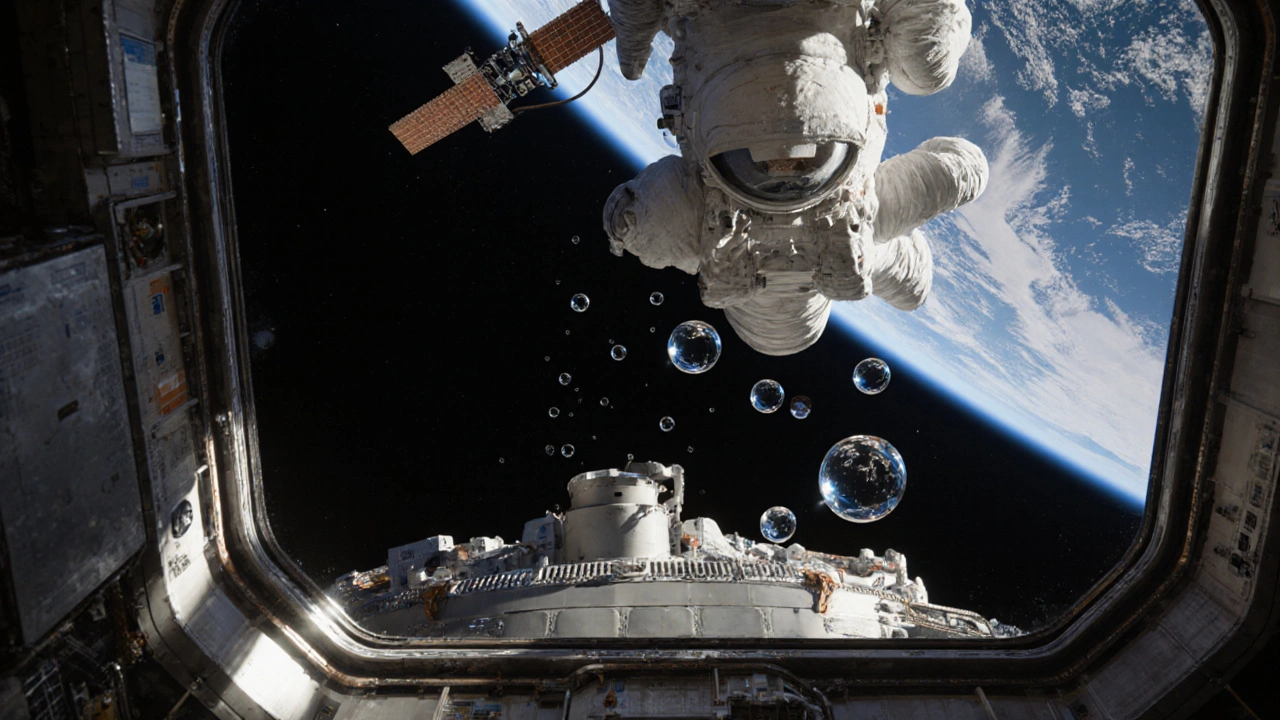
Microgravity isn't zero gravity-it's falling together. Learn how orbital motion creates weightlessness, why NASA rejects the term 'zero gravity,' and how this environment drives breakthroughs in medicine, materials, and science.
Learn More